


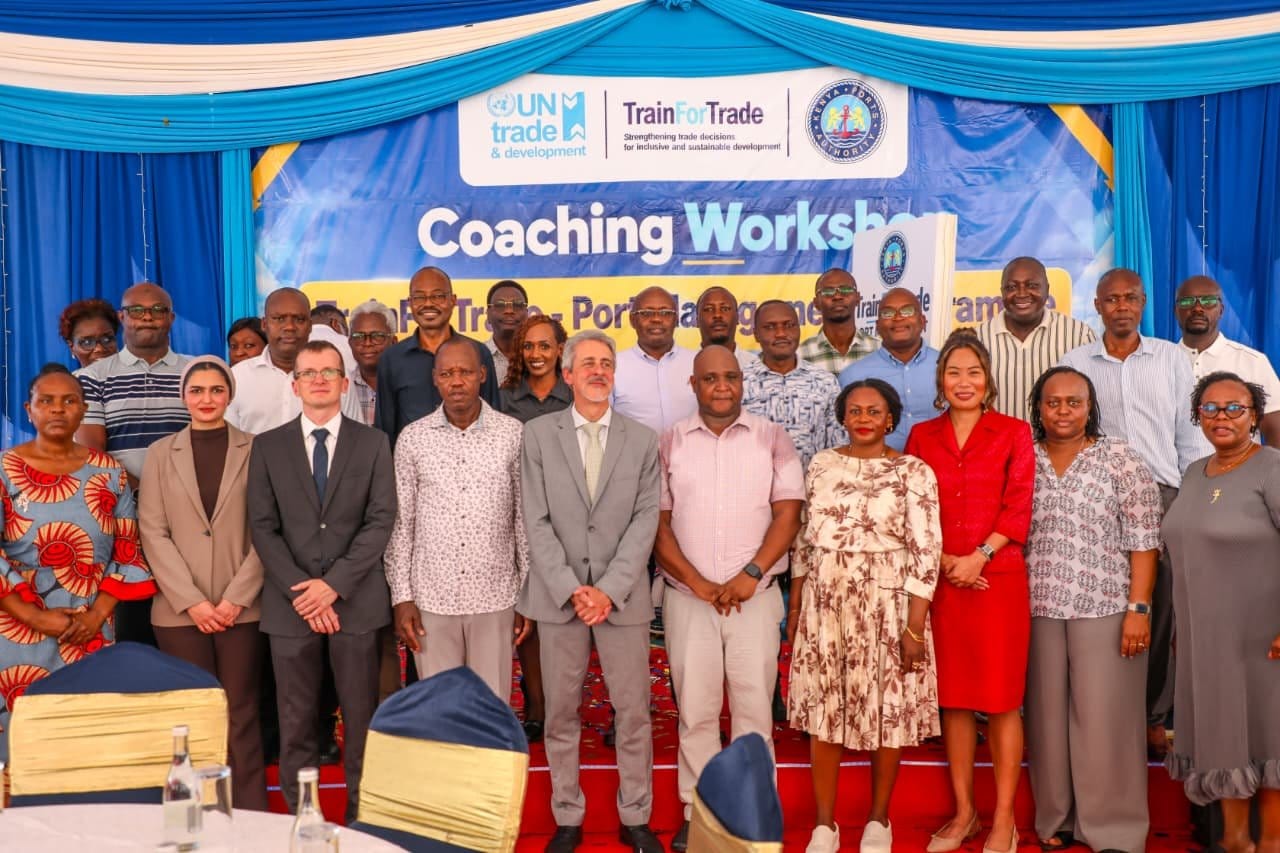
The recent launch by the Kenya Ports Authority (KPA) of the UNCTAD TrainForTrade Modern Port Management Programme is easy to file under “capacity building as usual”: twenty middle managers in Kilifi, eight modules, international certificates, and the familiar choreography of speeches about competitiveness, human capital, and regional hub status. But to treat it as a routine training announcement is to miss its deeper significance. In an era when African ports are racing to expand physical capacity while struggling with efficiency, digital readiness, and institutional depth, this partnership is a strategic bet on the scarcest resource of all: people who can run complex, modern ports at scale.
Kenya’s maritime ambitions are not abstract. The Port of Mombasa remains East Africa’s primary gateway. Construction of Berth 19B is more than halfway complete and is projected to add roughly 300,000 TEUs of capacity. The Dongo Kundu Special Economic Zone’s port component is advancing, and associated roadworks are easing access bottlenecks. These investments are necessary. They are also insufficient. Global shipping has become more complex, more digital, more environmentally constrained, and more vulnerable to disruption. Larger vessels, tighter schedules, shifting trade patterns, and rising expectations around sustainability and data-driven performance mean that operational excellence now depends less on berth length than on managerial sophistication.
Captain William Ruto, KPA’s CEO, has framed the challenge correctly. Port managers today operate in an environment of “increasing operational complexity, changing trade patterns, supply chain disruptions, [and] technological advancement.” The logical response is continuous investment in skills, professional growth, and leadership capacity. The TrainForTrade programme is designed precisely for this environment.
Its Modern Port Management course spans roughly two years and 240–280 hours of instruction across eight intensive modules. Topics range from international trade and maritime transport to port operations, commercial and financial management, performance measurement, environmental sustainability, and human resource development. Participants conclude with a practical dissertation—a case study of a real problem or opportunity in their own port community—defended before an international jury. Graduates can themselves become trainers, embedding knowledge locally rather than leaving it dependent on external experts.
This is not a generic executive short course. TrainForTrade, run by UNCTAD since the late 1990s, has trained thousands of port professionals across more than 60 countries through language-based networks. It emphasizes local ownership: senior managers from participating ports are trained as instructors so the programme can be sustained and replicated. Kenya’s entry into the English-speaking network places it alongside ports in Ghana, Nigeria, Tanzania, Namibia, the Philippines, and others that have used the curriculum to drive operational reforms. The model deliberately blends international standards with South-South knowledge exchange. Certified Kenyan officers will eventually be able to train peers both at home and in other countries in the network—an export of expertise that is rare and valuable.
The timing is deliberate. Kenya’s government has repeatedly stressed the need for human capital that can support a modern, efficient, and competitive transport and logistics sector. Remarks from the Ministry of Trade and Transport underscore that capacity-building is no longer peripheral; it is central to institutional effectiveness. Mark Assaf, of UNCTAD’s TrainForTrade programme, has been equally clear: Africa’s blue-economy potential will be unlocked not merely by infrastructure but by the people who manage it. Ports that are efficient, greener, and more inclusive require managers who understand both the commercial logic of global trade and the operational realities of their own facilities.
Critics may ask whether twenty trainees, even if expanded to several dozen over time, can move the needle at an authority the size of KPA. The answer lies in the programme’s design. By creating a cohort of certified local trainers and requiring participants to produce actionable case studies, it aims at institutional learning rather than one-off individual upskilling. The real test will be whether the recommendations that emerge from those dissertations are taken seriously, whether performance metrics improve, and whether the knowledge cascades beyond the initial group. History shows that ports that treat training as a continuous system rather than a periodic event tend to outperform those that treat it as a public-relations exercise.
There is also a regional dimension. Mombasa competes with other East and Southern African ports for traffic. Efficiency differentials—dwell times, turnaround, reliability of data, environmental compliance—increasingly determine which gateway shippers prefer. A better-trained cadre of managers improves not only KPA’s internal performance but also Kenya’s broader claim to be the region’s logistics leader. In that sense, the programme is soft infrastructure that amplifies the hard infrastructure already under construction.
None of this is guaranteed. Training programmes can become box-ticking exercises. Modules can remain theoretical. Trainees can return to organizations that lack the authority or incentive to implement change. Success will require sustained leadership commitment, integration of the programme’s outputs into operational decision-making, and a willingness to measure results against clear performance indicators. Irish Aid’s support and UNCTAD’s established methodology provide external accountability, but ultimate ownership rests with KPA and the Kenyan government.
The launch in Kilifi is therefore best understood as a statement of priorities. Kenya is investing in berths and hinterland connections. It is also investing in the people who will decide whether those assets deliver competitive advantage or simply higher fixed costs. In the long run, the quality of port management may matter more than the quantity of concrete. TrainForTrade is a concrete step—pun intended—toward closing that gap. If executed with the seriousness it deserves, it will help ensure that Kenya’s ports are not only bigger, but smarter.