


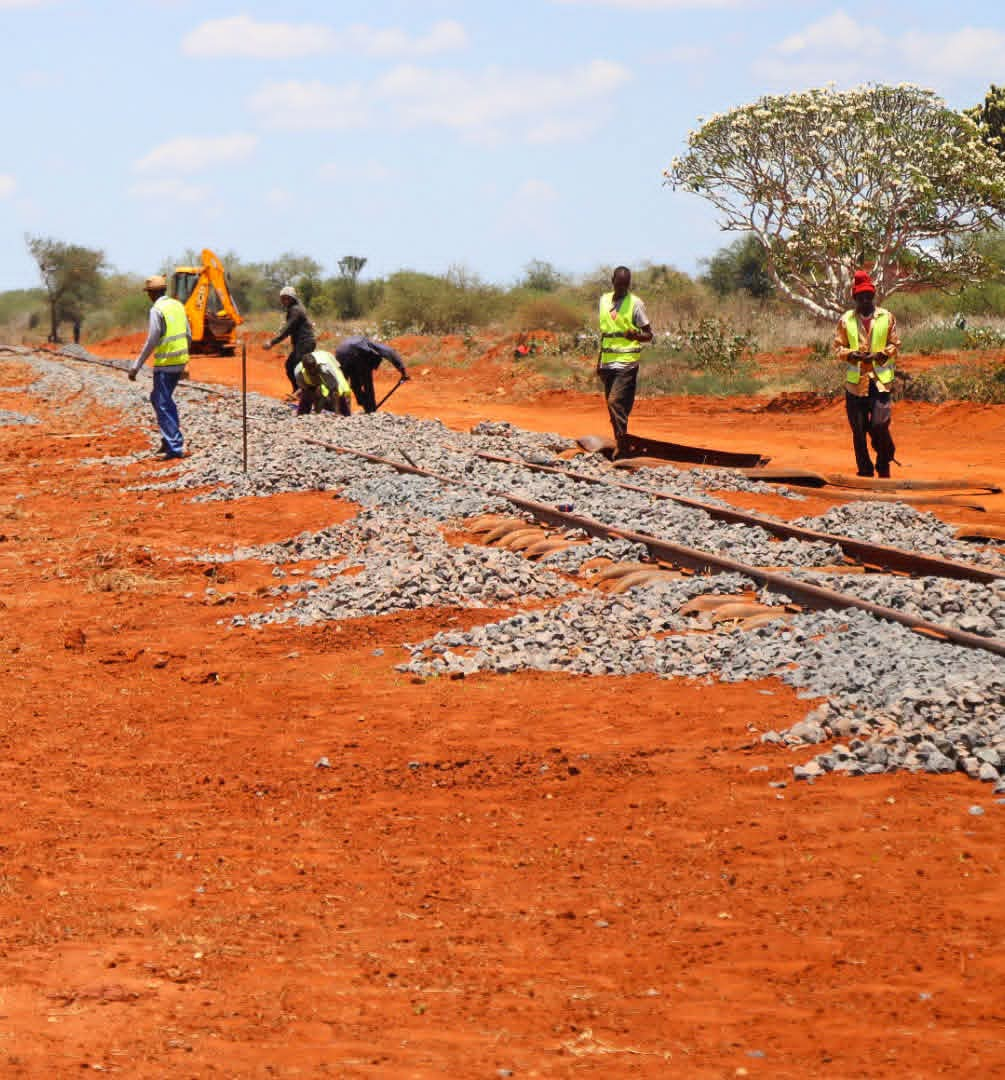
The recent announcement that the Voi–Taveta Railway Rehabilitation Project has reached 40% completion is more than a construction update. It is a reminder of what was lost—and what could yet be regained. For over two decades, the 120-kilometre metre-gauge line from Voi to Taveta has lain dormant, a relic of an era when rail was the backbone of trade between Kenya’s coast and northern Tanzania. Now, with subgrade and cross-drainage works advancing, the corridor is slowly stirring back to life.
The weight of twenty lost years
The line was never abandoned by choice. It fell into disuse as freight and passenger services declined, and by 2006 it had effectively ceased operations. The consequences were predictable: road transport filled the gap, costs rose, and Taita-Taveta County’s strategic position on the Kenya–Tanzania border became a logistical afterthought rather than an asset. The revival launched by President Ruto in April 2026, backed by a KSh5.5 billion budget, is therefore not merely an infrastructure project. It is an attempt to undo two decades of economic isolation.
What 40% actually means
Precision matters here. The 40% figure reflects progress on subgrade and cross-drainage structures along the 120-kilometre stretch. As the image above illustrates, this is foundational work—the unglamorous, essential preparation that must precede track laying and station rehabilitation. It is real progress, but it is also early progress. The rehabilitation of stations at Voi, Mwatate, Bura, Mwaktau and Taveta, along with the planned dry port in Voi, still lies largely ahead. The project’s completion target of early 2027 is ambitious, and the 40% milestone should be viewed as a checkpoint, not a victory lap.
The strategic prize: linking two corridors
The true significance of Voi–Taveta lies in what it connects. The line branches from Voi Station on the Mombasa–Nairobi main line and runs southwest to Taveta, where it will link to Tanzania’s network through the Holili border. This would effectively bridge Kenya’s Northern Corridor—the busiest trade route in East Africa—with Tanzania’s Central Corridor. The projected result is a 358-kilometre reduction in the distance between Mombasa and Bujumbura, a saving that translates directly into lower freight costs for landlocked countries.
Jobs, trade, and the local economy
The project is already generating employment for local communities, and Kenya Railways has been explicit that this is a deliberate objective. The workers in high-visibility vests seen along the corridor are not just laying ballast; they are laying the groundwork for Taita-Taveta’s economic revival. Beyond construction jobs, the railway is expected to unlock the county’s mining potential and boost the export of agricultural products such as sisal and maize. The planned dry port in Voi is intended to position the town as a logistics hub, handling cargo destined for both Kenya and Tanzania. These are not abstract promises. They are the kind of economic multipliers that rail corridors have delivered elsewhere—provided the supporting infrastructure and policy environment are right.
What must not be lost
The 40% milestone deserves recognition, but it also invites scrutiny. Kenya’s track record with megaprojects is mixed, and the Voi–Taveta line is competing for attention with the Standard Gauge Railway’s westward expansion and the proposed SGR extension from Voi to Tanzania. The risk is that the metre-gauge rehabilitation becomes a forgotten sibling—sufficiently funded to show progress, but not sufficiently prioritised to meet its 2027 deadline. The dry port, in particular, must not remain a planning document while the track is laid.
A corridor, not just a line
Ultimately, Voi–Taveta is not merely a railway. It is a test of whether Kenya can revive dormant infrastructure and integrate it into a coherent regional strategy. The line’s connection to Tanzania, its role in serving the Port of Mombasa, and its potential to serve as a logistics spine for Taita-Taveta all depend on decisions that go beyond construction. Tariff policy, border clearance efficiency, and coordination with Tanzania’s rail authorities will determine whether the rehabilitated line becomes a functioning corridor or a well-built cul-de-sac.
Forty percent is a number worth noting. But the harder work—the work of making the railway truly matter—has barely begun.