


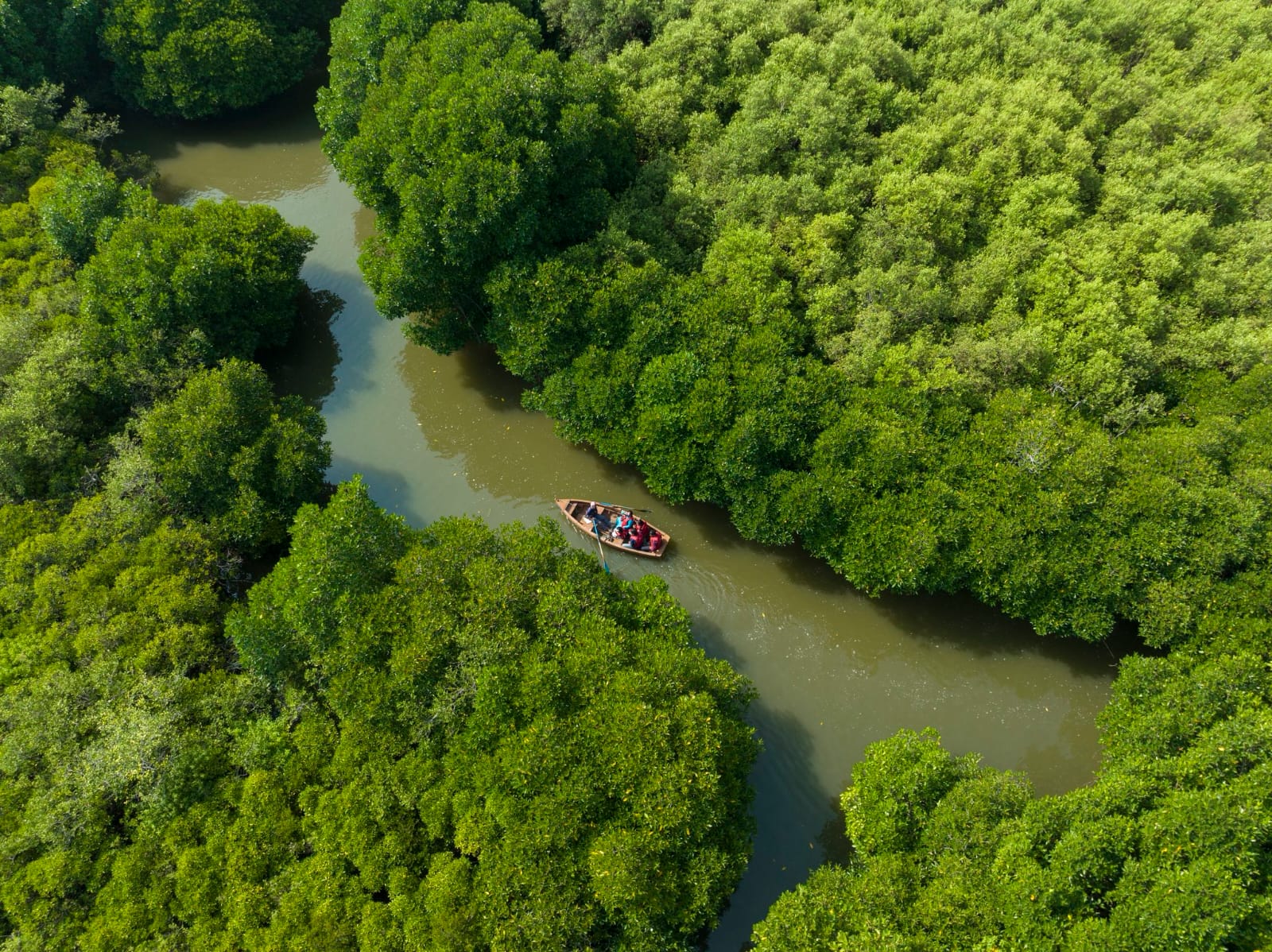
The world’s first community-led blue carbon project sits in Gazi Bay, a quiet inlet on Kenya’s south coast. Since 2012, Mikoko Pamoja—“Mangroves Together” in Swahili—has protected 117 hectares of mangrove forest, sequestered over 22,000 tonnes of CO₂, and channelled more than USD 190,000 into village meetings where residents decide together how to spend the money, often on clean water, schools, and health clinics. It is a genuine triumph of locally driven conservation.
But as Kenya positions itself as a leader in the global carbon market, with a ten-year, USD 620 million national investment plan and sweeping new regulations, we must ask a hard question: will this emerging market empower coastal communities, or will it repeat the extractive dynamics that have long defined Africa’s relationship with global capital? The evidence so far is mixed—and the stakes could not be higher.
The Carbon Market, Explained
A carbon market is, at its core, a trading system. One carbon credit represents one tonne of carbon dioxide that has been either reduced, avoided, or sequestered from the atmosphere. Companies and governments buy these credits to offset their own emissions, and the revenue flows to projects that protect or restore carbon-rich ecosystems. The global voluntary carbon market is projected to reach USD 100 billion annually by 2030, with Africa hosting over 500 registered projects.
For Kenya, this represents a potentially transformative revenue stream. The country’s Blue Carbon Ecosystems—61,000 hectares of mangroves and 39,000 hectares of seagrass beds—cover less than 0.2% of its land area, yet they have stored over 75 million tonnes of CO₂ equivalent since 1990, accounting for 7% to 14% of Kenya’s total land-sector carbon sequestration. Mangroves alone are among the most carbon-dense ecosystems on Earth, storing up to four times more carbon per hectare than terrestrial tropical forests. Seagrass meadows in Lamu store an average of 74.3 megagrams of carbon per hectare in their sediments, with protected areas holding even more.
Why This Matters for Coastal Communities
For the nearly 800,000 artisanal fishers and their families along Kenya’s coast, these ecosystems are not abstract climate assets. They are life support. An estimated 80% of fish stocks along the coast depend on mangroves at some point in their life cycle, whether for breeding, shelter, or food. The dense root systems of mangroves form a natural buffer against coastal erosion and storm surges—a service whose value will only grow as climate change intensifies. Seagrass meadows similarly serve as nurseries for marine life, supporting fisheries productivity that sustains coastal economies.
The carbon market offers a way to monetise these services. In Lamu County, a UNEP-supported mangrove carbon project aims to restore 8,000 hectares, removing approximately 75,000 tonnes of CO₂ annually and generating an estimated USD 1 million per year for local communities. The Papariko project, the first Verra-registered blue carbon initiative in Kenya, is restoring 1,500 hectares of degraded mangroves across Kwale, Kilifi, and Tana River counties, with a projected sequestration of one million tonnes of CO₂ and a commitment to revenue-sharing, training, and community employment.
The Mikoko Pamoja model demonstrates what is possible when communities lead. Carbon revenues have funded schoolbooks, school buildings, and clean drinking water for over 5,400 residents. The project has won the Equator Prize and inspired sister initiatives like Vanga Blue Forest, which protects 460 hectares and involves 974 households.
The Cracks in the Model
Yet the promise of blue carbon is shadowed by structural risks that communities and policymakers must confront.
First, the economics are precarious. High-integrity blue carbon credits from Kenya are selling for as little as USD 20 per tonne, while comparable projects in the Global North command USD 200 to USD 500 per tonne. Mikoko Pamoja’s credits are sold at approximately USD 25.30 per tonne on the voluntary market. This price disparity reflects deeper inequities in how carbon markets value African conservation versus Northern industrial offsets. A reliance on the voluntary market also exposes projects to price volatility and regulatory uncertainty, leaving communities vulnerable to forces beyond their control.
Second, governance and labour rights remain unresolved. A 2026 report by the Solidarity Center found that workers in carbon offset projects across Africa are often classified as “community participants” rather than employees, denying them minimum wage protections, workplace safety standards, and the right to organise. Benefit-sharing arrangements, while mandated by Kenya’s Climate Change (Carbon Markets) Regulations 2024—which require at least 40% of net earnings for land-based projects to flow to host communities—are inconsistently enforced. The expertise and administration required for carbon credit projects present a barrier for remote communities to participate meaningfully, even as their labour makes the projects possible.
Third, there is the spectre of carbon colonialism. A 2026 study in Ocean & Coastal Management warns that without careful attention to equity, transparency, and local control, blue carbon risks “reinforcing forms of ‘carbon colonialism’”—a system where land and labour from natural resource-rich countries are commodified for the benefit of high-polluting nations. The paper identifies persistent concerns around additionality, permanence, governance, and social justice, noting that carbon offsetting operates as a socio-technical system shaped by power relations that can both enable and constrain community agency.
The warning is not hypothetical. In 2023, a Dubai-based company, Blue Carbon, signed agreements covering millions of hectares of community land across Kenya, Liberia, Tanzania, Zambia, and Zimbabwe—deals that critics describe as a new scramble for African land under the guise of climate action. These large-scale deals risk displacing communities and undermining the very local stewardship that makes blue carbon projects effective.
A Fork in the Road
Kenya stands at a crossroads. The Blue Carbon Ecosystems NDC Implementation and Investment Plan 2025–2035 sets ambitious targets: restoring 75% of degraded mangroves, creating up to 70,000 jobs, and mobilising USD 620 million in investment by 2035. The plan is a significant step forward, consolidating commitments across two NDC cycles and explicitly including seagrasses for the first time. The 2024 carbon market regulations provide a legal framework that, if rigorously enforced, could ensure that communities are not merely consulted but genuinely empowered.
But frameworks on paper are not enough. Three priorities must guide implementation.
First, communities must own the projects, not just participate in them. The Mikoko Pamoja model works because the community organisation holds the carbon rights, decides how revenues are spent through open village meetings, and receives training in leadership, financial management, and monitoring. This model should be the rule, not the exception. Carbon projects imposed from outside—no matter how well-intentioned—will fail to deliver lasting conservation or equitable development.
Second, benefit-sharing must be transparent and enforceable. The 40% revenue-sharing requirement is a strong start, but it needs teeth. Independent audits, public reporting, and grievance mechanisms must be standard features of every project. The Africa-led carbon market principles launched by AUDA-NEPAD in 2026 provide a continental framework for fair benefit-sharing and social safeguards—Kenya should adopt and exceed these standards.
Third, the carbon market must be understood as a transitional mechanism, not a permanent solution. Carbon credits are a way to finance conservation, but they are not a substitute for the deep decarbonisation that the climate crisis demands. If the global carbon market becomes a tool for wealthy nations to avoid reducing their own emissions, it will have failed its fundamental purpose. Kenya’s blue carbon projects should be celebrated for what they are—innovative, community-led conservation models—but they should not be romanticised into a panacea.
The mangroves of Gazi Bay have sustained coastal communities for generations, long before anyone thought to put a price on their carbon. The question now is whether the carbon market will strengthen that relationship or instrumentalise it. Kenya has the vision, the regulatory framework, and the community leaders to get this right. What it needs now is the political will to ensure that blue carbon remains, first and foremost, a tool for local resilience—not another commodity extracted from the coast and sold to the highest bidder.
The world is watching. Kenya’s coastal communities deserve nothing less than a carbon market that works for them.