


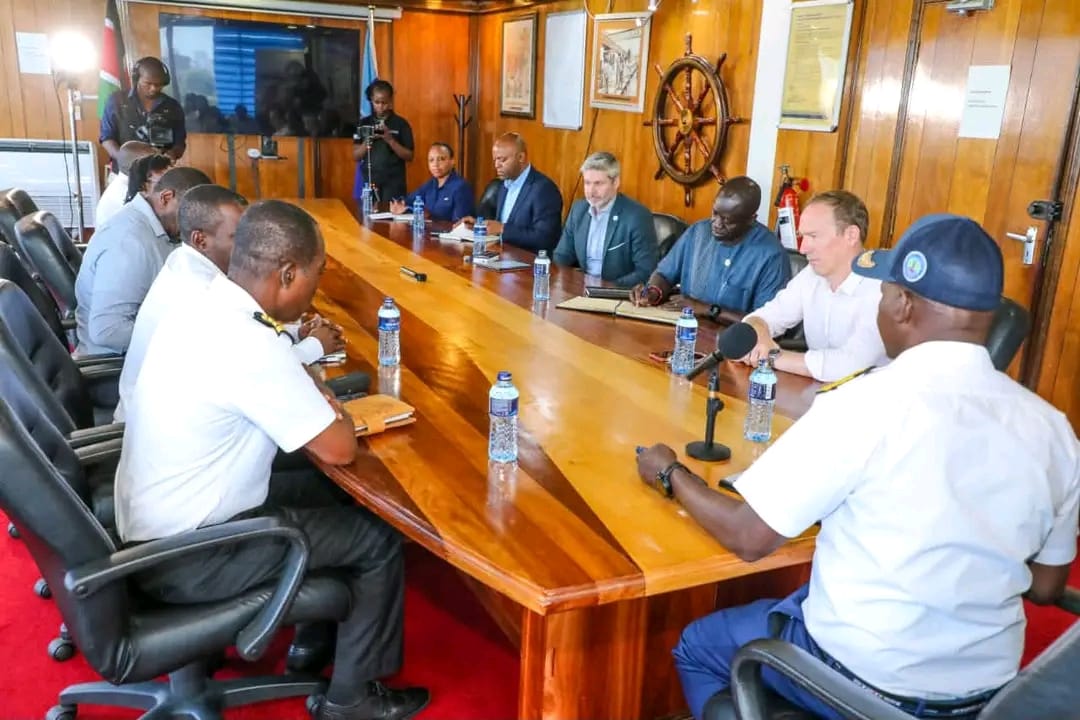
The recent visit to the Port of Mombasa by British High Commissioner H.E. Matt Baugh OBE and Kenya’s High Commissioner to the UK, Ambassador Maurice Makoloo, was more than a ceremonial photo opportunity. It was a concrete reaffirmation of the United Kingdom’s readiness to partner with Kenya Ports Authority (KPA) in infrastructure, technology, and investment to advance the Port’s strategic development plan. Captain William Ruto, KPA’s CEO, welcomed the engagement and identified practical areas for collaboration: smart gates, carbon-emission reduction, technology exchange, cool logistics, the Dongo Kundu Special Economic Zone (SEZ), and the Port of Lamu. In an era of contested supply chains and intensifying competition among Indian Ocean ports, this is a strategically significant moment for both countries—and for the wider East African region.
The Port of Mombasa is not merely Kenya’s main seaport; it is the primary maritime gateway for a hinterland stretching into Uganda, Rwanda, the Democratic Republic of Congo, South Sudan, and beyond. It handles the overwhelming majority of Kenya’s international trade and serves as a critical node on the Northern Corridor. Cargo volumes have risen sharply, reaching a record 45.45 million metric tonnes in 2025—a 10 percent increase on the previous year. KPA is responding with tangible capacity expansion: Berth 19B is under construction to add 300,000 TEUs of capacity; a major interchange project aimed at easing back-of-port congestion is advancing; and the first multipurpose berth at Dongo Kundu is taking shape as part of a larger SEZ ambition.
The UK’s interest is neither sudden nor purely altruistic. Britain has already channelled significant resources through partners such as TradeMark Africa to improve cargo-handling systems, reduce dwell times, and streamline processes. High Commissioner Baugh has publicly noted efficiency gains that have sharply cut cargo movement times while boosting revenue. The latest pledge focuses on the remaining constraints to growth: reliable power, road connectivity, and other enabling infrastructure inside SEZs, alongside digital and green technologies. These are precisely the bottlenecks that have slowed full realisation of the Dongo Kundu SEZ—a 3,000-acre project long envisioned as an industrial and logistics extension of the port itself.
Captain Ruto’s emphasis on smart gates, cool logistics, and emissions-reduction programmes is well placed. Digital automation at the gates, pre-arrival processing, and better visibility for cargo owners in landlocked countries directly reduce the soft costs that still make the corridor more expensive than it should be. Cool-chain infrastructure is essential if Kenya is to expand high-value agricultural and horticultural exports. The Green Port Policy—solar generation, hybrid equipment, and shore power pilots—aligns port operations with both national climate commitments and the expectations of global shipping lines increasingly focused on Scope 3 emissions. Technology transfer and investment from the UK can accelerate these transitions in ways that purely commercial capital sometimes cannot.
The opportunities at Lamu and Dongo Kundu are equally compelling. Lamu Port, still underutilised relative to its potential, offers a complementary northern gateway. Dongo Kundu’s proximity to Mombasa, the Southern Bypass, and the Standard Gauge Railway creates the possibility of a true port-industrial complex rather than a pure transit facility. British investors and development finance, working alongside existing Japanese support and private interest already registering in the zone, could help close the infrastructure gap that has kept many manufacturers on the sidelines.
Yet realism is required. Dongo Kundu has spent two decades on the drawing board; enabling utilities and internal connectivity have lagged. Public–private partnership (PPP) frameworks for additional berths and terminals are only now moving towards procurement. Geopolitical competition in the Western Indian Ocean is intensifying, and Kenya must carefully balance partnerships without becoming over-reliant on any single external actor. Implementation capacity, transparent procurement, and predictable policy will determine whether diplomatic statements translate into steel in the ground and systems that work.
For the United Kingdom, deeper engagement in Kenya’s maritime sector advances several strategic objectives at once: secure and efficient trade routes, influence in a growing African market, climate and green-growth credentials, and reinforcement of the 2025–2030 Strategic Partnership that aims to double bilateral trade. For Kenya, the partnership offers technology, capital, and market access that can help convert the port from a high-volume transit node into a higher-value logistics and manufacturing platform—exactly the shift required if the blue economy is to deliver jobs and foreign exchange at scale.
The visit by the two High Commissioners and the subsequent statements should therefore be read as an invitation to move from goodwill to structured pipelines: specific power and connectivity projects inside the SEZs, measurable digital and green technology partnerships, and clear pathways for British capital into Lamu and Dongo Kundu. Maritime cooperation of this depth is not a soft-power luxury; it is hard economic infrastructure for a region whose growth trajectory depends on the efficiency of its gateways. Kenya and the UK have the history, the mutual interest, and now the public commitment. The test will be delivery.