


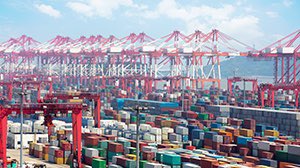
Shanghai has done it again. For the 16th consecutive year, the Port of Shanghai stands as the world’s busiest container gateway. In 2025 it handled roughly 55.06 million TEUs—more than 10 million ahead of Singapore and over five times the volume of Los Angeles, America’s busiest port. The gap is not narrowing; in some respects it is widening. This is not a temporary statistical curiosity. It is structural evidence of where manufacturing still concentrates, how supply chains actually function, and why diversification narratives often overstate the pace of change.
The Scale That Still Defines the Map
The latest rankings, drawing on Lloyd’s List data for 2025 throughput, are unambiguous. Shanghai leads, followed by Singapore (≈44.7 million TEUs), Ningbo-Zhoushan (≈43.9 million), Shenzhen, Qingdao, Guangzhou, Busan, and Tianjin. Six of the top eight ports sit in China. Chinese ports as a group continue to account for more than 40 percent of top-100 container traffic. Los Angeles, the U.S. leader, ranks outside the top 15 in most recent tallies. Europe’s biggest gateway, Rotterdam, trails far behind.
These numbers matter because container ports are the physical manifestation of global production and consumption. TEUs measure the movement of the goods that fill stores, factories, and homes. When one complex handles more boxes than the entire top tier of another continent, it signals enduring concentration rather than rapid diffusion.
Shanghai’s advantage is not merely coastal geography. It is the deep integration with China’s vast manufacturing hinterland via the Yangtze River system, extensive rail and road networks, and continuous investment in automation, deep-water capacity (especially Yangshan), and operational efficiency. Yangshan alone now accounts for more than half of Shanghai’s throughput and has driven much of the recent growth through higher productivity and smarter berthing practices. The port has also pushed green initiatives—shore power, LNG bunkering, and early methanol trials—while expanding transshipment. Efficiency gains compound volume advantages.
Diversification Is Real—but Incomplete
The broader shifts are undeniable: manufacturing spreading across Asia, deeper China-Southeast Asia trade links, and more diversified supply chains. Vietnam’s ports (Ho Chi Minh City, Hai Phong, Cai Mep) have climbed steadily. Malaysia’s Port Klang has entered the global top 10. India, Indonesia, and Thailand show momentum. Intra-Asian trade is growing faster than many long-haul routes. Red Sea disruptions, tariff front-loading, and geopolitical risk have redistributed some cargo and boosted certain transshipment hubs.
Yet the hierarchy has proven remarkably sticky. Even as companies pursue “China+1” strategies, a large share of final assembly, component production, and export logistics still flows through Chinese ports or China-centric networks. Diversification often means adding capacity in neighboring countries while the core remains anchored. The absolute volume gap between Shanghai and its nearest rivals has not collapsed; in 2025 it remained enormous. Predictions of a sharp Chinese slowdown from tariffs and trade tensions have repeatedly underdelivered. Growth moderated in places, but the top ranks held firm.
What This Means for Strategy and Risk
For companies, the message is sobering. Over-reliance on any single corridor creates vulnerability—whether to congestion, policy shifts, weather, or geopolitics. Building resilience requires genuine multi-sourcing, inventory buffers, and alternative routing options, not just rhetorical diversification. At the same time, underestimating the enduring efficiency and scale of Chinese logistics infrastructure is equally costly. The cost, speed, and reliability advantages that Shanghai and its peers offer remain hard to replicate quickly.
For policymakers, the rankings underscore the limits of decoupling rhetoric. Trade patterns reflect comparative advantage, industrial ecosystems, and sunk capital as much as political preference. Ports in Southeast Asia and South Asia will continue rising, but the transition will be evolutionary, not revolutionary, over the next decade. Investment in hinterland connectivity, digital systems, and green operations will determine which emerging hubs capture lasting share.
For the maritime industry itself, the data highlight both concentration risk and adaptive capacity. Global top-100 ports handled strong growth in recent years despite persistent disruptions—pandemic aftershocks, Red Sea diversions, and geopolitical tensions. The system has proven resilient, but resilience is not the same as diversification. The industry must continue investing in alternative gateways, digital visibility, and contingency planning while acknowledging that, for now, the gravitational center of global container trade remains firmly in East Asia.
Shanghai’s 16-year reign is not merely a Chinese story. It is a mirror held up to global trade—revealing both the enduring logic of concentration and the slow, uneven work of diversification. Those who read it clearly will be better positioned for what comes next.