


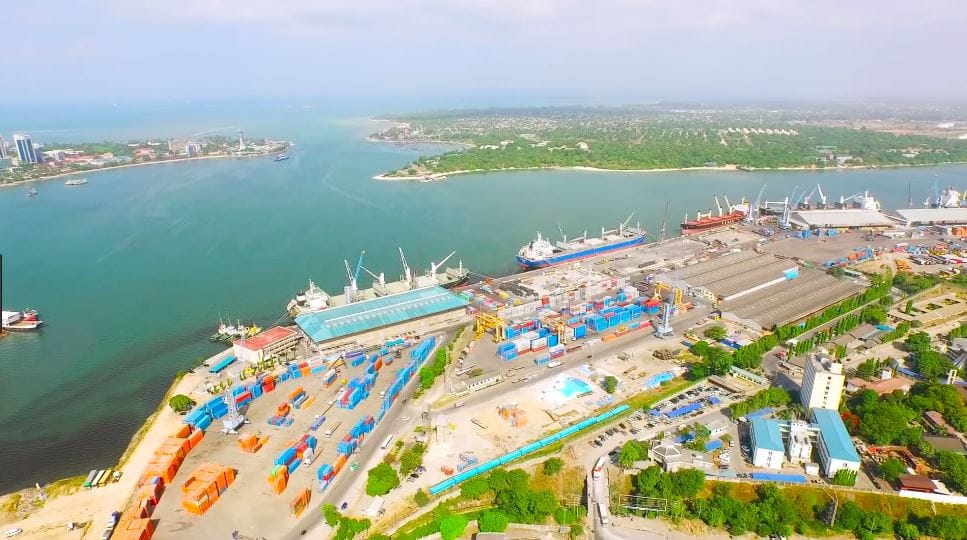
Tanzania is making a decisive bet on its main maritime gateway. The official confirmation that the Port of Dar es Salaam will expand from roughly 12 to 22 berths at a cost of about US$2 billion marks one of the region’s most ambitious infrastructure pushes. The entrance channel has already been deepened from 10 to 15.5 metres, enabling larger vessels of up to around 8,000 TEU. DP World and Adani (via Tanzania East Africa Gateway Terminal Limited) operate key terminals under long-term concessions. The Port Infrastructure Development Levy has been halved from 9% to 4.5% of customs duty, and transit cargo through Tanzanian ports stood at approximately 12.6 million tonnes in 2024/25, of which Zambia accounted for about 3.5 million tonnes.
These moves are not incremental. They form part of a broader strategy to reposition Dar es Salaam as the preferred gateway for seven landlocked countries and to cement Tanzania’s claim as East and Central Africa’s leading logistics hub. The early operational gains are measurable. The harder question is whether new berths and deeper water will translate into consistently faster, cheaper, and more predictable door-to-door service for shippers—especially Zambian importers who still live with the realities of the inland corridor.
From Congestion to Record Throughput
Cargo volumes tell a clear story of recovery and acceleration. The port handled 27.7 million tonnes in 2024/25 and jumped to a record 33.7 million tonnes in 2025/26—growth that arrived years ahead of earlier master-plan expectations. Container vessel turnaround times have fallen dramatically, from averages of 10–30 days in previous years to roughly 3–6 days in recent reporting. The World Bank’s Container Port Performance Index recorded a 105-place climb for Dar es Salaam, making it the top-ranked port in East Africa while Mombasa slipped.
Private operators have been central to the turnaround. DP World has invested heavily in equipment, systems, and yard modernisation; TEAGTL is committing substantial capital to berths 8–11. Specialised facilities—a dedicated RoRo berth for vehicles, expanded oil storage tanks under construction, and digital yard management—are reducing friction. The removal of a US$1,000-per-container demurrage fee has delivered estimated annual savings of around US$600 million for traders. Direct employment at the private terminals has grown into the hundreds, with tens of thousands of indirect jobs reported across the ecosystem. The levy cut further improves the cost equation on paper.
For Zambia, the volume share is material. Faster vessel handling and the ability to accommodate larger ships should, over time, lower unit shipping costs and reduce waiting. In theory, Dar es Salaam becomes a stronger competitor to Durban and Beira for certain cargoes.
Where the Bottlenecks Persist
Yet more berths do not automatically equal shorter door-to-door times. The critical constraints for most Zambian cargo remain on the landside: yard congestion, truck turnaround, border processes at Nakonde or Tunduma, and the condition and capacity of the road and rail corridors. Official reports still note vessels waiting offshore even as average service times improve. The master plan’s targets of 62 million tonnes by 2031 and container capacity of roughly 1.35 million TEU will require not only the phased construction of berths 12–15 and beyond, but also seamless intermodal connections—the Malindi cargo hub, the Morogoro terminal, SGR integration, and supporting dry ports. Delays or underperformance on any of these will simply move the bottleneck inland.
Competition is intensifying. Mombasa continues to invest, and other corridors actively court Copperbelt and DRC volumes. Shippers route cargo on the basis of total landed cost, reliability, and security—not headline berth counts or ranking improvements alone.
Practical Implications for Zambian Importers
In the near term, the expansion remains more promise than immediate relief. No firm completion dates have been published for the full set of ten new berths, and capacity will come online gradually. Importers and freight forwarders should therefore continue rigorous, shipment-by-shipment comparisons between Dar es Salaam and alternative routes. Real-world performance on the entire corridor—not just vessel time at berth—will determine outcomes.
Over the medium term, the opportunity is substantial. If Tanzania delivers both the maritime expansion and the hinterland links, Dar es Salaam can capture a larger share of regional transit trade. Lower shipping costs, reduced demurrage exposure, and improved reliability would benefit Zambian manufacturers, retailers, and mining operations that depend on imported inputs and equipment. Logistics providers who master visibility, documentation, and corridor management stand to gain a competitive advantage.
The levy reduction and the discipline brought by private operators already signal a more commercial orientation. Sustained user pressure—measured in actual door-to-door metrics rather than port statistics—will decide whether the US$2 billion investment produces a lasting modal shift.
A Strategic Test
Dar es Salaam’s expansion is the most visible expression of a larger national wager: that infrastructure, public-private partnership, and policy reform can convert geography into durable advantage. The gains in throughput, vessel time, and global ranking are real and welcome. The ultimate test, however, is whether landlocked neighbours choose Dar es Salaam because it is consistently the fastest, cheapest, and most predictable route—not because it has the most berths on paper.
For Zambia, the approach should be pragmatic. Welcome the capacity additions. Track delivery schedules closely. Compare every shipment against alternatives. And maintain pressure on the full logistics chain, because the last mile still decides the outcome.
The port is being rebuilt. The question now is whether the entire system will keep pace.