


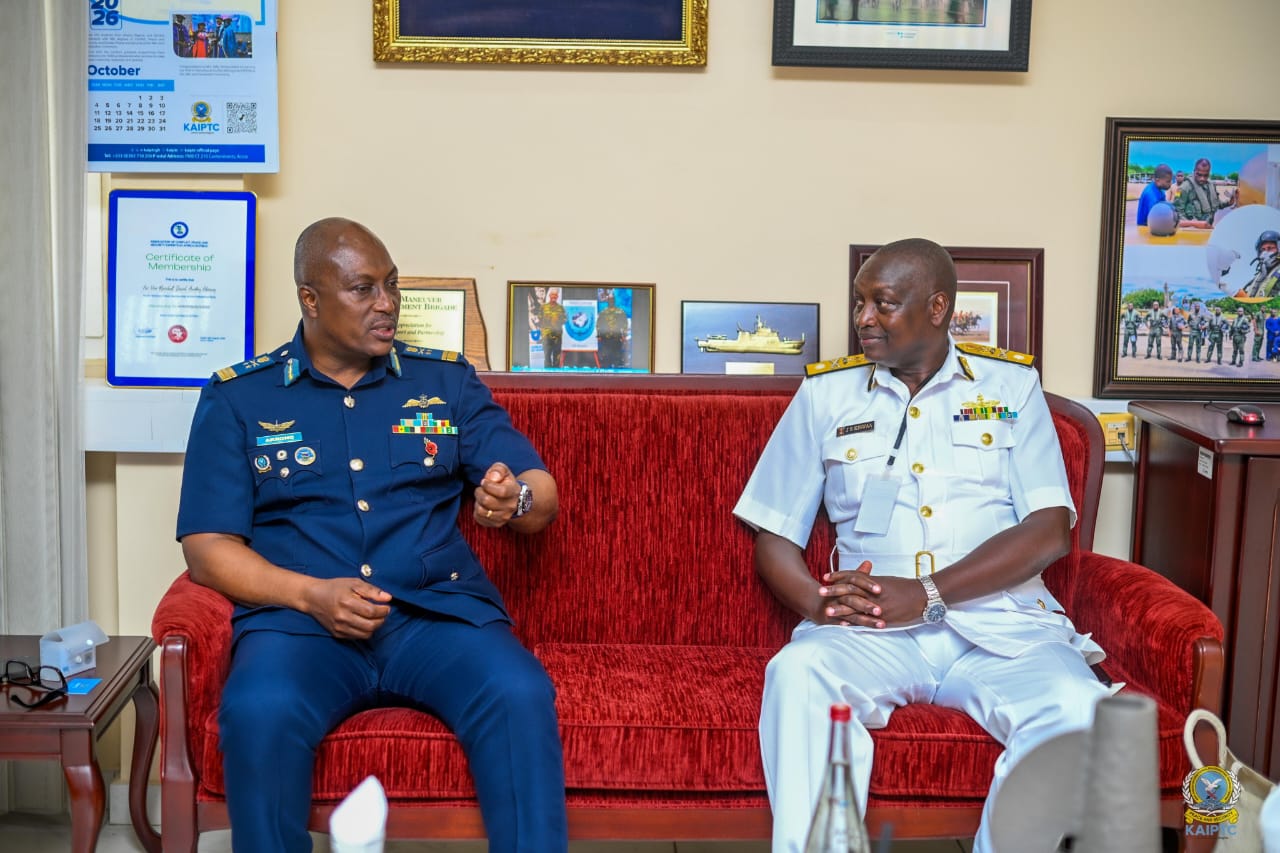
On the sidelines of the inaugural African Maritime Security Forum in Accra, a seemingly routine courtesy call carried strategic weight. Brigadier John Sankale Kiswaa, Deputy Commander of the Kenya Navy, met Air Vice Marshal David Anetey Akrong, Commandant of the Kofi Annan International Peacekeeping Training Centre (KAIPTC), on behalf of Kenya’s Navy Commander. The discussion centred on two concrete proposals: an exchange of instructors between Kenya’s International Peace Support Training Centre (IPSTC) and KAIPTC, and deeper collaboration between the Kenya Navy and the Ghana Navy. Akrong welcomed both, stressing that inter-state and inter-service engagement would strengthen professional capacity, reinforce Ghana-Kenya partnership, and advance maritime security and peacekeeping across Africa.
This was not mere protocol. It occurred against the backdrop of a forum deliberately expanded from its earlier Gulf of Guinea focus into a continental platform. Held on 14–15 October 2026 under the theme “The African Maritime Landscape in Times of Geopolitical Uncertainty in 2026 and Beyond,” the event brought together naval leaders, practitioners, researchers, and partners from West, Southern, and East Africa. It was organised by KAIPTC with the Royal Danish Defence College and Stellenbosch University’s SIGLA. Ghana’s Defence Minister, Kenneth Gilbert Adjei, opened proceedings with a clear message: maritime insecurity cannot be solved by any single state. Criminal networks exploit connections across sea, land, and air; only coordinated, intelligence-led, cross-regional action can protect trade routes and the blue economy.
The Kenya-Ghana engagement sits at the intersection of two critical African security architectures. KAIPTC, an ECOWAS centre of excellence, has long trained military, police, and civilian personnel for peace support operations. IPSTC in Kenya performs a parallel role for the East African region and beyond, with a strong record in peacekeeping preparation. The two institutions already signed an MoU in 2024 covering collaborative research, joint training, and trainer exchanges. The Accra courtesy call moves from paper to practice, proposing concrete instructor mobility that would transfer specialised expertise in maritime domain awareness, peace support doctrine, and operational lessons between the Western Indian Ocean and the Gulf of Guinea.
Why does this matter now? Africa’s maritime domain is simultaneously more secure in some respects and more contested in others. Piracy in the Gulf of Guinea has declined sharply in recent years thanks to regional coordination and capacity-building. Yet new pressures are rising: the geopolitical ripple effects of Red Sea and Middle East instability that have rerouted shipping around the Cape; the persistence of illegal, unreported, and unregulated fishing; trafficking networks that treat maritime borders as opportunities rather than barriers; and the growing sophistication of illicit actors who exploit technology and jurisdictional gaps. Kenya’s navy operates in a Western Indian Ocean environment shaped by residual Somali piracy risks, narcotics routes, and the need to protect blue-economy assets. Ghana’s navy faces the residual and evolving threats of the Gulf of Guinea. Linking the two services and their associated training centres creates a practical East-West bridge that continental forums can theorise but only bilateral and inter-service action can operationalise.
Instructor exchange is particularly potent. Peacekeeping and maritime security both suffer from fragmented expertise. Officers trained in one theatre often lack exposure to the operational cultures, legal frameworks, and threat profiles of another. Rotating instructors between IPSTC and KAIPTC would institutionalise knowledge transfer, standardise best practices, and build personal networks that later facilitate information sharing and joint exercises. It also reinforces the principle that African centres of excellence should serve the continent rather than remain regionally siloed. When Akrong emphasised inter-state and inter-service collaboration as essential to shaping the future of peacekeeping, he was stating a practical truth: sustainable capacity cannot be imported indefinitely. It must be co-produced among African institutions.
The naval collaboration dimension is equally significant. Navies remain the primary instruments for maritime domain awareness, interdiction, and presence. Yet African navies are unevenly resourced and often operate with limited interoperability. Structured engagement between Kenya and Ghana—ranging from officer exchanges and combined training to eventual coordinated patrols or information-sharing protocols—would demonstrate that African states can build practical partnerships without waiting for larger multilateral frameworks to deliver. It also aligns with existing regional instruments such as the Djibouti Code of Conduct and the Yaoundé Architecture, while extending them across traditional regional divides.
There are, of course, challenges. Instructor exchange requires sustained funding, alignment of curricula, language and doctrinal compatibility, and political will that survives changes of government or leadership. Naval collaboration must navigate differing operational priorities, equipment standards, and rules of engagement. Geopolitical uncertainty itself is a double-edged sword: external partners—Denmark, the United States, France, and others present at the forum—remain important sources of training and equipment, yet over-reliance risks diluting African ownership. The Accra meeting’s emphasis on African-led solutions is therefore crucial. The courtesy call succeeded precisely because it framed cooperation as mutual professional strengthening rather than one-sided assistance.
The broader implication is institutional. Africa’s security challenges—maritime crime, violent extremism, climate-related resource pressures, and the demands of multidimensional peacekeeping—are increasingly interconnected. Training centres such as KAIPTC and IPSTC are among the continent’s most valuable public goods. When their leaders and the services that use them actively seek deeper ties, they signal a maturing security culture: one that prioritises practical capacity over rhetorical solidarity. The fact that this conversation occurred on the margins of a newly continental maritime forum underscores a healthy feedback loop—multilateral dialogue generating bilateral action, which in turn strengthens the multilateral agenda.
If the proposals advance as both sides intend, the results will be measurable in better-trained peacekeepers, more interoperable naval forces, and denser networks of professional trust across the continent. In an era when global shipping routes are being rewritten by conflict and when Africa’s blue economy represents both opportunity and vulnerability, such quiet diplomacy is strategic statecraft. Kenya and Ghana have taken a useful step. The task now is implementation—turning courtesy into curriculum, and conversation into capability. Africa’s maritime future will be shaped less by grand declarations than by the steady accumulation of exactly these kinds of partnerships.