


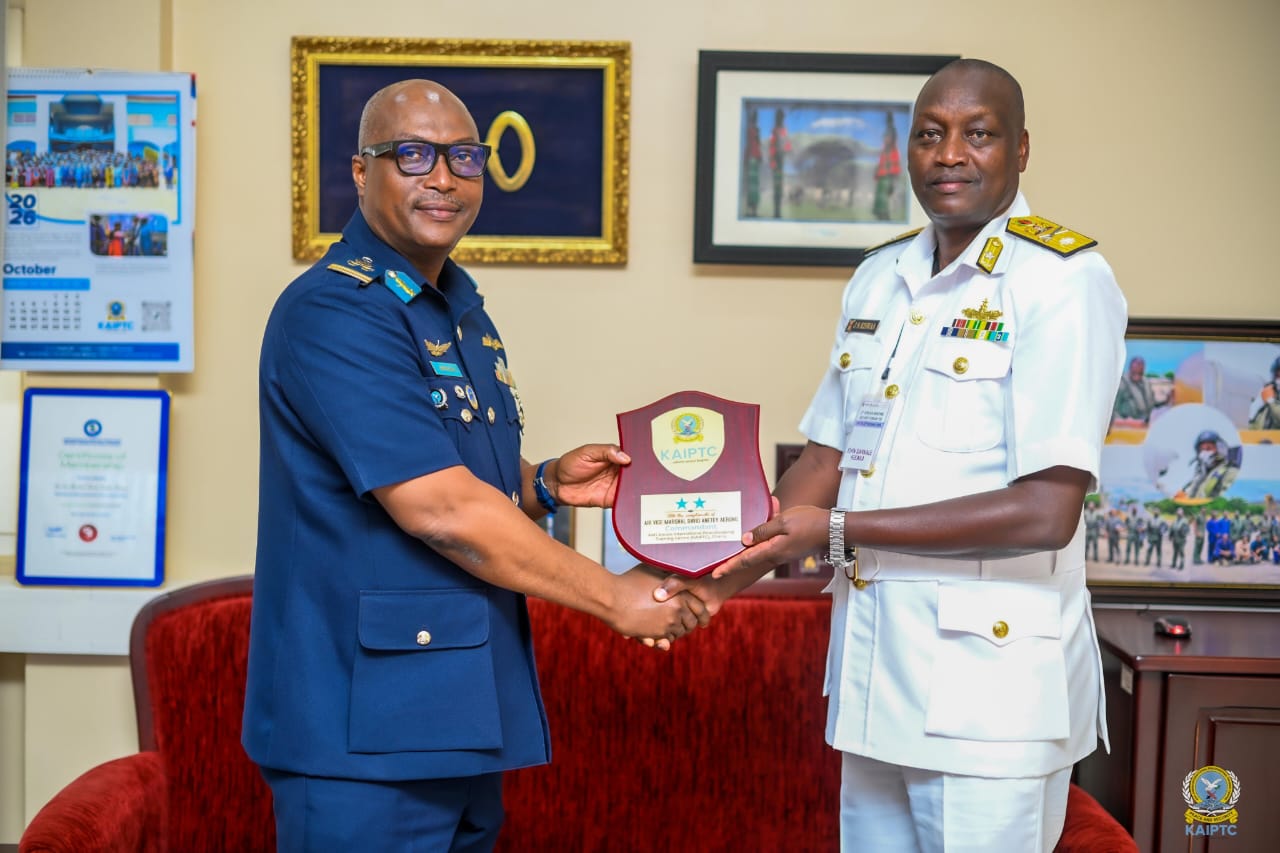
In mid-October 2026, naval leaders from across Africa gathered at the Kofi Annan International Peacekeeping Training Centre in Accra for the inaugural African Maritime Security Forum. Under the theme “The African Maritime Landscape in Times of Geopolitical Uncertainty in 2026 and Beyond,” they confronted a stark reality: the continent’s waters are no longer merely regional concerns. They form an interconnected domain where threats in the Gulf of Guinea spill over into the Western Indian Ocean, and where global power competition reshapes the shipping lanes that sustain African economies.
Kenya’s Deputy Commander of the Navy, Brigadier John Sankale Kiswaa, stood among counterparts from Ghana, Nigeria, Sierra Leone, and South Africa on a high-level panel on maritime governance. His presence, and Kenya’s broader message, was clear: no single nation can secure these waters alone. Stronger African-led coordination, intelligence sharing, technological adoption, and collective responses are essential to protect strategic sea lanes, maritime trade, and the continent’s economic future. This is not abstract diplomacy. It is a pragmatic response to converging crises that demand urgent, practical action.
The Interconnected Threat Landscape
Africa’s maritime domain faces a complex mix of persistent and emerging dangers. Piracy incidents worldwide have fallen to levels last seen in 1992, with only 51 reported in the first nine months of 2026. Yet the Horn of Africa and Western Indian Ocean have seen a worrying resurgence of Somali piracy, accounting for the majority of crew hostages and several high-profile hijackings. This revival occurs against the backdrop of redirected shipping traffic caused by instability in the Red Sea and surrounding chokepoints, increasing the volume of potential targets off East Africa’s coasts.
Illegal, unreported, and unregulated (IUU) fishing continues to bleed African economies. Kenya alone loses an estimated Sh40 billion annually. Across the continent, IUU activity extracts millions of tonnes of fish valued in the billions of dollars, undermining food security for coastal communities, depleting stocks, and eroding biodiversity. Weak monitoring, control, and surveillance systems, combined with the ease of operating “dark” vessels that switch off tracking, make unilateral enforcement nearly impossible.
Transnational crime—drug and arms trafficking, human smuggling, and environmental crimes—thrives in the seams between jurisdictions. Geopolitical uncertainty adds another layer. Great-power competition, disruptions to traditional routes, and the growing use of autonomous systems and dual-use technologies introduce new vulnerabilities that no African navy can address in isolation. The Accra forum rightly emphasised that these challenges are interconnected. What happens off West Africa affects East African shipping interests, and vice versa. Protecting sea lines of communication requires cooperation that spans the Western Indian Ocean, the Gulf of Guinea, and Southern African routes.
Kenya’s Strategic Position and Growing Leadership
Kenya sits astride critical Western Indian Ocean routes that link Asia, the Middle East, Africa, and Europe. Its ports, particularly Mombasa, serve as gateways for regional trade and a growing blue economy agenda focused on jobs, logistics, and sustainable ocean use. Insecurity at sea directly threatens these ambitions—raising insurance costs, deterring investment, and limiting opportunities for Kenyan seafarers.
The Kenya Navy has steadily expanded its role in regional and international frameworks, including the Djibouti Code of Conduct, Combined Maritime Forces, and various working groups on operational cooperation. Brigadier Kiswaa’s participation in Accra, including discussions on instructor exchanges and deeper collaboration with the Ghana Navy and KAIPTC, fits a pattern of proactive defence diplomacy. Kenya has hosted workshops on operational coordination at sea, updated its national maritime security risk register through multi-agency efforts, and engaged partners from India, Pakistan, and others on staff talks and joint operations.
This is not posturing. It reflects a recognition that maritime security underpins economic resilience. Secure waters enable legitimate trade, protect fisheries that support livelihoods, and create the conditions for blue economy growth. Insecure ones do the opposite.
From Dialogue to Deliverables
The inaugural African Maritime Security Forum marks an important expansion beyond earlier Gulf of Guinea-focused meetings. Bringing East, West, and Southern African perspectives into one room is progress. Yet forums succeed only if they produce lasting mechanisms.
Several priorities stand out. First, deepen real-time intelligence and information sharing. Existing platforms must become more interoperable and trusted across regions. Second, accelerate the adoption of technology—satellite monitoring, AIS analytics, unmanned systems, and shared maritime domain awareness tools—while building the human capacity to use them effectively. Third, strengthen legal and operational frameworks for joint responses, including clearer rules for hot pursuit, evidence sharing, and coordinated patrols. Fourth, link security more tightly to blue economy and development goals so that coastal communities see tangible benefits from safer seas.
African-led solutions must remain central. External partners provide valuable training, equipment, and data, but ownership and prioritisation must rest with African states. Capacity gaps in many navies and coast guards are real; closing them requires sustained investment, professional military education exchanges, and political will.
Kenya’s consistent advocacy—from the Accra forum to regional workshops and bilateral engagements—positions it as a credible bridge between the Western Indian Ocean and the wider continent. Its call for stronger cooperation is not a plea for assistance. It is a strategic assessment grounded in geography, economics, and hard-won operational experience.
The Cost of Inaction
The alternative is fragmentation. Criminal networks already exploit gaps between national jurisdictions and between land and sea domains. Geopolitical competition will continue to redirect traffic and introduce new risks. IUU fishing will keep depleting resources that African communities depend upon. Each unaddressed incident raises the cost of trade and erodes confidence in African waters as safe corridors for commerce.
Africa’s coastline stretches more than 30,000 kilometres. Its exclusive economic zones hold vast potential for food, energy, transport, and jobs. Realising that potential requires treating the maritime domain as a shared strategic space rather than a collection of separate national waters.
The Accra forum offered a platform. Kenya’s message provided clarity. What remains is the harder work of turning shared diagnosis into coordinated action—through sustained political commitment, practical operational mechanisms, and African leadership that matches the scale of the challenge. The seas that connect Africa also expose its vulnerabilities. Securing them is no longer optional. It is a continental imperative.