


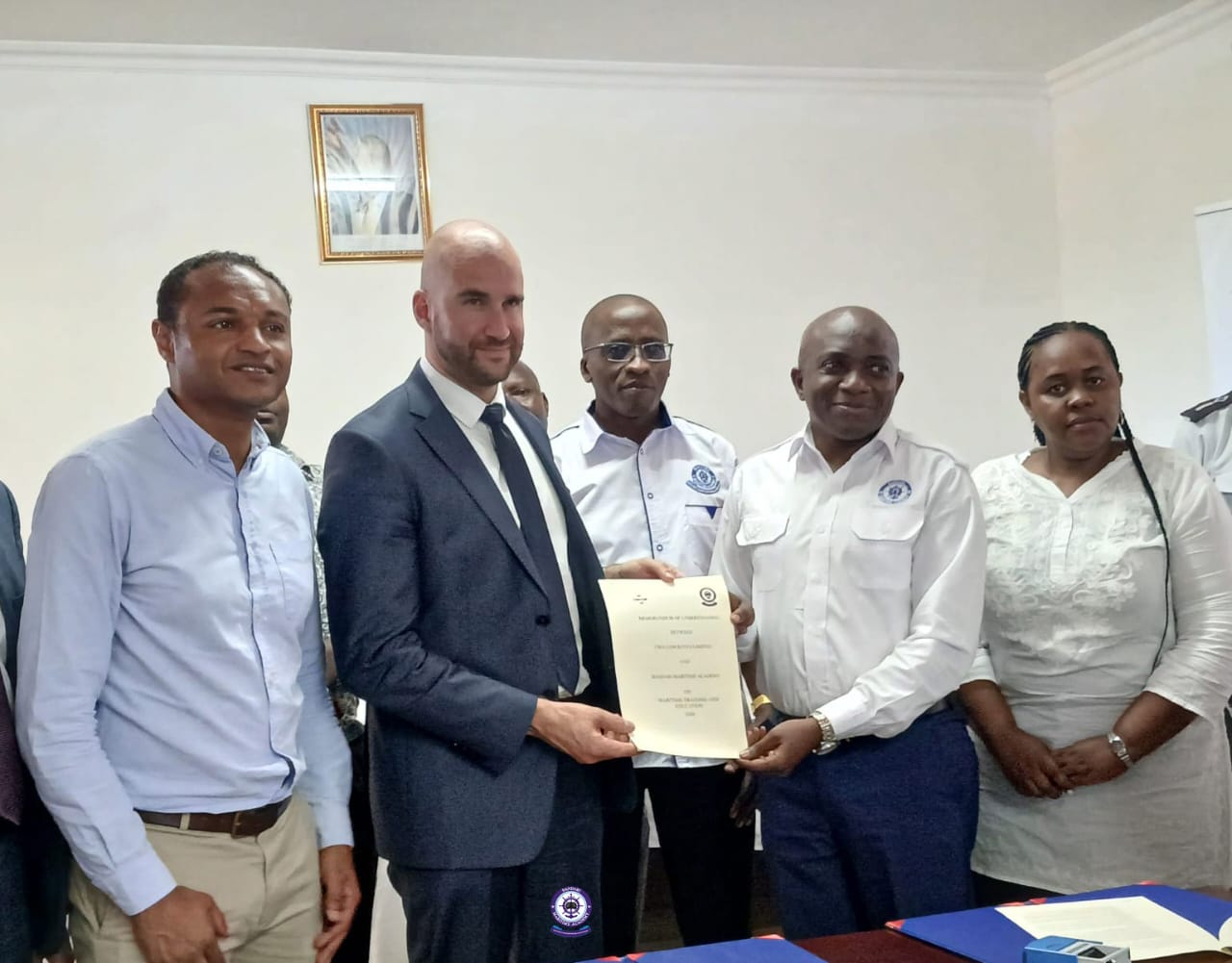
In a quiet but consequential ceremony in Mombasa, Bandari Maritime Academy (BMA) and CMA CGM, the French shipping and logistics giant, formalised a Memorandum of Understanding (MoU) that does more than promise placements for cadets. It confronts one of the most stubborn bottlenecks in Kenya’s maritime development: the chronic shortage of mandatory sea-time that leaves classroom-trained seafarers stranded on the dockside, certificates incomplete and careers stalled.
The agreement, signed by BMA Chief Executive Officer Dr Eric Katana and CMA CGM’s Kenyan Cluster Managing Director Benjamin Coston in the presence of French Ambassador H.E. Wadid Benaabou, creates structured pathways for cadets to gain practical experience aboard one of the world’s largest fleets. CMA CGM operates more than 700 vessels, spanning regional feeders to ultra-large container ships. For Kenya, this is not merely another industry handshake. It is a practical response to a structural failure that has undermined the country’s ambition to turn its extensive coastline and strategic Indian Ocean position into a genuine economic engine.
The Sea-Time Crisis
Maritime education under the STCW Convention is incomplete without documented sea service. Without it, cadets cannot sit for Certificates of Competency and cannot work as officers. Kenya has no national training ship of its own. For years, graduates of BMA—and other institutions—have faced a cruel paradox: they complete rigorous theoretical and simulator training only to discover that berths on commercial vessels are scarce, competitive, and often reserved for candidates from countries with established crewing pipelines.
This is not a uniquely Kenyan problem, but its local consequences are acute. BMA has reported hundreds of cadets in its database awaiting placements. Recent placements of small cohorts—12 with CMA CGM, others with Danica Crewing, Maersk, and various other lines—illustrate both progress and the scale of the remaining gap. Each successful placement is a victory; the backlog is a national policy failure waiting to be fixed.
The BMA–CMA CGM MoU, building on earlier collaboration dating back to at least 2021, begins to convert that backlog into a pipeline. It pairs classroom competence with real operational exposure—navigation, cargo operations, safety culture, and the discipline of life at sea—while giving the company access to a pool of English-proficient, locally trained talent.
France, Language, and Soft Power
The presence of the French Ambassador was not ceremonial filler. France has systematically deepened its maritime engagement with Kenya. Parallel MoUs between BMA and Alliance Française de Mombasa for French-language training are a smart complement. Proficiency in French expands opportunities in Francophone shipping markets and within companies headquartered or heavily active in France and its spheres of influence. In an industry where language can determine employability on certain vessels or in certain trades, this is practical soft power that serves both sides.
CMA CGM’s own scale makes the partnership especially valuable. As a major player in container shipping and integrated logistics, the company offers exposure across vessel types and global routes. For Kenyan cadets, that translates into broader professional networks and higher future earning potential once they obtain their certificates.
Beyond Cadets: Building Institutional Muscle
The significance extends past individual placements. BMA itself has undergone a transformation—from the old Bandari College under Kenya Ports Authority into a semi-autonomous government agency and designated regional Centre of Excellence for Blue Economy skills. It now pursues a deliberate partnership strategy: agreements with Regional Maritime University in Ghana, KMFRI for research-vessel sea time, the Institute of Chartered Shipbrokers for professional qualifications, Technical University of Mombasa for shared facilities, and multiple flag-state recognition arrangements under STCW Regulation I/10.
These moves reflect a recognition that no single institution can solve the sea-time problem alone. Shipping lines control the berths. Flag states control certification recognition. Training institutions control the quality of the pipeline. Effective national strategy requires all three to align. The CMA CGM deal is one node in that emerging network.
Kenya’s broader Blue Economy agenda—anchored in Vision 2030 and subsequent policy documents—depends on precisely this kind of human-capital development. Ports, shipping, logistics, fisheries, coastal tourism, and emerging ocean industries all require skilled people. Seafarers who complete their sea time and return as officers become the officers, superintendents, and managers of tomorrow. Remittances from those who work internationally add another layer of economic return.
Risks and Realism
Optimism must be tempered. MoUs are frameworks, not guarantees. Delivery depends on consistent selection processes, cadet performance, company operational needs, and sustained political attention. Small cohorts of 10–12 cadets are meaningful for those individuals and for demonstrating proof of concept, but they remain modest relative to the annual output of trainees and the backlog. Scaling will require more partners, longer-term commitments, and possibly creative solutions such as dedicated training berths or government-backed incentives for companies that take Kenyan cadets.
There is also the question of retention and career progression. Sea time is the first hurdle. Ensuring that qualified officers find sustained employment—whether at sea or ashore in Kenya’s growing maritime services sector—will determine whether the investment yields national returns or simply exports talent.
Gender inclusion deserves monitoring. Maritime training in Kenya has seen rising female participation. Partners that treat this as an asset rather than an afterthought will strengthen the talent pool and the social legitimacy of the sector.
A Model Worth Expanding
The BMA–CMA CGM partnership, set against the French language initiative and the wider web of industry and academic agreements, offers a working model: identify a hard constraint (sea time), recruit a capable commercial partner with scale and interest in the region, layer complementary soft skills (language, cultural familiarity), and embed the arrangement in a broader institutional strategy for the Blue Economy.
Kenya does not need to reinvent maritime training. It needs to close the practical loop between training and certification, between competence and employment. Every successful cadet who boards a CMA CGM vessel, completes sea time, and returns with a Certificate of Competency is evidence that the loop can be closed.
If this approach is replicated with other major lines, expanded in volume, and supported by consistent policy attention, the quiet signing ceremony in Mombasa may come to be seen as an early marker of a more serious national commitment to turning Kenya’s maritime geography into maritime capability. The sea has always been there. The question is whether the institutions and partnerships exist to put Kenyan talent on it—and keep them there.