


Shipping is often described as the backbone of globalization—a borderless conveyor belt moving goods with quiet efficiency. But the week of 19–25 October 2026 exposed a troubling paradox: the industry may be global, but the risks are becoming intensely, dangerously local for the people who actually operate the vessels. From the Strait of Hormuz to the Black Sea, from Mumbai’s detention yards to a shipyard near Chennai—and now, directly to Kenya’s fuel supply—the defining developments of the week all converge on one question: who bears the human cost when geopolitics collides with commerce?
Hormuz: The War’s Worst Month for Commercial Shipping—and a Kenyan Fuel Shock
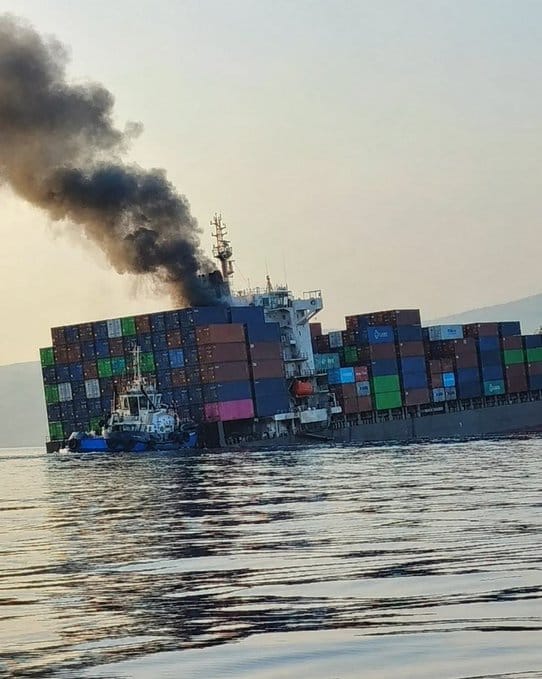
The Strait of Hormuz remained the epicenter of maritime insecurity, and the numbers are sobering. More than 120 attacks on commercial shipping have been recorded since the conflict began on 28 February 2026. October alone saw 29 ships hit, surpassing March’s 20 attacks and making it the war’s worst month for commercial shipping. UKMTO data showed transits through the strait running 70 percent below pre-conflict levels, with 12 attacks reported in a single week in mid-October. Two Singapore-registered container vessels, GFS Pride and GFS Giselle, were struck by unidentified projectiles; GFS Pride sank after catching fire, though all 21 crew were safely evacuated.
For Indian seafarers, the danger became visceral. On 21 October, the Kuwait-flagged oil product tanker M/T Al Dasma, carrying 21 Indian crew members, was struck by an unknown projectile about 11 nautical miles west of Bukha, Oman. Union Minister Sarbananda Sonowal confirmed all Indian crew were “completely safe.” Just days earlier, the crude tanker MT ST 3, with 15 Indian seafarers aboard, was also hit. Each “all safe” headline is a relief, but also a warning. The margin between a safe crew and a casualty list is narrowing with every projectile.
Now add a detail that should puncture any notion that this is a Gulf-only crisis: two oil tankers were attacked while heading away from the region carrying fuel for Kenya. That single fact collapses the distance between the Strait of Hormuz and East African energy security. For Kenyan motorists, manufacturers, and households already sensitive to fuel prices, the Hormuz crisis is not a distant geopolitical spectacle. It is a direct threat to landed fuel costs, freight and insurance premiums, and supply reliability. And for the crews aboard those tankers, it is a reminder that the cargo they carry—ordinary fuel for ordinary economies—does not make them any less of a target.
The Black Sea: NATO’s Surveillance Surge and the Deadly Drone Campaign
The Black Sea has become a second front in the war’s maritime dimension. Following a series of deadly drone attacks on commercial ships near the coasts of Bulgaria and Romania, NATO announced it would deploy additional maritime patrol aircraft, radar systems, and unmanned aerial vehicles to the region. Intelligence experts and explosive ordnance teams were also dispatched after a North Atlantic Council meeting on Black Sea security. The human toll is already severe: in the past ten days, at least five ships were attacked off Romania and Bulgaria, with at least 23 sailors killed or missing. One attack saw seven sailors go missing after drones hit two chemical tankers near the Romanian coast on a vital shipping route used by Ukraine. NATO has refrained from formally attributing responsibility, though military analysts assess Russia as the most likely perpetrator. For crews transiting these waters, enhanced surveillance is welcome—but it does not stop a drone already in flight.
The Paper Shield: Fake Registries and Forged Insurance
Perhaps the most insidious threat of the week came not from a projectile but from a document. The Forward Seamen’s Union of India wrote to the IMO on 16 and 21 October, warning that “hundreds” of seafarers were being put at risk by shipowners using fake ship-registration certificates and forged protection-and-indemnity insurance papers. The union cited five vessels, including the Palau-flagged tanker Settebello, where families of crew who died in a missile attack are still fighting for compensation because fake P&I documents had been used to secure registration. Three sanctioned tankers linked to a Dubai-based owner were detained in Mumbai, with one allegedly using a forged P&I certificate and another entering a recycling centre on forged papers. At least three vessels have been detained in Mumbai since February 2026 over fake registration certificates. The IMO has responded, reaffirming its commitment to seafarer safety and pointing to work on ship-registration guidelines to strengthen due diligence. But for a seafarer joining a vessel in a conflict zone, the practical takeaway is stark: checking a ship’s flag, IMO number, and P&I cover is not bureaucratic box-ticking—it can be the difference between having insurance and having nothing at all.
The Suez Return: Normalization on Shifting Sands
In a week dominated by risk, there was one notable signal of normalization. Container lines shifted 63 percent of Far East–Europe capacity back to the Suez Canal route between mid-September and mid-October, according to Alphaliner. CMA CGM maintained transits throughout the crisis, while COSCO, OOCL, Maersk, and MSC have also returned; Evergreen and ZIM remain the only top-ten carriers yet to resume Red Sea transits. The Suez route saves roughly two weeks of sailing compared with the Cape of Good Hope and reduces fuel consumption. Yet security risks persist—a naval frigate recently shot down a drone that threatened the 23,112 TEU CMA CGM Champs Elysees during a Red Sea transit. The return to Suez is economically rational, but it places crews back into a corridor where the threat has not disappeared, merely receded.
India’s Ship-Repair Ambition: A Strategic Bet
Amid the security crises, a quieter but strategically significant development unfolded at L&T Shipbuilding’s Kattupalli Shipyard near Chennai. The Singapore-flagged container vessel Maersk Chattogram entered the yard for its scheduled 10-year planned drydocking and overhaul—Maersk’s first planned drydocking in India. The activity marks the first operational milestone under a Memorandum of Understanding signed during India Maritime Week 2025, covering shipbuilding, ship repair, and knowledge exchange. The vessel will undergo its special survey and maintenance using India’s largest shiplift system. For India, this is a concrete step toward becoming a global maritime hub—a capability that matters not only for commercial efficiency but for strategic resilience. A region that can repair its own ships is a region less dependent on distant yards when crisis hits.
The Common Thread: Local Risks in a Global Industry
What ties these stories together is not geography but human geography. A seafarer on Al Dasma shares the same vulnerability as a crew member on a chemical tanker off Romania, or a mariner who signed onto a vessel with a forged P&I certificate believing the paperwork was real. The two tankers carrying fuel for Kenya add another layer: the same attack that endangers a crew in the Gulf can raise fuel costs in Mombasa, disrupt Kenyan supply chains, and remind East African consumers that maritime security is energy security.
The industry’s global supply chains, flags of convenience, and cost pressures create a system where risk is externalized—onto crews, their families, and the coastal states that must respond when things go wrong. NATO’s surveillance surge and the IMO’s response to the Forward Seamen’s Union of India are necessary steps, but they are reactive. The deeper lesson of this week is that maritime security cannot be measured only in transits restored or capacity shifted. It must be measured in whether the person on the bridge has a genuine flag, genuine insurance, and a genuine plan for getting home—and whether the economies that depend on their cargo, from India to Kenya, have a genuine plan for when the route breaks.
Shipping may be global, but for the people who operate it—and for the countries that rely on what they carry—the risks are already local. The industry would do well to treat that as its central operational challenge, not an unfortunate byproduct.