


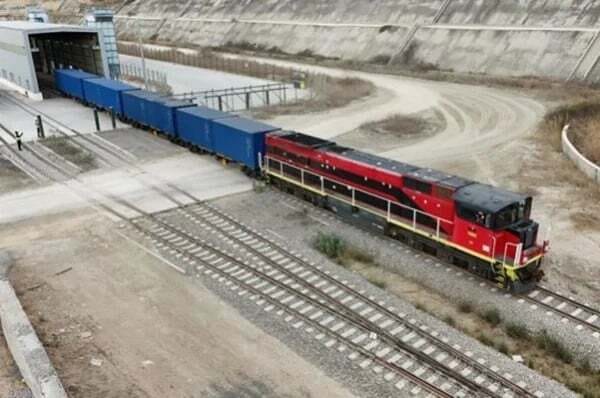
Tanzania and Angola have agreed to link their transport corridors so that the Benguela Railway—the spine of the Lobito Corridor on the Atlantic—connects through Zambia and the Democratic Republic of Congo to the Tanzania-Zambia Railway Authority (TAZARA) line running to Dar es Salaam on the Indian Ocean. The result, if realized, would be a continuous freight route spanning the continent’s two coasts.
This is more than incremental infrastructure news. It is a practical assertion of African agency in the middle of a high-stakes contest over critical minerals and logistics corridors.
Two Corridors, One Copperbelt, Competing Visions
TAZARA was built in the 1970s with Chinese financing and engineering precisely to give landlocked Zambia an outlet that did not depend on white-ruled Rhodesia or apartheid South Africa. The 1,860-kilometre line carried copper out and fuel in. Decades of underinvestment left it struggling, but in 2025 China signed a roughly $1.4 billion deal to modernize the track, rolling stock, and operations under a long-term concession. The aim is to raise annual freight capacity dramatically—from low hundreds of thousands of tonnes toward multi-million-tonne levels—and cut transit times.
On the other side of the continent sits the Lobito Corridor. Its core is the rehabilitated Benguela Railway from the Angolan port of Lobito inland toward the DRC border, now operated under a 30-year concession by a consortium involving Trafigura, Mota-Engil, and Vecturis. Western governments and institutions have poured political capital and financing into the project. The U.S. International Development Finance Corporation, European partners, the African Development Bank, and the Africa Finance Corporation have backed upgrades and a new greenfield section intended to link Zambia’s Copperbelt more directly to the Atlantic. Preferred bidders for an 830-kilometre Zambia–Angola stretch were named in late October 2026. The strategic framing is explicit: create a reliable, Western-aligned route for copper, cobalt, and other critical minerals that currently move heavily through Chinese-influenced logistics.
Until recently, the two projects were widely portrayed as rivals. TAZARA was the China-backed eastern option; Lobito the U.S. and EU-backed western alternative. Tanzania and Angola’s announcement reframes them as complementary segments of a single coast-to-coast system. Both networks use the same 1,067 mm Cape gauge, which removes one major technical barrier to through-running of wagons.
Why It Matters
Landlocked Zambia and the mineral-rich southern DRC gain optionality. Exporters can choose the nearest or cheapest seaport, hedge against congestion, political disruption, or commercial disputes on any single route, and potentially lower overall logistics costs. Shorter, more reliable rail journeys reduce the carbon footprint of bulk mineral transport relative to long road hauls and ease pressure on already strained trucking corridors. Agricultural produce and general cargo stand to benefit as well, supporting regional value chains beyond extractives.
For the continent, the symbolism is powerful. African governments are stitching together infrastructure built or rehabilitated with different external partners rather than accepting a binary choice between Beijing and Washington. The agreement emerged from a state visit—the first by an Angolan head of state to Tanzania in decades—and includes exploratory talk of Tanzanian participation in Angola’s Lobito oil-refinery project. It is an exercise in multi-alignment rather than non-alignment theater.
The African Continental Free Trade Area needs physical connectivity as much as tariff schedules. A functioning east–west spine across the Copperbelt and adjacent agricultural zones would make that ambition more tangible. Ports at Lobito and Dar es Salaam would both gain hinterland traffic; intermediate economies would capture more transit and service activity.
The Hard Remaining Questions
No completion date or cost estimate was announced. Connecting the networks requires more than political goodwill. Additional track, bridges, signaling, border facilities, and operating protocols must still be planned, financed, and built, particularly across Congolese and Zambian territory. Security and governance challenges in eastern and southern DRC remain real. Financing packages for the missing links will test whether African, Western, Chinese, and multilateral capital can coordinate rather than merely coexist. Customs harmonization, wagon interchange agreements, and maintenance standards will determine whether the system operates as a seamless corridor or a series of disconnected segments.
Gauge compatibility is helpful but not sufficient. Capacity bottlenecks, last-mile connections to mines and farms, port efficiency, and reliable power will decide commercial viability. History is littered with ambitious African rail maps that never carried the promised tonnage.
Agency Over Alignment
The deeper significance is political. External powers will continue to pursue their interests—China through TAZARA revitalization and broader Belt and Road relationships, the United States and Europe through Lobito and critical-minerals security. African states are demonstrating that they can invite both, extract value from both, and then connect the resulting assets on their own terms. That is a more mature posture than either exclusive dependence or rhetorical rejection of partnership.
If the Tanzania–Angola vision moves from announcement to operating trains, it will not end great-power competition in African logistics. It will change the geometry of that competition. Minerals, crops, and manufactured goods will have more routes to the sea. Landlocked producers will have more leverage. And the map of African infrastructure will look a little less like a set of externally sponsored spokes and a little more like a continental network.
The distance between a presidential handshake and a functioning transcontinental railway remains long. But the direction of travel—linking the Atlantic to the Indian Ocean under African initiative—is the right one.
About the Author
Andrew Mwangura is a maritime and logistics analyst. He writes on African infrastructure, trade corridors, and maritime security.