


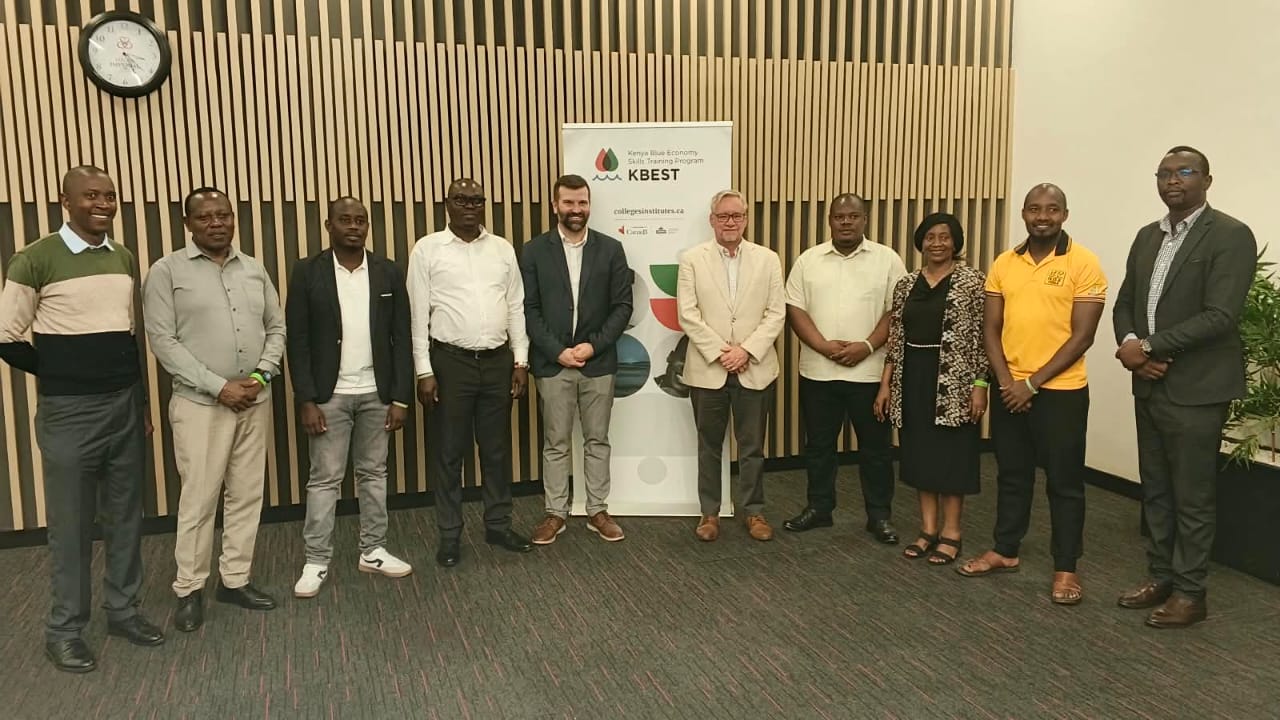
Bandari Maritime Academy (BMA) has announced that a team of its officers is participating in the Kenya Blue Economy Skills Training (KBEST 12) programme on Open, Distance and eLearning (ODeL) in Kisumu. Led by Assistant Director Quality Assurance and KBEST Lead Michael Njogah, alongside ICT and ODeL leads Benson Karanja and Felix Muriuki, and Nautical Trainer Jacob Kazungu, the delegation is working with Canadian partners from Algonquin College under Colleges and Institutes Canada (CICan). The stated goal is straightforward: build institutional capacity to develop, deliver and manage quality online learning programmes. BMA plans to launch its first online courses early next year.
This is more than a routine training update. It signals a deliberate shift by Kenya’s premier maritime training institution toward flexible, technology-enabled delivery at a moment when the country’s blue economy ambitions—and the stubborn challenge of youth unemployment—demand scale, access and relevance that traditional campus-based models alone cannot deliver.
The Strategic Context
Kenya has identified the blue economy as a critical frontier for growth, with potential contributions estimated in the billions of dollars across fisheries, maritime transport, logistics, coastal tourism, aquaculture and related services. Bandari Maritime Academy, transformed from the old Bandari College into a Semi-Autonomous Government Agency in 2018, was explicitly positioned as a Regional Centre of Excellence to supply the skilled human capital this sector requires. Its programmes in nautical science, marine engineering, maritime transport and logistics, and short courses aligned to International Maritime Organization standards sit at the heart of that mandate.
Yet physical capacity and geographic concentration in Mombasa create natural bottlenecks. Many potential learners—especially young women, rural youth, working adults and those in the Lake Victoria basin or inland counties—face barriers of distance, cost and competing responsibilities. ODeL offers a partial answer: greater flexibility, broader reach and the possibility of continuous professional development for serving seafarers and port workers without removing them from employment for extended periods.
KBEST itself is a seven-year (2022–2029), roughly CAD 25 million initiative funded by Canada and implemented by CICan in partnership with Kenyan TVET institutions, the Ministry of Education and other stakeholders. It focuses on coastal and Lake Victoria counties, prioritises women, youth and vulnerable groups, and aims to strengthen industry-responsive, competency-based training. The specific ODeL strand (KBEST-12) partners Canadian colleges—including Algonquin, with involvement from others such as Camosun—with Kenyan institutions and the Kenya School of TVET to build master trainer capacity in online and blended delivery.
BMA’s participation is therefore both institution-specific and systemic. By developing in-house capability to design and manage online programmes, the Academy is preparing to extend its maritime expertise beyond the physical campus while contributing to a wider digital transformation of Kenya’s TVET sector.
Opportunities and Implications
The potential benefits are substantial. First, access. Online and blended maritime courses can reach learners who would otherwise never enrol, supporting national targets around youth skills and blue economy employment. Second, responsiveness. Digital platforms allow faster updating of content as technology, regulations and industry needs evolve—critical in a sector shaped by IMO conventions, the digitalisation of shipping and sustainability requirements. Third, efficiency. Once developed, quality digital materials can be reused and scaled at lower marginal cost than purely face-to-face delivery.
For BMA specifically, the first online courses planned for early next year represent a milestone in diversifying delivery modes. Success here could position the Academy as a regional leader not only in traditional maritime training but in hybrid models suited to the realities of East African labour markets. It also aligns with broader efforts already visible at the institution: international partnerships for shipboard training, accreditation as an Institute of Chartered Shipbrokers centre, and collaborations aimed at practical sea-time and research exposure.
At the national level, embedding strong ODeL capacity in a specialised institution like BMA strengthens the credibility of digital TVET more broadly. When a centre of excellence demonstrates that rigorous, safety-critical and practical maritime content can be delivered effectively online or in blended formats, it lowers resistance among other institutions and regulators.
Risks and Realities
Optimism must be tempered by realism. Maritime training is not purely theoretical. Watchkeeping, engine-room operations, firefighting, survival techniques and many port skills require hands-on practice, simulation and, ultimately, sea-time or workplace experience. Purely online programmes risk producing theoretically competent but practically under-prepared graduates if practical components are not carefully designed and assessed. Blended models—combining digital theory with intensive residential practical modules—will almost certainly be necessary for core seafarer qualifications.
Infrastructure and digital divides remain material constraints. Reliable connectivity, devices, electricity and digital literacy are uneven across Kenya. Quality assurance frameworks for online assessment, proctoring and recognition of prior learning must keep pace. Faculty workload and the cultural shift required for effective online pedagogy should not be underestimated; training master trainers is a necessary but not sufficient step.
There is also the question of industry acceptance. Employers in shipping, ports and logistics will need confidence that online or blended graduates meet the same standards as traditional ones. Transparent quality assurance, industry co-design of content and clear pathways to practical certification will be essential.
A Broader Imperative
The BMA–KBEST ODeL engagement is one piece of a larger puzzle. Kenya’s TVET system is being asked to deliver both volume and quality at speed while responding to the dual pressures of youth unemployment and the green-and-blue transition. Canadian partnership brings technical expertise, pedagogical models and resources; Kenyan institutions must own the adaptation, contextualisation and long-term sustainability.
Success will depend on several factors: sustained investment beyond the life of the project; genuine industry engagement in curriculum and assessment design; deliberate attention to gender equity and inclusion; robust digital infrastructure support; and honest evaluation of what works in the Kenyan context rather than simple transplantation of foreign models.
If BMA can demonstrate that high-quality maritime education can be made more accessible through thoughtful digital delivery without compromising standards, it will have advanced not only its own institutional mission but the national project of building a skilled, adaptable workforce for the blue economy. The Kisumu training is a beginning, not an end. The real test will come when the first online cohorts enrol, complete their programmes, and enter the labour market—or return to their workplaces—better equipped to contribute.
Kenya’s blue economy ambitions will not be realised by infrastructure and policy alone. They require people with the right skills, delivered at the right scale and with the flexibility modern learners demand. Bandari Maritime Academy’s digital step is a pragmatic and necessary response to that reality. The coming years will show whether the system can convert training capacity into lasting opportunity.