


Kenya is once again reaching for an oil prize it has chased for more than a decade. The decision to revive a long-dormant crude pipeline linking the Turkana oil fields to Aliko Dangote’s planned Lamu refinery is more than an infrastructure announcement. It is a high-stakes wager that Kenya can convert modest domestic crude into strategic leverage, industrial capacity and regional influence—while riding the coattails of Africa’s richest man.
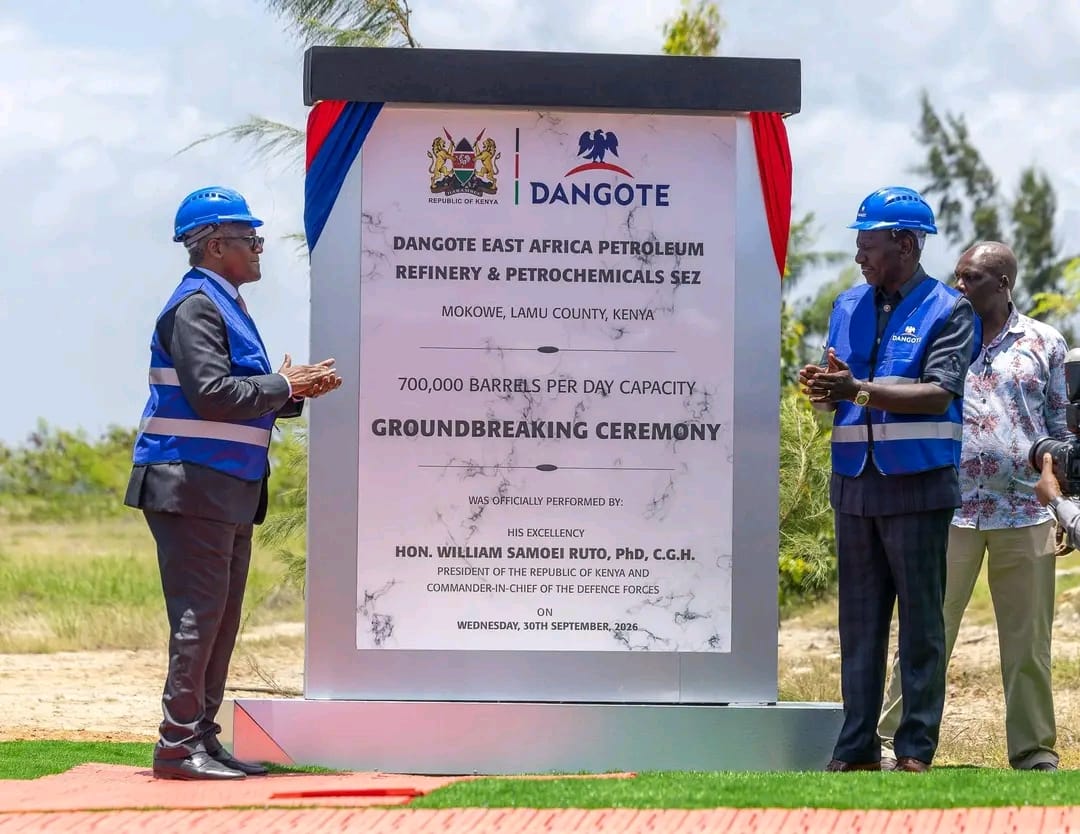
The facts are straightforward. In late September 2026, President William Ruto and Aliko Dangote broke ground on a roughly $16 billion, 700,000-barrel-per-day refinery in Lamu, the largest industrial project of its kind planned for East Africa. Shortly afterward, Kenyan officials confirmed plans to build a pipeline from the South Lokichar Basin in Turkana to Lamu so that Kenya’s own crude can feed the plant. The pipeline idea is not new. It was first seriously studied during the Tullow Oil era, only to stall amid production delays, high costs and doubts about commercial viability. Its revival is explicitly tied to Dangote’s project.
On paper, the logic is compelling. Kenya has long imported nearly all its refined fuels, exposing the economy to currency drain, price volatility and supply shocks—vulnerabilities underlined by recent Middle East disruptions. A domestic refinery of this scale, even if initially fed largely by imports, promises energy security, foreign-exchange savings, petrochemical spin-offs and tens of thousands of jobs. Linking Turkana crude into that system would finally give Kenya a tangible stake in the value chain rather than merely hosting a foreign-owned facility. President Ruto has framed it as part of a broader industrialisation push, with the project potentially contributing significantly to GDP and foreign direct investment.
Yet the ambition collides with stubborn realities.
First is scale. Kenya’s initial commercial production from Turkana is expected to be modest—perhaps 20,000 to 50,000 barrels per day in the early phase. Even if those volumes rise, they will represent only a small fraction of the Lamu refinery’s design capacity. Kenyan crude will be a “key” feedstock only in a political and symbolic sense; commercially, the plant will depend on regional supplies from Uganda and South Sudan and, more importantly, on seaborne imports. The pipeline therefore solves a political problem more cleanly than an economic one. It allows Nairobi to claim that Kenyan oil will be refined at home, but it does not fundamentally alter the feedstock arithmetic.
Second is history. The earlier Turkana-to-Lamu pipeline concept foundered precisely because the volumes did not justify the capital outlay and because financing proved elusive. Dangote’s involvement changes the political calculus and may improve bankability, but it does not erase the underlying economics of a long, remote pipeline carrying waxy crude across challenging terrain. Cost overruns, security risks in the north and the technical demands of handling viscous oil remain real. Kenya has a mixed record on delivering complex, multi-year infrastructure projects on time and on budget.
Third is regional competition and geopolitics. Uganda is already advancing its own crude exports through the East African Crude Oil Pipeline to Tanzania’s Tanga port. South Sudan’s oil routes have been repeatedly disrupted by conflict. Kenya’s Lamu play, tied to the broader LAPSSET corridor, positions the country as an alternative energy and logistics hub. That is strategically smart, but it also risks overlapping or competing with neighbours’ plans. Success will depend less on the pipeline itself than on whether East African governments can coordinate rather than undercut one another on feedstock and market access.
Environmental and social flashpoints add further complexity. Lamu’s status as a UNESCO World Heritage site and the sensitivity of its marine ecosystem have already generated local protests over land acquisition and compensation. Turkana communities, long promised benefits from oil discoveries, will watch closely to see whether the pipeline and refinery deliver tangible local value or merely extract resources for distant industrial centres. Dangote’s track record of rapid execution in Nigeria is impressive, but Kenya’s regulatory, community and political environment is different.
The larger question is what kind of industrialisation Kenya is choosing. Hosting a mega-refinery owned largely by a Nigerian conglomerate, even with minority stakes held by regional governments, is not the same as building indigenous refining and petrochemical capacity. It can accelerate technology transfer, skills development and downstream industries if deliberately structured that way. Without such deliberate design—local content rules with teeth, training pipelines and petrochemical linkages—the project risks becoming another large foreign enclave that generates activity without deeply embedding industrial capability.
Still, dismissing the initiative as mere hype would be a mistake. Africa’s chronic shortage of refining capacity has left the continent importing fuels while exporting crude, a classic value-chain failure. Dangote’s Nigerian refinery has already begun to shift that pattern in West Africa. Replicating a version of that model in East Africa, even imperfectly, is a rational response to structural weakness. The Turkana pipeline, for all its limitations, gives Kenya a concrete instrument to claim a share of the upside and to integrate its domestic resource into a larger industrial platform.
The test will be execution and realism. Kenya must avoid overselling the volume of “Kenyan crude” the refinery will process in the early years. It must secure transparent financing and governance arrangements that protect the public interest. It must manage community expectations in both Turkana and Lamu with more care than past extractive projects. And it must treat the pipeline and refinery not as standalone trophies but as anchors for a broader energy and industrial strategy that includes efficiency, renewables and regional market integration.
If those conditions are met, the revived Turkana-to-Lamu line could mark a genuine step toward energy sovereignty and industrial depth. If they are not, it will join the long list of East African megaprojects that looked transformative on the day of the groundbreaking and quietly faded into underwhelming reality. The difference will be decided less by the length of the pipeline than by the seriousness with which Kenya approaches the hard work that follows the announcements.