


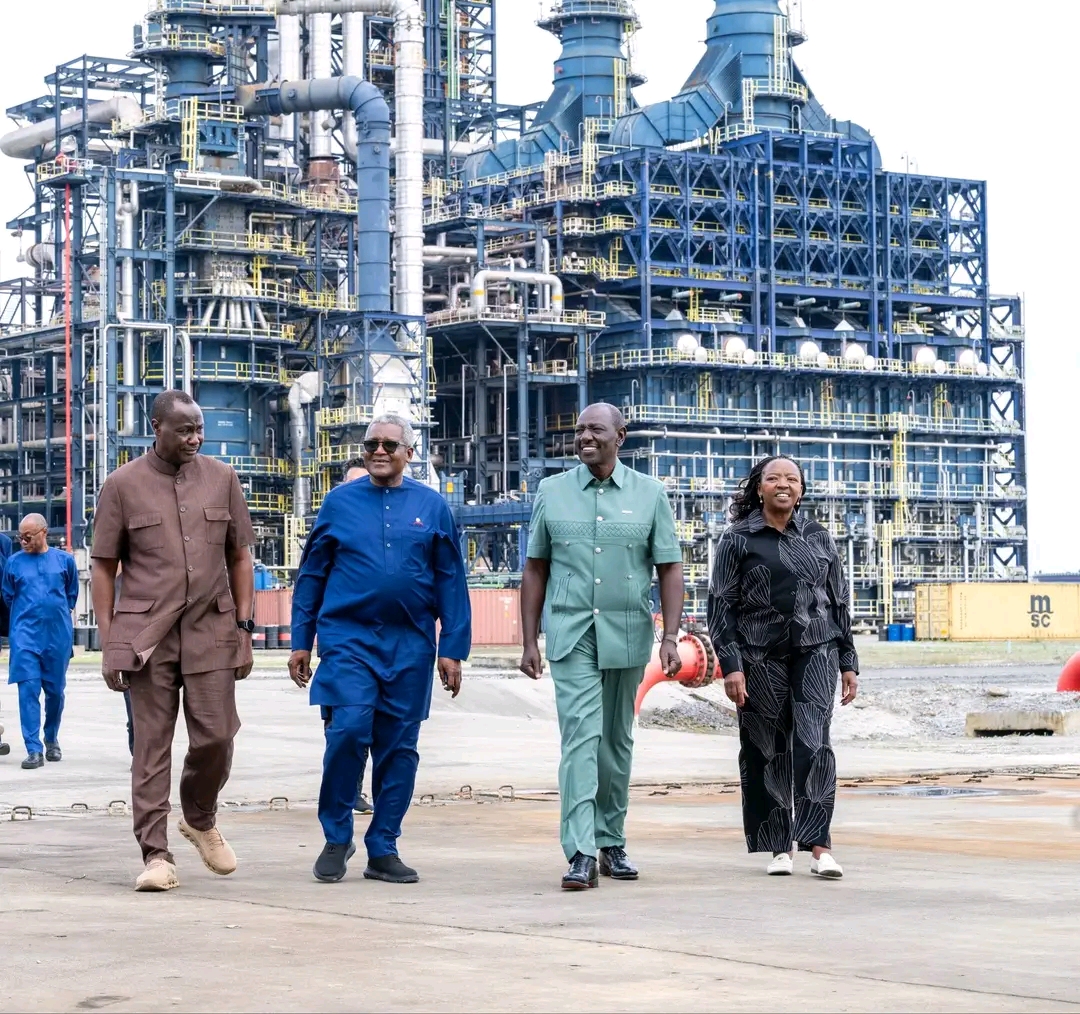
The headline writes itself: a Nigerian billionaire breaks ground on a $16 billion refinery in Kenya, months after his Lagos mega-refinery upended global fuel markets. The numbers are staggering, the ambition almost implausible. But the real story of Aliko Dangote’s pan-African expansion is not the size of the latest bet. It is the sequence.
Look at the order in which Dangote built. Cement plants in Tanzania, Ethiopia, Zambia, and Senegal. A $2.5 billion fertiliser complex in Nigeria. The 650,000 barrel-per-day Lagos refinery. Now, the Lamu project and a $660 million pipeline linking Djibouti to Ethiopia . Each step was larger, riskier, and more complex than the last. This is not a scattergun portfolio. It is a ladder, climbed deliberately, one rung at a time.
The cement phase taught Dangote how to build, finance, and operate heavy industry across different regulatory environments. Cement is a commodity with proven technology and predictable demand—a product Africa needed in volume, where execution mattered more than invention . By the time he moved to fertiliser, he had learned how to manage cross-border logistics and navigate African governments. The fertiliser plant, with its three million metric tonnes of annual urea capacity, was a bet on agriculture, but also a bet on his own operational maturation .
Then came the refinery. The Lagos facility, now processing 650,000 barrels per day, was the leap that changed Dangote’s trajectory from regional industrialist to global energy player . Its reported net income of $4.7 billion in the first nine months of 2026 explains why his fortune has swelled to nearly $40 billion . But more importantly, the Lagos build gave him something no amount of cement money could buy: experience in executing a project at a scale that terrifies most investors.
That experience is now being exported. Dangote himself has said the Lamu estimate came down from $17 billion to roughly $16 billion partly because of lessons from Lagos . The Kenyan project, scheduled for completion around 2030, will process 700,000 barrels per day and generate up to 1,000 megawatts of electricity . It is the same playbook, applied to a new country with new regulators and new communities.
But the refinery is only half the strategy. Around the production assets, Dangote is assembling the infrastructure that controls the route from plant to customer: storage tanks, pipelines, and a stake in Kenya’s national pipeline company. The Djibouti-Ethiopia pipeline, a 120-kilometer link with over one million cubic meters of combined storage, is a case study in this logic . Ethiopia, landlocked and dependent on trucking for fuel, currently spends five days moving product from port to capital. The pipeline aims to cut that to one . Production is power. Logistics is control.
This is where the Dangote model diverges from the extractive logic that has defined too much of Africa’s relationship with its own resources. For decades, the continent exported crude and imported refined product, exported raw commodities and imported finished goods. Dangote’s stated ambition—to break that pattern—is not merely rhetorical . The Lagos refinery already produces Euro-V petrol, meeting quality standards that were previously the exclusive province of imports . The fertiliser plant exports to the United States, Brazil, and India . The direction of trade is being reversed, incrementally.
None of this is guaranteed. The Lamu refinery faces a land dispute that was before a Kenyan court at the time of the groundbreaking . Financing must still be secured. Crude supply and power arrangements remain open questions. Announced is not completed, and Dangote’s own track record, while impressive, does not immunize him from the risks of operating in a new jurisdiction with unfamiliar politics and legal systems. The Lagos success is the reason to take Lamu seriously. It is not a guarantee.
For the broader African industrial project, however, the specific fate of Lamu matters less than the template it represents. The Dangote ladder is not a strategy reserved for billionaires. It is a logic that any ambitious African enterprise can study: start with something you can execute, prove you can operate it, then take the next larger step. Build the logistics that protect your margin. Learn the regulators before you need their permission. Nobody starts at $16 billion.
The AfCFTA, Africa’s continental free trade agreement, has been celebrated for opening markets. But markets without production are just consumption. What the continent needs is not more trade agreements but more producers capable of climbing their own ladders. Dangote’s sequence—cement, fertiliser, refinery, pipeline—is one such climb. It is not the only possible path, and it is not without its blind spots. But it is a demonstration that the ladder exists.
The ambition looks sudden from the outside. From the inside, it is just the next rung.
Andrew Mwangura is a commentator on Maritime Affairs, African political economy and industrial policy. The views expressed are the author’s own.