


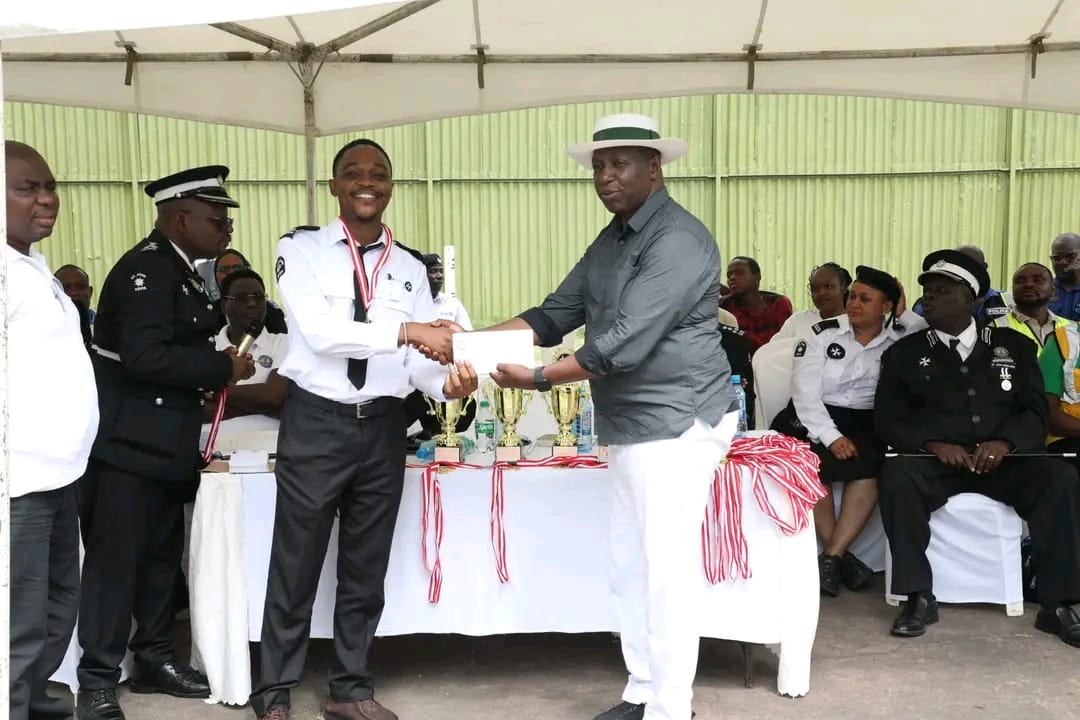
In the high-stakes environment of East Africa’s premier port—where containers move by the tens of thousands daily and human lives intersect with heavy machinery, hazardous cargo, and complex logistics—preparedness is not a slogan. It is operational insurance. The Kenya Ports Authority’s successful hosting of the 2026 Mombasa Regional Adults and Links First Aid Competitions at Mbaraki Sports Club is therefore more than an internal sporting event. It is a deliberate investment in the human infrastructure that keeps the Port of Mombasa—and, by extension, regional trade—functioning when things go wrong.
Twelve teams drawn from Mombasa, Lamu, and the Inland Container Depot Nairobi gathered to test knowledge, practical skills, teamwork, and emergency response under competitive pressure. The results were telling. Mombasa Division dominated the adult categories: Team L (Flavian Mwambi and Patrick Ngumbao) took the male title with 146 points, while Team Q (Sharlet Halima and Lola Nekesa) claimed the female crown with 145 points. Team K from ICD Nairobi edged the mixed category with 144 points. For the first time in the region, a Links category was contested, and Team D (Hope Wekesa and Lilian Tawa) emerged winners with 124 points. In the drill competition, Division 10 (Security) narrowly prevailed over Division 1 (Fire Services) with 175 points to 171, while Daniel Ubo Marura was named best drill commander. These winners now advance to the National Adults and Links First Aid and Drill Competitions on 13 and 14 November 2026 at the GSU Campus in Nairobi.
Dr. Gome Lenga, KPA’s Manager of Medical Services, rightly commended the improved standards of performance and underlined the centrality of teamwork and preparedness in workplace emergency response and humanitarian assistance. He also acknowledged the patronage of CEO Capt. William Ruto in advancing the objectives of the St. John Ambulance movement. That institutional support is not incidental. Ports are inherently high-risk workplaces. The combination of heavy-lift equipment, confined spaces, chemical and oil cargoes, vessel movements, and shift work creates scenarios in which minutes determine outcomes. A workforce trained to stabilise casualties, manage scenes, and coordinate with professional responders reduces both human suffering and operational downtime.
The inclusion of the Links category is particularly significant. It signals an intentional effort to cultivate the next generation of responders within the organisation. Safety culture is not transmitted solely through policy documents or annual drills; it is built by embedding practical competence across age groups and departments. When Security outperforms Fire Services in a tightly contested drill competition, it also illustrates healthy inter-divisional rivalry that sharpens collective capability rather than siloing expertise.
KPA’s track record with St. John Ambulance competitions is well established. The Authority has previously claimed national honours, including best overall drill team and strong showings in mixed categories. Continuity matters. Competitions create measurable benchmarks, force participants to rehearse under observation, and generate institutional memory that pure classroom training cannot replicate. They also foster the soft skills—clear communication under stress, decisive leadership, mutual trust—that determine whether a response succeeds or fragments.
Critics might dismiss such events as ceremonial or resource-intensive. That view underestimates the cost of unpreparedness. An industrial incident at a major port can cascade: injury to workers, disruption of vessel schedules, reputational damage to the gateway that serves landlocked neighbours, and potential environmental consequences. Investing in first-aid competence is cheaper and more humane than managing the aftermath of preventable failures. Moreover, the skills acquired travel beyond the workplace. Employees trained to respond effectively become community assets in a country where emergency medical services remain unevenly distributed.
Capt. Ruto’s support for the St. John movement aligns with a broader leadership posture that treats safety and operational excellence as inseparable. Modern ports compete not only on berth depth and digital systems but on reliability. Reliability includes the ability to manage contingencies without prolonged paralysis. A safety-conscious workforce equipped with practical skills and the confidence to act is a strategic asset in that competition.
The regional competition’s success should therefore be read as more than a local achievement. It is evidence of a culture that takes emergency preparedness seriously enough to test it publicly, to celebrate excellence, and to send its best teams to the national stage. As those teams prepare for Nairobi later this month, the real prize is not the trophy. It is the quieter assurance that, when the next emergency arrives at the Port of Mombasa or its associated facilities, someone nearby will know what to do—and will have practised doing it under pressure.
In an industry measured by throughput and turnaround times, the human capacity to protect life and restore order after disruption remains the ultimate measure of institutional maturity. KPA’s continued investment in that capacity deserves recognition and emulation.
Andrew Mwangura is a maritime safety and security analyst.