


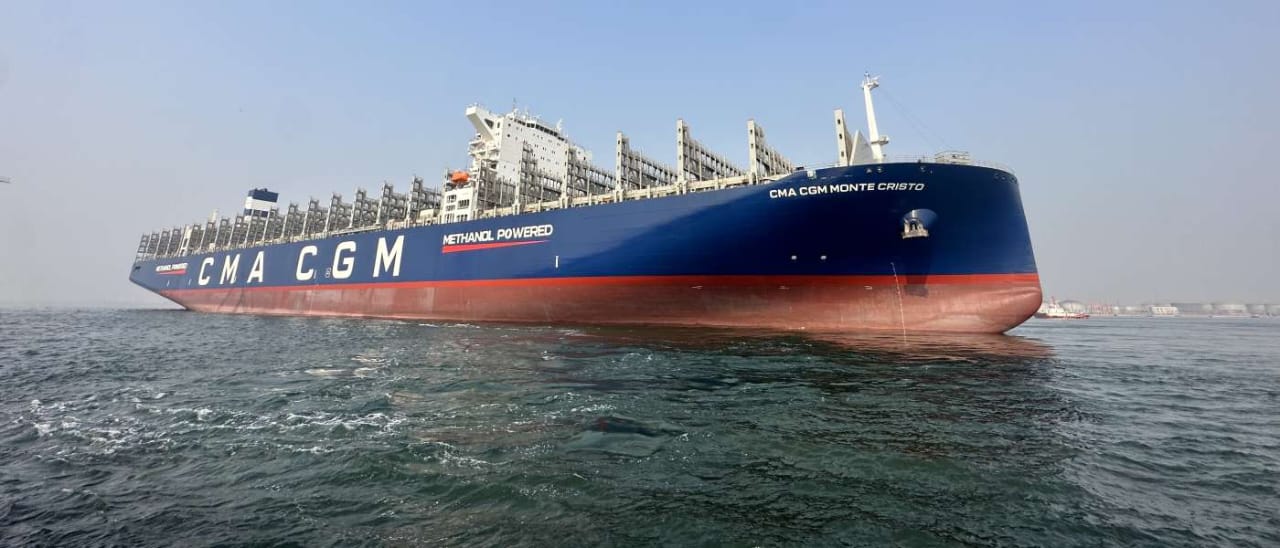
In the hierarchy of global container shipping, Mediterranean Shipping Company (MSC) sits unchallenged at the top. As of early November 2026, Alphaliner data put MSC’s operated fleet at roughly 7.48 million TEU—more than 21% of the world liner fleet—across over 1,000 ships. Far behind, the real contest is for second place. A.P. Moller-Maersk holds the position with about 4.71 million TEU (roughly 13.6%), while France’s CMA CGM Group trails closely at approximately 4.48 million TEU (12.9%). The gap has narrowed to roughly 230,000 TEU.
CMA CGM Chairman and CEO Rodolphe Saadé has been explicit: the group aims to become the world’s second-largest container carrier by the end of 2027. Maersk CEO Vincent Clerc, by contrast, has framed recent newbuilding orders as a measured “first step” in fleet expansion rather than a pure ranking play. Both carriers are ordering aggressively. Maersk’s confirmed 2026 programmes already cover dozens of vessels—including 26 ships of around 18,600 TEU scheduled for 2029–2030, totaling more than 630,000 TEU—with market reports linking the company to further 24,000-TEU megamax projects. CMA CGM maintains a substantial orderbook of its own and posted the strongest capacity growth among the top ten carriers in the first half of 2026, adding roughly 235,500 TEU.
Existing construction programmes, charter decisions, vessel withdrawals, and delivery schedules will shape the 2027 ranking. The latest investments will influence the competitive balance toward 2030 and determine how long either carrier can hold or seize an advantage. Yet the contest is far broader than nominal TEU totals. It extends into terminals, logistics networks, network design, and the ability to convert scale into reliable service and sustained earnings.
Diverging Strategies
MSC’s rise to dominance reflected a long, opportunistic campaign of newbuildings and second-hand acquisitions. Maersk and CMA CGM are responding from different starting points and with different philosophies.
Maersk spent years emphasizing integrated logistics, disciplined capacity management, and a shift away from pure volume leadership. Its recent ordering surge—after a period of relative restraint—signals a recognition that competitive scale still matters on the water, particularly as alliances reconfigure and the industry transitions to lower-emission fuels, with LNG dual-fuel and methanol-capable ships featuring prominently. Clerc and other Maersk executives have repeatedly stressed profitability and market-share stability over chasing the absolute top ranking. Industry observers note that Maersk deliberately allowed MSC to pull ahead years ago and has not treated second place as an existential prize.
CMA CGM, under Saadé, has pursued a more expansionist path. It has grown faster in recent periods, invested heavily in large vessels—including its own 24,000-TEU LNG-powered flagships such as CMA CGM Notre Dame—and continued building out terminals, logistics, and related capabilities. The public target of second place by end-2027 is both a statement of ambition and a rallying point for the organization. CMA CGM’s orderbook has at times appeared larger relative to its current fleet than Maersk’s, giving it a clearer arithmetic path to closing the remaining gap—if deliveries proceed on schedule and Maersk does not accelerate further.
Both carriers understand that raw fleet size is only half the equation. Unit slot costs fall with larger, more efficient vessels, but those savings materialize only if ships can be productively deployed. Port access, terminal productivity, hinterland connectivity, and schedule reliability determine whether investment translates into cargo volumes and earnings. A 24,000-TEU megamax that cannot be discharged and reloaded efficiently simply creates expensive congestion.
The Landside Constraint
Several voices in the industry have correctly highlighted the landside bottleneck. Deploying ultra-large vessels only expands real margin if terminals can handle the discharge surges. When 10,000-plus TEU hit a terminal in a short window, quay gridlock, yard congestion, and documentation delays quickly erode the economics of scale. The carrier that ultimately secures or holds second place will likely be the one that pairs fleet growth with controlled hubs, high container velocity, and reliable gate turns. Terminal ownership or preferential access, inland logistics networks, and digital coordination matter as much as shipyard contracts.
Chartering dynamics also remain relevant. Maersk has historically relied more heavily on chartered tonnage in certain periods, while CMA CGM has built a stronger owned-capacity position. Charter decisions, redelivery options, and the ability to flex capacity in a softening or oversupplied market will influence short-term rankings and longer-term resilience.
Industry Context and Risks
The race is unfolding against a backdrop of elevated orderbooks industry-wide. The global containership orderbook has hovered near or above 40% of the existing fleet in recent snapshots—levels not seen since the late 2000s. Deliveries concentrated in the late 2020s risk creating surplus capacity if demand growth moderates. Freight rates and earnings have recovered in phases, but the industry’s history is one of boom-bust cycles in which excess tonnage destroys returns for everyone.
Shippers and traders, meanwhile, continue to voice frustration with surcharges, ancillary fees, and service reliability. Carriers argue that higher charges recover costs incurred during disruptions and fund the transition to cleaner fuels and more resilient networks. The ethical and commercial debate is real: sustained high profitability for carriers alongside persistent friction for cargo interests is not a stable equilibrium. Ranking ambition that prioritizes scale without corresponding improvements in service quality risks amplifying that tension.
Environmental regulation and fuel strategy add another layer. Both Maersk and CMA CGM are ordering dual-fuel vessels capable of running on LNG or methanol. The winner of the capacity race will also need to navigate fuel availability, bunkering infrastructure, and the evolving carbon-pricing landscape. First-mover advantages in alternative fuels can become stranded costs if technology or regulation shifts.
What Actually Matters
Being second or third is not inherently more valuable than running a profitable, resilient network that grows with the market. Ranking provides branding, negotiating leverage with ports and customers, and internal motivation. It does not automatically deliver superior returns. Maersk’s leadership has long argued that the goal is sustainable profitability and the ability to keep and grow market share intelligently. CMA CGM’s public ambition is clearer on the ranking metric itself.
The next 12–24 months will be decided less by who announces the next order and more by who executes: timely deliveries, effective deployment of new tonnage, terminal performance, network design that matches cargo flows, and the commercial discipline to protect margins when capacity arrives faster than demand. Existing orderbooks and charter portfolios already in the pipeline will determine much of the 2027 ranking. The megamax programmes now under discussion or negotiation will shape the picture into the early 2030s.
Fleet scale creates optionality. Port access, network efficiency, and dependable service will determine how effectively that investment converts into volumes and sustained earnings. In that sense, the battle for second place is real—and it is being fought on more fronts than TEU tables alone can capture. The carrier that best integrates ocean capacity with landside execution is the one most likely to turn ranking ambition into durable competitive advantage.