


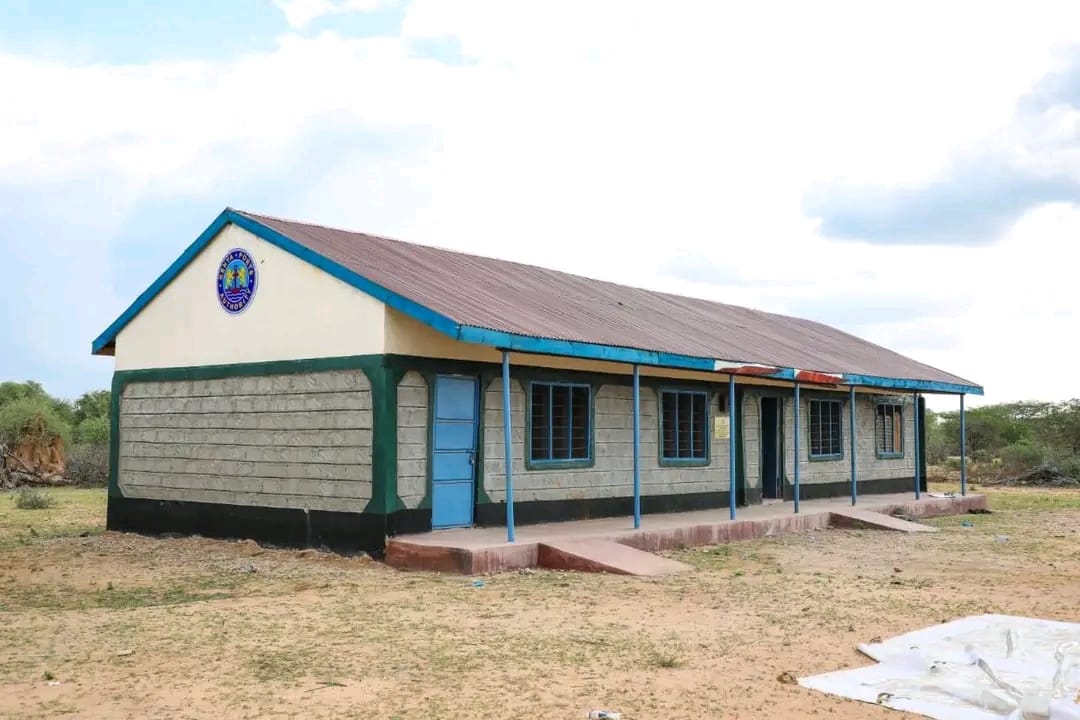
In the arid expanses of Wajir South, near the Kenya-Somalia border, something ordinary yet profound is taking shape. The Kenya Ports Authority (KPA) has constructed and handed over two new classrooms at Mathabaqay Primary School, delivered three additional classrooms at Bilimarado Primary School, and broken ground on another at Elmadagol Primary School. These are not grand flagship projects with ribbon-cutting fanfare designed for national headlines. They are practical interventions addressing a basic, stubborn deficit: enough physical space for children to learn.
The Authority frames this work under its long-running Tunahusika Corporate Social Investment programme. Board Director Hon. Ahmed Ali Muktar stated the obvious and the essential: every child, regardless of geography or background, deserves a conducive learning environment. The projects, he said, support the government’s development agenda with particular attention to arid and semi-arid lands. The language is familiar corporate social responsibility phrasing. The geography is not. Wajir South is far from the Port of Mombasa, the Authority’s commercial heartland. That distance is precisely why the gesture matters.
Kenya’s education system still carries deep spatial inequalities. In northern counties, permanent classrooms remain scarce. Learners continue to study under trees or in overcrowded, makeshift structures. Teacher shortages, water scarcity, and long distances compound the problem. Senate debates and county assessments have repeatedly flagged these conditions as unacceptable. Infrastructure is not the only variable that determines learning outcomes, but the absence of basic shelter for teaching and learning is a hard ceiling. When children sit in dust or under the open sky, concentration, attendance, and retention suffer. Classrooms do not guarantee a quality education, yet without them the rest of the system struggles to function.
KPA’s Tunahusika programme has operated for more than two decades. The Authority allocates a share of its profits—historically around two percent—to community needs, with education and health receiving the bulk of the allocation. Over the years, the programme has delivered classrooms, laboratories, dormitories, and medical camps across coastal counties and increasingly further inland. Recent activity in Wajir includes earlier handovers at Marothiley Primary and inspection visits to other sites such as Dardar and Ibrahim Ure. The pattern is consistent: identify infrastructure gaps in underserved areas, build, hand over, and move on.
This approach has strengths. It is tangible. A completed classroom is measurable in a way that many development interventions are not. It also demonstrates that a state corporation whose primary mandate is ports and logistics can choose to project its social licence beyond its immediate host communities of Mombasa, Lamu, or Kisumu. In an era when many institutions talk about equity, KPA is putting concrete and roofing sheets into places that rarely receive such attention from coastal-based institutions.
Yet the limitations are equally clear. Corporate social investment of this scale is necessarily selective and episodic. Three schools in Wajir South do not transform the county’s education landscape. Sustainability after handover depends on county and national education budgets, teacher deployment, water supply, and community ownership—variables outside KPA’s control. Without complementary investments in textbooks, teacher training, feeding programmes, or digital resources, new walls can become underutilised shells. There is also the question of coordination. Multiple actors—national government, county governments, NGOs, and other corporates—operate in the same space. Fragmented efforts risk duplication or gaps that no single actor fills.
More fundamentally, infrastructure alone does not close the opportunity gap. Historical marginalisation, insecurity, pastoralist mobility patterns, and limited economic opportunity shape educational trajectories in northern Kenya. A classroom in Mathabaqay improves the daily experience of the children who attend. It does not, by itself, alter the structural forces that determine whether those children complete primary school, transition to secondary, or find pathways beyond subsistence. Celebrating the classrooms is necessary; treating them as sufficient would be a category error.
Still, the symbolic and practical value should not be dismissed. When a major public corporation with national reach chooses to invest in the most peripheral primary schools, it signals that these children are visible. For communities that have long felt peripheral to national development narratives, that visibility carries weight. The closing line of the Authority’s own post captures the principle cleanly: where a child begins their education should never determine how far they can go. The statement is aspirational. The classrooms are a modest, concrete step toward making it less false.
The test of such programmes is not the press release on the day of handover. It is whether the structures remain functional five years later, whether enrolment and attendance improve, and whether the Authority and its partners continue to show up in the same places with the same consistency. Equity in education will require far more than corporate classrooms. It will also require fewer institutions deciding that arid counties are someone else’s problem. On that narrower measure, KPA’s work in Wajir South is worth noting—and worth watching.