


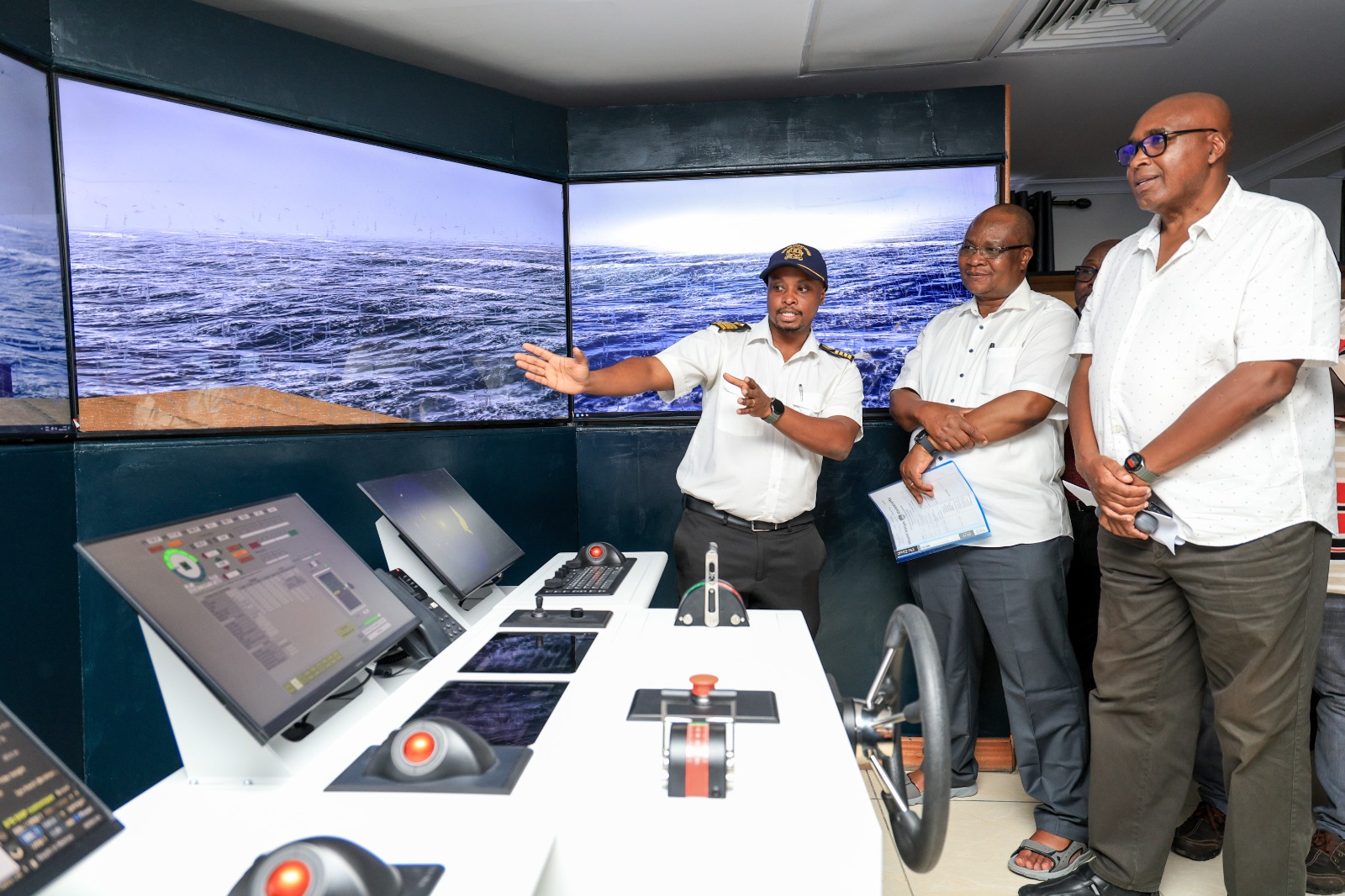
When delegates from Germany, Ghana, Nigeria, Ethiopia, Rwanda, Tunisia, Benin and Kenya walked into Mount Kenya University’s Maritime Academy in Malindi earlier this week, they encountered more than a campus tour. They saw a working model of how African universities can convert education into employable skills for one of the continent’s most promising economic frontiers: the Blue Economy.
The visit formed part of the ACCESS IDEAS Summer School 2026, hosted by MKU. ACCESS—the African Centre for Career Enhancement and Skills Support—is a DAAD-supported consortium led by Leipzig University that links African higher education institutions with practical pathways to graduate employability. The Malindi stop was deliberate. It showcased how specialised infrastructure, industry-aligned training and international collaboration can prepare young Africans for careers at sea and in the broader ocean economy.
A Simulator That Changes the Equation
At the centre of the demonstration stood the Wärtsilä NTPro 6.0 Full Mission Bridge Simulator. This high-fidelity system—the only one of its kind in a teaching university in Kenya and the region—immerses trainees in realistic ship navigation and bridge operations through wide-angle visual projections and integrated controls. It costs roughly Sh30 million and allows learners to practise navigation, collision avoidance, emergency response and vessel handling under varying sea and weather conditions without leaving dry land. For a sector where sea-time experience remains a major bottleneck to certification, such technology is transformative.
Prof. Peter Kirira, MKU’s Deputy Vice-Chancellor for Administration, Planning and Institutional Advancement, captured the larger point: universities must move beyond classroom instruction to build industry partnerships and practical projects that translate learning into jobs. Prof. Utz Dornberger, ACCESS Project Lead from Leipzig University, praised both the investment in infrastructure and MKU’s willingness to open its facilities to aspiring seafarers beyond its own student body. These are not polite diplomatic remarks. They point to a necessary shift in how African higher education approaches high-skill, high-demand sectors.
The Opportunity and the Bottleneck
Kenya and East Africa sit on significant Blue Economy potential. Sustainable ocean industries could add hundreds of billions of shillings to GDP and create tens of thousands of jobs in coastal counties. Globally, the shipping industry faces a shortage of officers, and African nations that produce competent, internationally certified seafarers stand to capture a meaningful share of that labour market.
Yet the region continues to underperform. Training capacity is limited, equipment is often outdated, qualified marine instructors remain scarce, and the critical requirement of sea-time experience is difficult and expensive to obtain. Many graduates stall before earning full Certificates of Competency because they cannot secure the necessary months onboard vessels.
In this context, MKU’s approach is instructive. The university has invested in modern simulation technology that meets international standards, aligned its programmes with STCW requirements, and positioned the academy as a regional resource rather than a closed institutional asset. It has also pursued partnerships, including with institutions such as the Abu Dhabi Maritime Academy. The ACCESS network adds another layer: structured international collaboration focused explicitly on employability, university-business linkages and skills that employers actually need.
This combination—specialised facilities, openness to external trainees, and embedded international partnerships—addresses several classic weaknesses in African maritime education simultaneously. Simulation reduces the cost and risk of early practical training. Sharing infrastructure improves utilisation rates and broadens access. Partnerships with European and African institutions create pathways for knowledge transfer, curriculum development and eventual job placement.
Lessons Beyond Maritime Training
The significance of the Malindi visit extends past seafaring. ACCESS itself focuses on graduate employability across disciplines, with particular attention to innovation, entrepreneurship and scaling micro, small and medium enterprises in line with SDG 9. The summer school’s broader programme emphasised co-creating practical solutions with industry and community partners. The maritime academy visit simply made the principle concrete: specialised, technology-enabled, partnership-driven education produces different outcomes from traditional lecture-based models.
African universities face persistent criticism that they produce graduates who struggle to find relevant work. In sectors with clear global demand and relatively high barriers to entry—maritime, specialised logistics, certain technical trades—the gap between classroom and workplace is especially costly. Institutions that close that gap through deliberate investment and collaboration will differentiate themselves. Those that continue to treat practical training as an afterthought will keep graduating students into saturated local markets while high-value international opportunities go elsewhere.
There are limits, of course. A single simulator does not solve the sea-time problem. Regulatory recognition, quality assurance by the Kenya Maritime Authority, sustained funding for maintenance and instructor development, and formal placement agreements with shipping lines all remain essential. Scaling the model across more institutions will require public investment, smarter public-private partnerships, and policy coherence that treats maritime skills as strategic human capital rather than a niche training programme. Kenya’s efforts to lower the cost of basic STCW courses and expand capacity at institutions such as Bandari Maritime Academy are steps in the right direction, but consistency and ambition matter more than isolated announcements.
A Practical Path Forward
The MKU example suggests a workable sequence. First, identify high-potential sectors where global demand exists and local training infrastructure lags. Second, make targeted capital investments in technology that delivers realistic practical experience at lower cost and risk than traditional methods. Third, design programmes to serve both the host institution’s students and a wider pool of aspiring professionals. Fourth, embed those programmes in international networks that provide quality benchmarks, curriculum support and eventual mobility opportunities. Fifth, measure success by employment outcomes and international certification rates, not merely enrolment numbers.
Other African universities do not need identical simulators. They need the underlying logic: treat employability as a core institutional responsibility, invest accordingly, and refuse to accept the separation between academic programmes and labour market realities. Governments can accelerate this by prioritising capital support for specialised training infrastructure, streamlining recognition of local certifications, and negotiating bilateral agreements that open sea-time and employment pathways for African cadets.
The Challenge Ahead
The delegates who visited Malindi this week left with a tangible demonstration that specialised maritime training is no longer the exclusive preserve of a few traditional maritime nations. From a coastal academy in Kenya, young Africans can now train on equipment comparable to that used in leading global centres. The remaining task is to convert that capability into sustained opportunity—through better policy, stronger industry linkages and a broader commitment across the higher education sector to connect skills with the global economy.
The Blue Economy will not wait for Africa to organise itself. Institutions that move first, invest intelligently and partner deliberately will position their graduates—and their countries—to claim a larger share of the value that ocean industries generate. MKU’s Maritime Academy has shown one viable route. The question is how many others will follow it.
Andrew Mwangura is a maritime affairs analyst and commentator on African shipping and Blue Economy issues.