


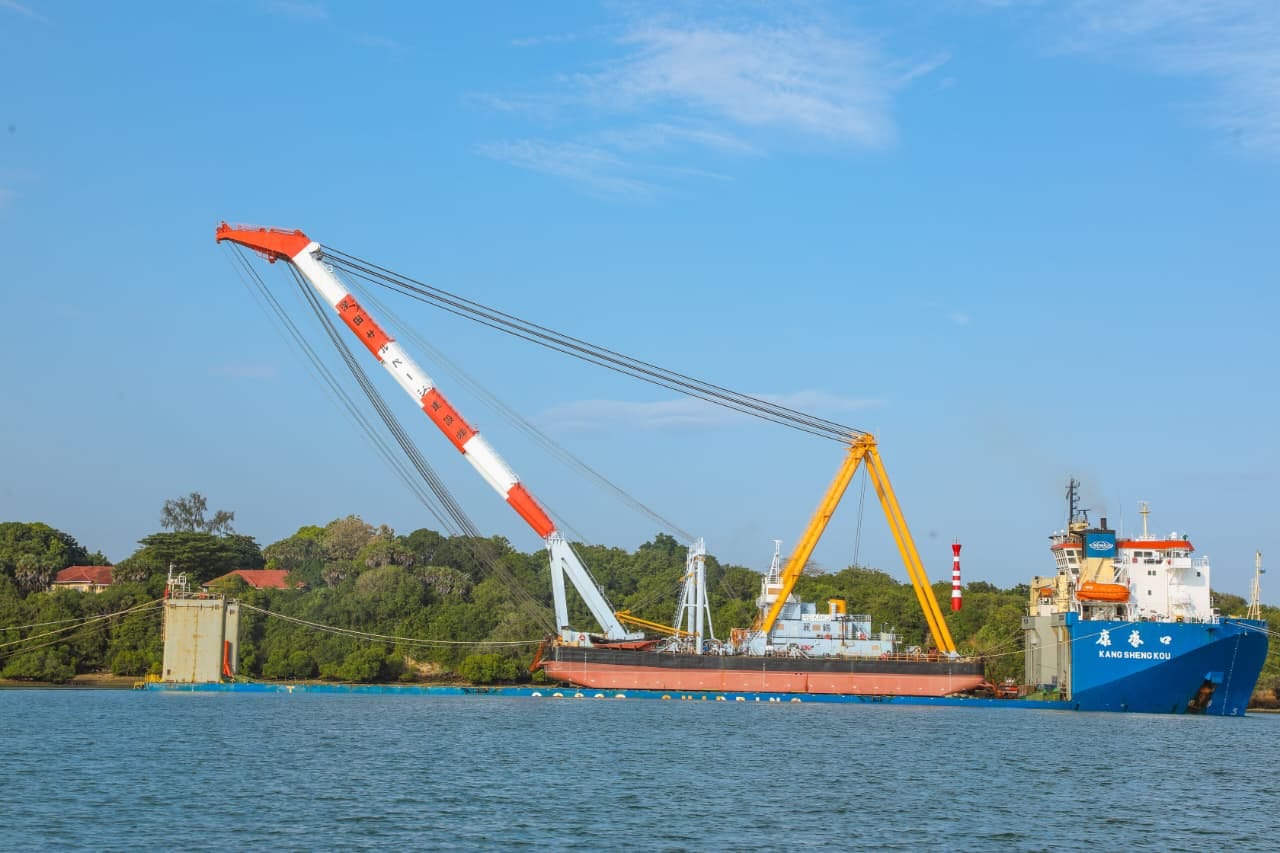
At approximately 0600 on Monday, the waterline began to rise around the Chinese-flagged MV Kang Sheng Kou in Kilindini Channel. To an untrained eye, it looked like a vessel in distress. In reality, the semi-submersible heavy-lift ship was executing one of modern maritime logistics’ more exacting manoeuvres: a Float-on/Float-off (FLO-FLO) discharge of a 3,613-metric-tonne crane-bearing barge.
Seawater flooded the ballast tanks. The 125-metre cargo deck descended. The barge, which had crossed oceans secured on the mother vessel, rose with the water until it floated free. The Kenya Ports Authority’s Azimuth Stern Drive tugs, Mwokozi II and Kiboko II, then took control, guiding the massive structure from the anchorage to Berth No. 1. The operation was clinical, coordinated, and largely invisible to the city that depends on this channel.
This was not routine container handling. It was specialised heavy-lift theatre, and it revealed more about the Port of Mombasa’s current capabilities—and its strategic posture—than a year’s worth of press releases.
Technical Mastery in Constrained Waters
FLO-FLO remains one of the most demanding techniques in the heavy-lift repertoire. A semi-submersible vessel deliberately reduces its freeboard through controlled ballasting until the cargo deck is submerged. The floating cargo is then released without the need for conventional cranes of extreme capacity. Success hinges on precise calculations of buoyancy, stability, residual free surface effect, and structural integrity after the load is transferred. Any miscalculation risks structural damage, grounding, or loss of control in confined waters.
Kilindini is no open roadstead. The channel is busy, the turning basins are constrained, and the commercial stakes are high. That KPA’s marine team—pilots, tug masters, and operations staff—could position two ASD tugs with the necessary bollard pull and manoeuvrability, maintain station, and complete the transfer without incident is a quiet demonstration of institutional competence. The same Mwokozi II that led this transfer was, within hours, involved in the successful re-floating of a grounded container vessel elsewhere in the approaches. Operational depth is not theoretical; it is tested under successive real pressures.
The Kang Sheng Kou itself (IMO 9223289, built 2003, operated by COSCO Shipping Specialized Carriers) is a workhorse of this niche. With a cargo deck of approximately 125 m by 36 m and substantial ballast capacity, she belongs to a relatively small global fleet capable of moving oversized floating structures across oceans. Her presence in Mombasa underscores a simple truth: certain categories of infrastructure cargo still require specialised foreign tonnage. Kenya does not yet operate its own semi-submersible heavy-lift capacity at this scale.
Modernisation Meets Capability
The timing is not coincidental. KPA is in the midst of a visible equipment modernisation drive. New ship-to-shore gantry cranes are arriving for Berth 16 and beyond; harbour mobile cranes and rubber-tyred gantries are being introduced at both Mombasa and Lamu; terminal tractors and reach stackers are being refreshed. Productivity targets—higher moves per hour, reduced vessel turnaround, capacity for larger ships—are explicit.
Yet new quay cranes address the vertical lift of containers. A 3,613-tonne crane-bearing barge addresses a different layer of the logistics stack: the ability to receive and position the very heavy equipment that builds and maintains ports, energy facilities, and industrial projects. FLO-FLO capability, even when executed with a foreign mother vessel, signals that the port can handle project cargo that conventional terminals cannot. In a region competing for industrial investment and energy infrastructure, that distinction matters.
East African ports are locked in a quiet contest for relevance. Dar es Salaam has expanded capacity; Lamu is being positioned as a northern corridor alternative; Djibouti and others continue to court transit cargo. Mombasa’s enduring advantage has been reliability and connectivity rather than sheer depth or length of quay. Demonstrating the ability to execute complex heavy-lift operations without disruption reinforces that reliability narrative.
The Deeper Currents
Three broader observations follow.
First, operational excellence is cumulative. Tugs with ASD propulsion, trained crews, precise coordination between marine and terminal teams, and a culture that treats non-standard cargo as solvable rather than exceptional do not appear overnight. They are the product of sustained investment in people and assets. The same assets that executed the FLO-FLO transfer also handle routine pilotage, emergency response, and salvage. Redundancy and versatility are competitive advantages that balance sheets rarely capture cleanly.
Second, dependence on specialised foreign tonnage is both pragmatic and revealing. COSCO’s specialised carriers move the world’s oversized cargo because the economics of owning such vessels are unforgiving for most national port authorities. There is no immediate requirement for KPA to acquire a semi-submersible of its own. There is, however, a longer-term question about whether East African states should develop deeper indigenous capability in project logistics—through regional cooperation, public-private partnerships, or targeted training pipelines—so that the next generation of energy, mining, and industrial projects can be served with less external friction.
Third, the narrative of “port modernisation” is incomplete if it focuses only on container throughput metrics. The ability to receive a crane-bearing barge via FLO-FLO is a form of soft power. It tells project developers, contractors, and financiers that Mombasa can handle the awkward, heavy, and time-sensitive cargo that accompanies large capital investment. In an era of nearshoring, energy transition infrastructure, and regional industrialisation, that signal carries weight.
A Harbour That Knows How to Take Over
The poetic image used by KPA—that of a mother vessel releasing her offspring—captures the drama. But the more enduring image is institutional: a port authority that can plan, resource, and execute a delicate multi-hour operation at dawn, then return the channel to normal commercial traffic without fanfare.
Some cargo cannot simply be lifted off a ship. Sometimes the ship must lower herself into the sea, and the harbour must be ready to take over. On Monday morning in Kilindini, the harbour was ready. The question now is whether that readiness will be treated as a one-off technical success or as evidence of a deeper operational culture worth protecting, expanding, and advertising to the region and the world.
The waterline rose. The barge floated free. The tugs took control. And Mombasa quietly demonstrated that it remains more than a container gateway. It is still a working harbour, capable of the difficult, specialised work that underpins the next phase of East African development.