


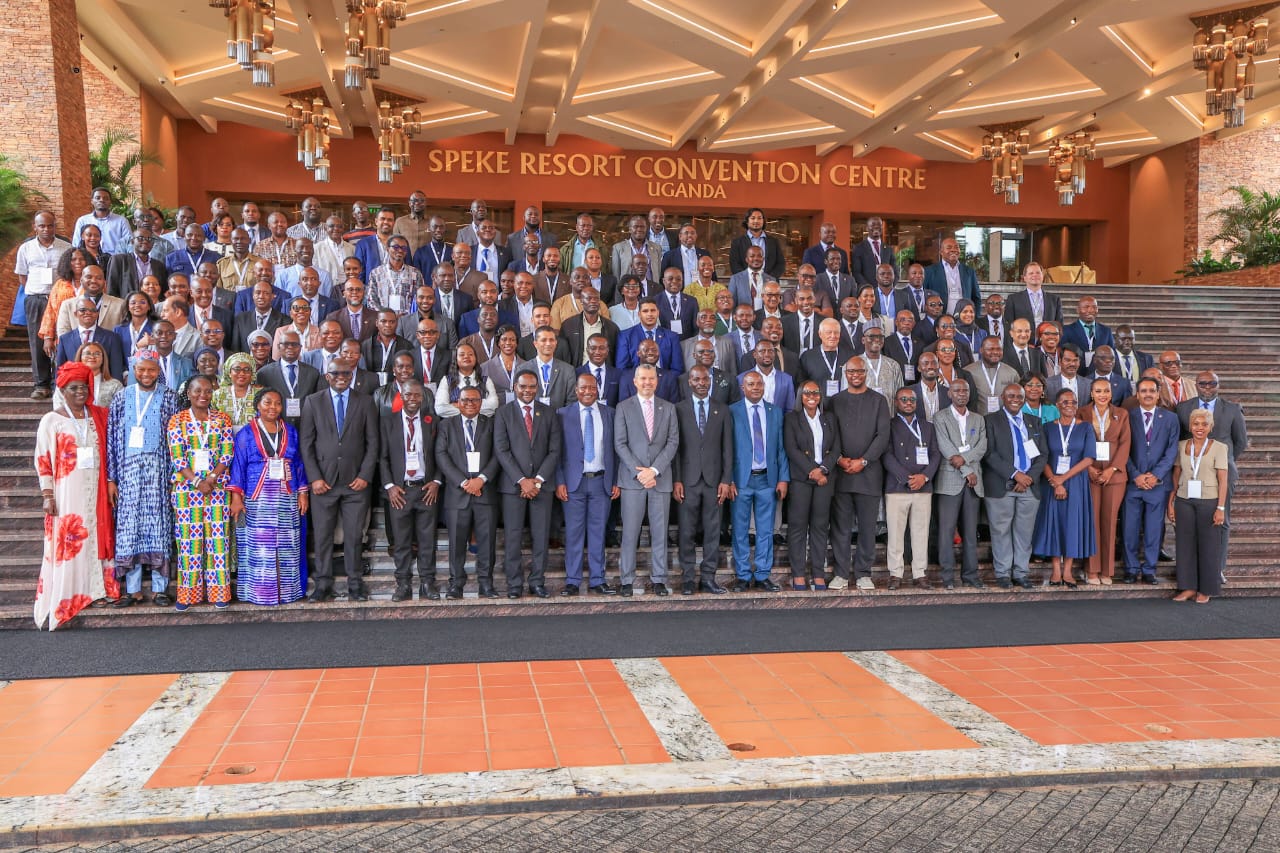
There is a particular kind of frustration that settles over maritime conferences in Africa after the closing plenary. The declarations are adopted, the resolutions circulated, the photographs taken. And then the delegates fly home, and the vessels that were promised remain on the drawing board while the cargo keeps moving by road—slowly, expensively, and with a carbon footprint that no amount of green rhetoric can offset. The Association of African Maritime Administrations’ 9th Annual Conference and General Assembly, held in association with the International Maritime Organisation, was, on the evidence, a more substantive affair than most. But the test of its value will be whether the operator’s perspective offered by Alex M. Mbonye, Director of East Africa Marine Transport, was heard as a diagnosis or merely absorbed as one more panel contribution .
His message was deceptively simple. Investment in African maritime transport is enabled by four things: a predictable regulatory environment, a pipeline of bankable projects, public-private partnership opportunities, and blended finance. This is not a novel formulation. It is, in fact, the standard vocabulary of infrastructure finance. What made it notable was the context in which it was delivered—by an operator who has actually built and launched a vessel on Lake Victoria, rather than a consultant describing what such an operator might theoretically require .
The Contradiction at the Heart of Africa’s Maritime Moment
Mbonye framed his remarks around a striking statistic: over 90 percent of Africa’s seaborne trade is transported by a handful of global ocean shipping lines . This is the central contradiction of the continent’s maritime economy. Africa is a growth market for global shipping—capacity into Sub-Saharan Africa has surged in recent years, with major carriers deploying larger vessels and new services to capture rising container volumes. Yet the value captured by African operators, African shipyards, and African crews remains marginal. The trade flows through African ports, but the assets that carry it are overwhelmingly foreign-owned, foreign-flagged, and foreign-crewed.
The logic of investing in African maritime transport is therefore not merely developmental. It is strategic. A continent that moves 90 percent of its trade on foreign hulls has ceded control of its own logistics chain to actors whose interests may not align with its own. The case for building regional shipping capacity—whether blue-water or inland—is a case for economic sovereignty as much as for efficiency.
But the case, however compelling, runs into the hard wall of bankability. And it is here that Mbonye’s four enabling conditions deserve closer scrutiny, because each of them is easier to state than to achieve.
Predictable Regulation: The Binding Constraint
Of the four conditions, the first is the most fundamental and the least discussed. A predictable regulatory environment is not simply a matter of having good laws on the books. It is a matter of those laws being applied consistently across borders, across political cycles, and across the multiple agencies that touch a vessel’s voyage.
Africa’s inland water transport is constrained, as Mbonye noted, by inadequate infrastructure and limited multimodal connectivity . But the deeper constraint is jurisdictional fragmentation. A ferry operating on Lake Victoria touches Uganda, Tanzania, and Kenya. It is subject to three sets of port procedures, three customs regimes, three safety inspection cultures, and three sets of fees that may or may not be transparently calculated. The vessel itself may be flagged in one jurisdiction, owned by a company registered in another, financed by a lender in a third, and crewed by nationals of all three. Each of these interfaces is a potential point of delay, dispute, or informal payment.
The AAMA process has recognized this. Prior assemblies have called for a sustainable financing framework for Africa’s maritime sector and welcomed concessional lending commitments . Kenya is now drafting a Maritime Investment Policy and Incentive Regime explicitly aimed at addressing high investment costs and inadequate financing mechanisms . These are necessary steps. But they remain national responses to a regional problem. The predictability that operators need is not predictability within a single country’s regulatory framework. It is predictability across the corridor.
The Pipeline Problem: Why Bankable Projects Are Rare
The second condition—a pipeline of bankable projects—is where the development finance community and the operator community often talk past each other. From a lender’s perspective, a bankable project has a clear revenue model, creditworthy counterparties, a proven technology, a credible sponsor, and a risk allocation that is transparent and enforceable. From an operator’s perspective, these requirements often feel like a demand to prove success before being given the opportunity to attempt it.
The M.V. Mpungu, EAMT’s flagship vessel, illustrates the challenge. The 96-meter roll-on/roll-off ferry was built at a purpose-built shipyard in Entebbe, certified by Bureau Veritas, and backed by private capital from InfraCo Africa and Grindrod, with EU-Africa Infrastructure Fund support during design . It cuts a journey that takes three to four days by road down to eighteen hours on water, carrying up to 21 laden trucks per sailing. The Blue Dot Network, which tracks bankable infrastructure, has recognized the project for its climate resilience and financial sustainability .
These are genuine achievements. But they are also the exception that proves the rule. The Mpungu required a confluence of favorable circumstances: a committed sponsor, a development finance institution willing to take early-stage risk, a technical partner with deep logistics experience, and a regulatory environment in Uganda and Tanzania that, while imperfect, was sufficiently permissive to allow the project to proceed. Replicating this across the continent requires a pipeline of similar projects, each with its own confluence of favorable circumstances. That is not a pipeline. It is a series of bespoke miracles.
Blended Finance and the PPP Illusion
The third and fourth conditions—PPP opportunities and blended finance—are where the rhetoric most frequently outruns the reality. Public-private partnerships are, in principle, an elegant solution to the infrastructure gap: the public sector provides the enabling environment and, where necessary, a revenue guarantee; the private sector provides capital and operational expertise; and the risk is allocated to the party best able to manage it. In practice, African PPPs are frequently delayed by procurement disputes, undermined by political changes, and complicated by the difficulty of enforcing contracts across jurisdictions.
Blended finance—the use of concessional capital to crowd in commercial investment—is similarly elegant in theory. In practice, it often functions as a subsidy that masks the underlying unbankability of a project, allowing a vessel to be launched without a clear path to commercial sustainability once the concessional layer is removed. The question that lenders and operators must answer together is not whether blended finance can get a project off the ground, but whether the project can stand on its own once the blending is done.
EAMT’s model offers a partial answer. The Mpungu’s value proposition does not depend on carbon credits or donor goodwill. It depends on a simple operational fact: a truck that arrives at Port Bell on Tuesday and rolls off at Mwanza on Wednesday morning has saved its operator a day and a half of driver wages, fuel, and border friction. That is a commercial value proposition that can survive the withdrawal of concessional support, provided the ferry shows up on time and the cargo materializes. The partnership with Grindrod, a logistics operator with over a century of experience, is an acknowledgment that operational excellence is as important as financial engineering .
What AAMA Should Do Next
The Kampala conference’s theme, “From Policy to Practice,” was aptly chosen. The policy architecture for African maritime financing has been discussed to the point of exhaustion. What is missing is a mechanism for translating the rhetoric of blended finance into actual term sheets.
Three practical steps would move the needle. First, AAMA member states should commit to harmonizing customs and port procedures for inland water freight corridors, beginning with Lake Victoria. A ferry that saves eighteen hours on the water but loses twelve hours to inconsistent documentation at either end delivers only marginal value. Second, the proposed AAMA-IMO joint action plan should prioritize a standardized project preparation facility for inland water projects—a small, specialized unit that can take a concept like EAMT and package it for development finance institutions without requiring each operator to reinvent the financial structuring wheel. Third, African pension funds and sovereign wealth funds should be explicitly engaged as potential debt providers for maritime assets with predictable revenue streams. The concessional lending commitments noted in AAMA resolutions are welcome, but they cannot carry the sector alone.
The Lake as Proving Ground
Lake Victoria is not the end goal. It is a proving ground. If the Mpungu and its peers demonstrate that scheduled inland freight services can be commercially viable, the model extends to Lake Tanganyika, the Congo River system, and the waterways of West Africa. If they fail—if the vessels sit idle because of regulatory friction, cargo uncertainty, or financing gaps—the lesson will be that Africa’s inland water potential is a mirage best left to donors and nostalgia.
The global shipping industry has already voted with its capacity: Africa is a growth market. The question now is whether African operators and African capital will participate in that growth, or whether the continent will continue to watch its trade pass through foreign hulls and foreign balance sheets. Mbonye’s four conditions are not a wish list. They are a checklist. The work of the next AAMA conference—and the next, and the next—should be to hold member states accountable for ticking them off.