


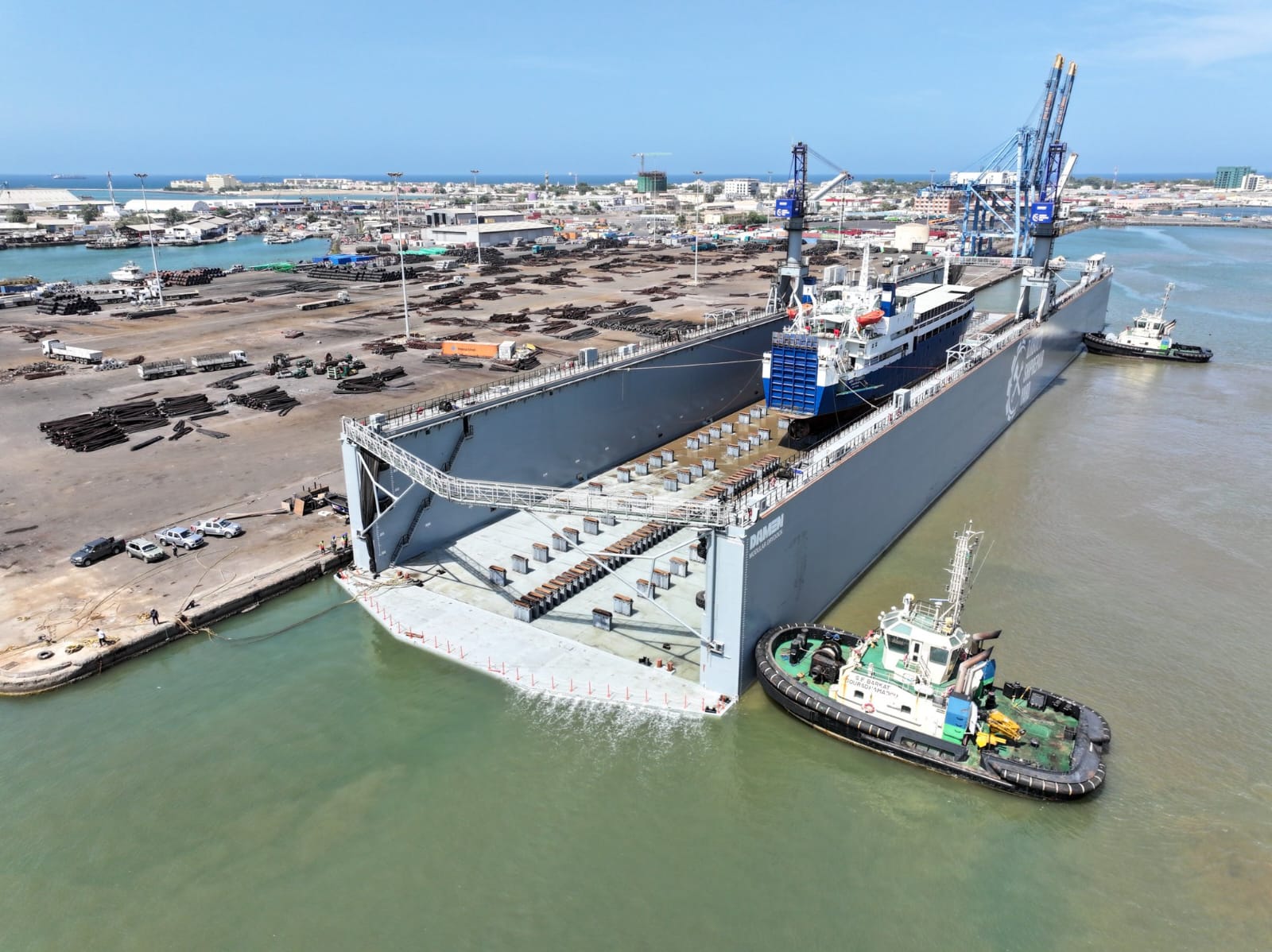
Djibouti formally inaugurated its Ship Repair Yard in early April 2026, which signals a decisive shift in the maritime balance of power along the western Indian Ocean and the Red Sea corridor.
For a region long defined by its strategic geography yet constrained by underdeveloped maritime infrastructure, the emergence of this yard as the largest and most capable ship repair facility in East Africa is a major development.
Developed in partnership with Damen Shipyards Group and financed by Invest International, the Djibouti Ship Repair Yard arrives with high credentials. Its floating dock—217 meters in length, 43 meters in width, with a lifting capacity exceeding 20,000 tons—instantly elevates it above anything currently available in East Africa.
Spread across 80 hectares with more than 800 meters of berth space, the yard is designed not merely as a repair facility but as a comprehensive maritime services hub, capable of handling large commercial vessels, including the containerships that navigate one of the world’s busiest sea lanes.
Its operational readiness, demonstrated by the docking of the 13,719 dwt containership Africa Sun as early as October 2025, underscores a crucial point: this is not a speculative investment awaiting demand, but a functioning enterprise already embedded in global shipping logistics. Djibouti has not just built capacity—it has timed its entry to coincide with a sustained surge in maritime traffic through the Red Sea and Gulf of Aden, corridors that connect Asia, Europe, and Africa in a continuous loop of trade.
Geography, of course, has always been Djibouti’s greatest asset. Situated at the mouth of the Red Sea, adjacent to the Bab el-Mandeb Strait, the country commands a chokepoint through which a significant portion of global commerce flows. Yet geography alone does not guarantee economic advantage.
What Djibouti has done—strategically and deliberately—is to convert location into capability. The ship repair yard is a logical extension of a broader national vision that has already seen the country invest heavily in ports, free zones, and logistics infrastructure. It is a classic case of value addition: capturing not just the passage of ships, but the services they require.
For East Africa, however, the implications are more sobering than celebratory. The region’s traditional maritime anchor, the Kenya Ports Authority, has long presided over the Port of Mombasa as the primary gateway to the hinterland markets of Uganda, Rwanda, South Sudan, and parts of the Democratic Republic of Congo. Yet in the critical area of ship repair and marine engineering, capacity has remained modest at best.
Facilities such as Kenya Shipyards Limited and legacy operators like African Marine have been constrained to handling vessels of roughly 4,000 tonnes and lengths not exceeding 150 meters. This limitation is not merely technical—it is strategic. It effectively excludes a vast segment of modern commercial shipping from being serviced within Kenyan waters.
The consequence is a quiet but persistent outflow of maritime revenue. Ships calling at East African ports for cargo operations must often sail elsewhere—sometimes as far as the Middle East or Southern Africa—for maintenance and repairs. Each such diversion represents lost income, lost jobs, and lost opportunities for skills development. With the commissioning of the Djibouti yard, that outflow will not only continue but accelerate, now redirected to a regional competitor that has positioned itself with precision.
It would be a mistake, however, to view Djibouti’s ascendancy as a threat alone. It is also a blueprint. The involvement of Damen Shipyards Group illustrates the importance of technical partnerships in bridging capacity gaps, while the role of Invest International highlights the necessity of innovative financing models for capital-intensive maritime infrastructure. These are lessons that countries like Kenya and Tanzania cannot afford to ignore.
In Mombasa, the conversation around ship repair has often been framed within the confines of incremental upgrades—expanding existing docks, rehabilitating aging facilities, or marginally increasing tonnage limits. What Djibouti demonstrates is that incrementalism is no longer sufficient. The scale of modern shipping demands step-change investments, not gradual adjustments. The global fleet has evolved; East Africa’s infrastructure must evolve with it.
There is also a broader economic dimension that deserves attention. Ship repair is not an isolated activity; it is a catalyst for an entire ecosystem. It drives demand for skilled labor—engineers, welders, electricians, naval architects—and stimulates ancillary industries ranging from steel fabrication to logistics and supply chain services. It anchors maritime clusters that can, over time, support shipbuilding, offshore services, and even renewable energy projects such as offshore wind installations. In this sense, the Djibouti yard is not just a facility but an industrial nucleus.
For a country like Kenya, with its ambitions of becoming a blue economy powerhouse, the absence of comparable infrastructure is increasingly difficult to justify. The narrative of the blue economy has often focused on fisheries, tourism, and port throughput, but these are only parts of a larger equation. Without robust marine engineering capabilities, the region risks remaining a consumer of maritime services rather than a producer.
The contrast with Djibouti is particularly striking because the latter has achieved this transformation despite having a far smaller domestic market. Its strategy has been outward-looking, targeting international shipping lines rather than relying on local demand. This export-oriented approach to maritime services is precisely what East Africa needs to embrace. The ships transiting the region are not East African; they are global assets seeking efficient, reliable, and competitively priced services. The question is not whether there is demand, but who is best positioned to capture it.
There is, of course, room for regional complementarity rather than zero-sum competition. Djibouti’s location at the northern gateway of the Red Sea does not diminish the importance of ports further south. Instead, it creates an opportunity for a networked maritime economy in which different hubs specialize and collaborate. But such a vision requires coordination, policy alignment, and, above all, investment.
The risk, if no action is taken, is that East Africa becomes increasingly peripheral in the higher-value segments of maritime trade. Ports may continue to handle cargo, but the more lucrative services—repairs, retrofits, conversions—will be performed elsewhere. Over time, this could erode the region’s strategic relevance, reducing it to a transit corridor rather than a value-adding hub.
Djibouti’s ship repair yard is, therefore, both an achievement and a challenge. It demonstrates what can be accomplished when vision, partnerships, and execution converge. It also exposes the gaps that persist in neighboring countries, particularly in terms of scale, technology, and strategic ambition. For policymakers, port authorities, and industry stakeholders across East Africa, the message is clear: the era of small-scale thinking in maritime infrastructure is over.
The ships passing through the Red Sea and the western Indian Ocean are getting larger, more complex, and more demanding. They require facilities that can match their scale and sophistication. Djibouti has stepped forward to meet that demand. The question now is whether the rest of East Africa will follow—or be left watching from the shoreline as the tide of maritime opportunity flows elsewhere.