


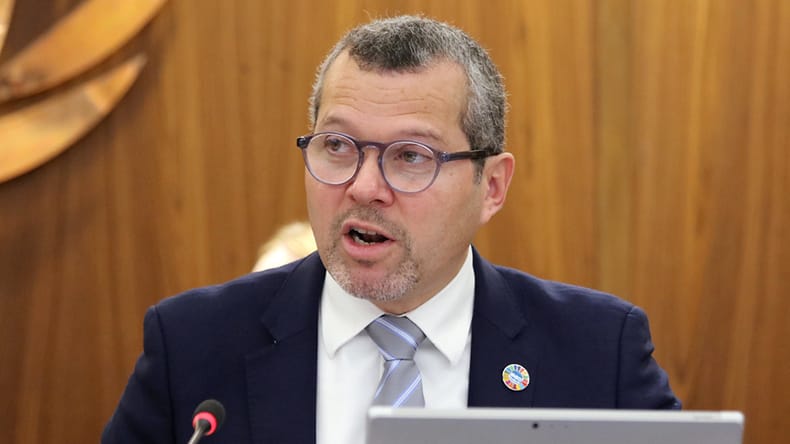
On Wednesday, the head of the International Maritime Organization stood before delegates in London and delivered a message that should alarm every government on Earth: the world’s most vital trade routes are becoming killing fields, and the victims are civilians.
IMO Secretary-General Arsenio Dominguez reported that since the Middle East conflict began on February 28, the organization has verified 80 attacks on international shipping in and around the Strait of Hormuz. At least 22 seafarers have been killed. Many more have been injured. And the numbers are climbing at a pace that should shock the conscience of the international community.
This is not a regional problem. It is a global one. And it demands a global response.
A Deteriorating Picture
The data tells a story of rapid, unrelenting escalation. On August 28 — six months into the crisis — the IMO had verified 70 attacks and 19 seafarer deaths around Hormuz. By September 15, just over two weeks later, those figures had risen to 80 confirmed incidents and at least 22 deaths. That is ten new attacks and three more dead sailors in roughly eighteen days.
Behind each statistic is a human being. The September 12 attack on the El Gaia left the vessel damaged and two seafarers missing. The Hercules Star was hit on September 9, killing one crew member. Two more were killed aboard the Sidr on August 31. These are not combatants. They are merchant mariners — the men and women who move the fuel, food, and goods that keep the global economy running.
The crisis extends far beyond Hormuz. In the Black Sea and Sea of Azov, the IMO reports dozens of fatalities from attacks on international shipping in recent months, though precise figures remain difficult to verify. In the Red Sea, violence has returned with deadly force: four seafarers were killed in the latest Houthi attack on a merchant vessel on August 11.
No Single Villain — and That’s the Point
Dominguez was careful to note that no single actor is responsible for the carnage. “In the Strait of Hormuz, it is not only one country attacking merchant vessels,” he said. “In the Black Sea and Sea of Azov, it is not only one country attacking merchant vessels.”
This is a critical observation. The threat to commercial shipping is not the product of one conflict or one belligerent. It is a systemic failure — a widening norm that merchant vessels and their crews are legitimate targets in wartime. That norm, once established, is extraordinarily difficult to reverse.
The consequences are already severe. The IMO reported in late August that as many as 400 ships carrying around 6,000 seafarers have been unable to safely depart the Persian Gulf since the conflict began. These are not abstract numbers. They represent thousands of people trapped in a war zone, unable to go home, unable to earn a living, and exposed to mortal danger every day they remain.
The Silent Crisis in Global Trade
The strategic implications are equally grave. The Strait of Hormuz is the world’s most important oil chokepoint. The Red Sea and Gulf of Aden are arteries of European-Asian trade. The Black Sea is a critical corridor for grain and agricultural exports. Disruption in any one of these waterways sends ripples through energy markets, commodity prices, and supply chains that reach every corner of the globe.
When shipping is threatened, insurance costs spike. When insurance costs spike, carriers reroute. When carriers reroute, delivery times lengthen and prices rise. The result is a slow, grinding inflation that hits consumers and businesses alike — a hidden tax imposed by those who would turn the sea into a battlefield.
The IMO Council recognized this in July, reaffirming that transit passage through straits used for international navigation must not be threatened, impeded, or suspended. It called for a coordinated return to unhindered navigation through the Strait of Hormuz. But since that reaffirmation, the situation has only worsened.
The Limits of the IMO’s Mandate
Dominguez is admirably clear-eyed about what the IMO can and cannot do. Resolving the underlying conflicts in the Middle East, the Black Sea, and the Red Sea falls outside the organization’s mandate. The IMO cannot negotiate ceasefires. It cannot deploy navies. It cannot impose sanctions.
What it can do is sound the alarm. And that is precisely what Dominguez did, urging member states to take the consequences for international shipping back to their governments and to the relevant United Nations bodies. “I call on you to share these impacts with the relevant bodies in your countries so that this can be dealt with within the United Nations, as appropriate,” he said.
This is a call for escalation — not of violence, but of attention. The security of international shipping is not a niche concern. It is a precondition for global stability. If the world’s governments do not treat it as such, the consequences will be borne not only by seafarers but by every person who depends on the goods and energy that move by sea.
What Must Be Done
The international community has several tools at its disposal, but they require political will to deploy.
First, the UN Security Council must treat attacks on merchant shipping as a threat to international peace and security, not merely a byproduct of regional conflicts. That means consistent condemnation, regardless of the perpetrator, and a willingness to impose consequences on those who target civilian vessels.
Second, naval coalitions operating in the region must prioritize the protection of commercial shipping and the safe evacuation of trapped vessels and crews. The 400 ships and 6,000 seafarers stranded in the Persian Gulf represent a humanitarian emergency that cannot wait for a political settlement.
Third, flag states and shipowners must be supported in implementing the best available protective measures, from convoy systems to enhanced onboard security. The IMO has offered to work with member states on technical and operational measures; that offer must be taken up with urgency.
Fourth, and perhaps most importantly, the norm that merchant shipping is off-limits in wartime must be vigorously defended. International humanitarian law is clear on this point. The deliberate targeting of civilian vessels and crews is a war crime. Those who commit such acts must be held accountable, whether they operate in the Strait of Hormuz, the Black Sea, or the Red Sea.
A Test of International Resolve
The attacks on international shipping represent a test of whether the international community can still uphold the most basic principles of maritime order. For centuries, the freedom of navigation has been a cornerstone of global prosperity. It is now under assault from multiple directions, and the institutions charged with protecting it are being tested as never before.
Dominguez’s warning is not alarmism. It is a measured, evidence-based assessment of a crisis that is deepening by the day. The question is whether governments will heed it — or whether they will wait until the body count rises higher, the supply chain disruptions grow more severe, and the trapped seafarers of the Persian Gulf become a permanent hostage population.
The sea belongs to all of us. It must not become a killing field. And the men and women who sail it — the invisible workforce that sustains modern life — deserve better than to be caught in the crossfire of conflicts they did not choose and cannot escape.
The IMO has done its job. Now it is time for the world’s governments to do theirs.
Andrew Mwangura is a Mombasa based maritime analyst specializing in maritime safety and security and international trade policy.