


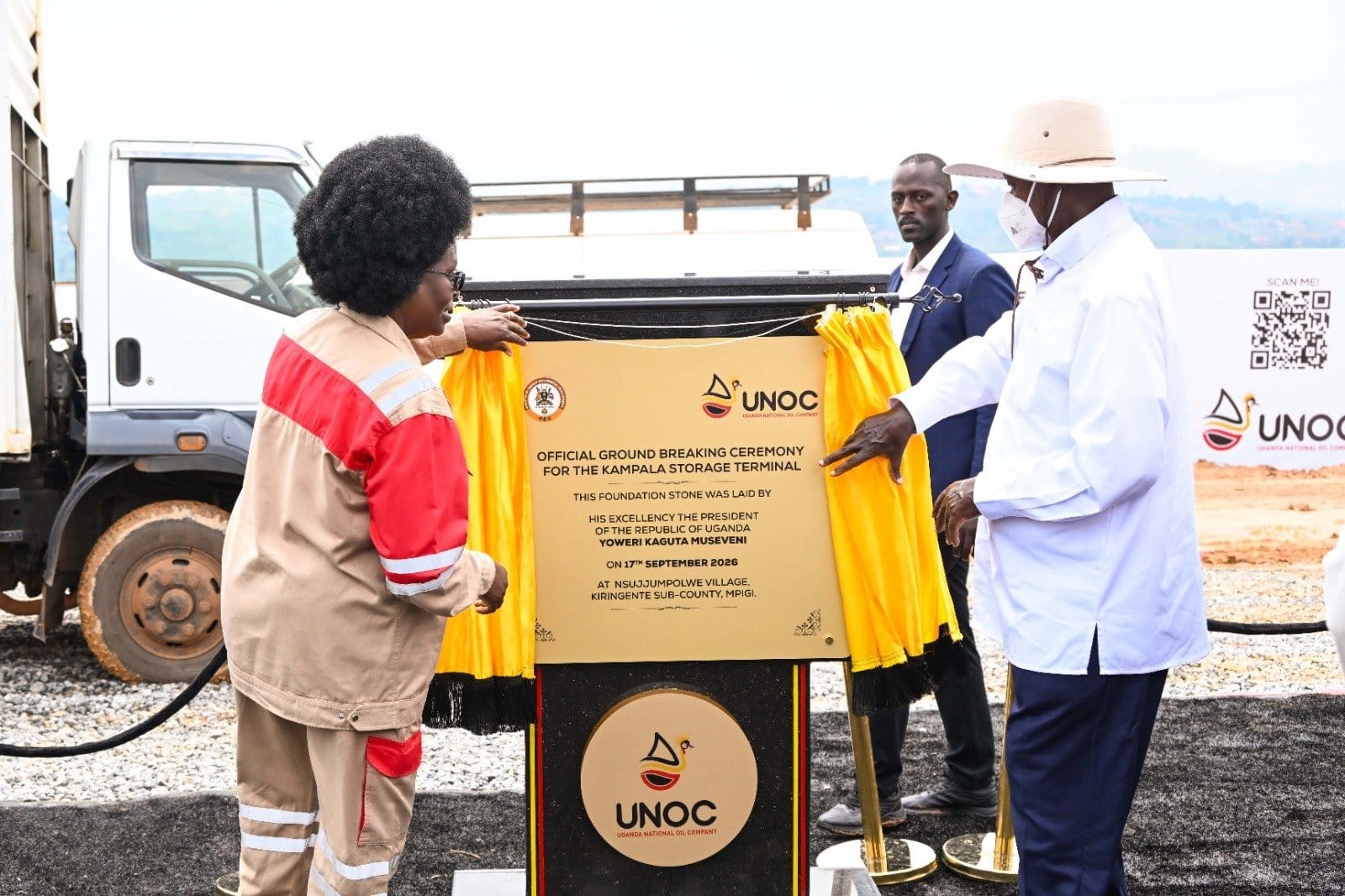
At the groundbreaking of Uganda’s 320-million-litre Kampala Storage Terminal in Mpigi District on 17 September 2026, President Yoweri Museveni delivered a pointed critique of his country’s long-standing fuel procurement system. Uganda, he stated, had for years purchased petroleum products through middlemen operating in Kenya rather than dealing directly with bulk suppliers and refiners. According to figures he and Energy Ministry officials presented, this arrangement imposed stark premiums: diesel at roughly $118 per metric tonne instead of $83; petrol at $97.50 instead of $61.50; and aviation fuel at $114.25 instead of $79.25. Following government intervention and a shift to direct contracts, those premiums fell.
Museveni added a striking institutional detail. Despite having permanent secretaries and commissioners in the Ministry of Energy, he noted, “it took a Senator in Kenya to bring a serious matter to my attention.” He said he raised the issue with then-Energy Minister Irene Muloni, who “did nothing.” The failure, in his view, could only be explained by “either ignorance or corruption.” This was not a sudden revelation. It was a public restatement of a problem Museveni had already flagged in late 2023, when he first denounced the middleman system and announced that Uganda would contract bulk suppliers directly.
The Economics Were Measurable
Uganda imports roughly 2.5 billion litres of refined petroleum products a year, historically valued at around $2 billion. For decades, more than 90 percent of that volume moved through Kenya’s Mombasa corridor. When the supply chain included layers of traders between the refinery or bulk supplier and the Ugandan market, the landed cost rose. Museveni’s 2023 and 2026 statements put numbers on the difference. Once the Uganda National Oil Company (UNOC) began sourcing through arrangements that cut out those layers—most prominently contracts involving Vitol Bahrain—the premiums declined. Officials later confirmed the same figures at the Mpigi ceremony.
The shift was not cost-free for Kenya. Volumes that once passed through Kenyan oil marketing companies declined. Kenya’s own government-to-government (G-to-G) fuel importation framework, introduced in 2023, had altered the previous open-tender system. That change, intended to secure supply and ease foreign-exchange pressure, left Ugandan buyers in a more secondary position during disruptions and contributed to the perception of higher costs. Uganda responded by strengthening UNOC’s mandate, exploring the Tanzanian corridor more systematically, and accelerating domestic storage and eventual refining capacity.
Regional Interdependence Remains Real
East Africa’s energy map is still defined by geography and infrastructure more than by ideology. Kenya remains the most developed coastal gateway. Uganda is landlocked and oil-rich but not yet a refined-products producer at scale. Tanzania offers an alternative corridor and is the route of the East African Crude Oil Pipeline. The Mpigi terminal, financed in part through arrangements with Vitol and designed to hold roughly a month’s national consumption, is one piece of a longer strategy: strategic storage, a multi-product pipeline from a planned Hoima refinery, and reduced dependence on road tankers and intermediary margins.
Later diplomatic efforts—including 2024 understandings that gave UNOC clearer access to Kenyan pipeline and storage facilities—showed that both governments recognised the costs of prolonged friction. Discussions about an Eldoret–Kampala refined-products pipeline and reciprocal investment talk around Uganda’s refinery project point in the same direction: cooperation is more efficient than zero-sum competition, but only if pricing and logistics are transparent.
Governance Questions Cut Both Ways
Museveni’s emphasis on a foreign senator discovering what Ugandan technocrats had not addressed is an uncomfortable admission of internal failure. It also raises a broader regional question: how much opacity is tolerated in fuel procurement when margins are large and political stakes are high? Kenya’s G-to-G system has faced domestic criticism over transparency and the selection of local distributors. Uganda’s move to a national oil company as importer of record improves bargaining power and can lower costs, yet it concentrates authority and requires rigorous oversight if new forms of rent-seeking are to be avoided.
The middleman problem was never purely Kenyan or purely Ugandan. It was a classic case of layered intermediaries extracting value in a market where information asymmetry and regulatory gaps allowed it. Removing those layers delivered measurable savings for Uganda. Whether those savings fully reach consumers depends on domestic pricing formulas, taxes, and distribution efficiency—areas that remain contested in both countries.
What the Record Actually Shows
The viral framing that reduces Museveni’s Mpigi remarks to a personal decision to cancel a deal “because Ruto was the broker,” or that attributes the tip-off to former President Uhuru Kenyatta, is not supported by the speech or by contemporaneous reporting. Museveni named an unnamed Kenyan senator. He criticised middlemen and the officials who tolerated them. He presented cost data and linked the change to bulk contracting. The rest is political colouring layered onto a concrete policy dispute.
The more consequential story is institutional. East African states are still building the infrastructure and governance arrangements that will determine whether refined fuel moves at competitive, transparent prices or continues to carry avoidable margins. Storage terminals, pipelines, national oil companies, and government-to-government contracts are tools. Their value depends on whether they reduce costs and increase security—or simply redistribute rents. Museveni’s speech, stripped of speculation, is a reminder that the numbers matter, and that discovering the numbers sometimes requires someone outside the system to speak up.