


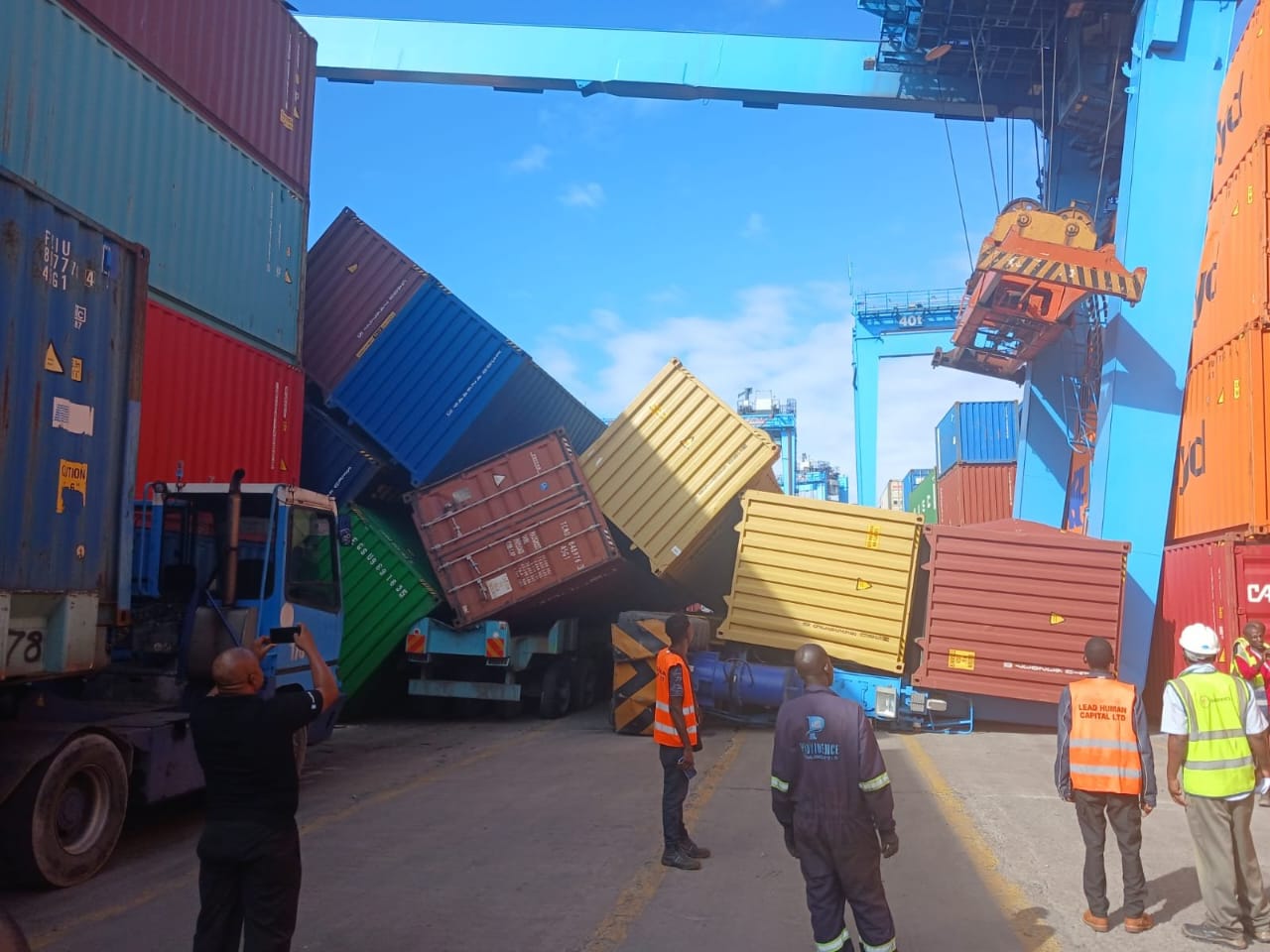
On the afternoon of Thursday, 17 September 2026, an operational incident involving a Rubber-Tyred Gantry (RTG) crane unfolded at the Port of Mombasa. Stacked containers toppled. Social-media footage captured the aftermath. By the next day, the Kenya Ports Authority (KPA) had issued a measured press statement: the truck operator was unharmed; the RTG operator sustained minor soft-tissue injuries to the legs, was treated and discharged; there were no fatalities. Investigations, we are told, are underway.
That is the official account. It is also the bare minimum. For a port that styles itself the gateway to East and Central Africa, handles tens of millions of tonnes of cargo annually, and serves landlocked economies from Uganda to the Democratic Republic of Congo, an RTG incident is never just an operational footnote. It is a stress test of systems, culture, capacity, and credibility.
The Incident in Context
RTGs are the workhorses of a modern container yard. They straddle stacks, lift and place boxes with precision, and keep the landside machine of a port moving. When one is involved in a toppling event, the immediate questions are mechanical, human, and procedural: Was the crane overloaded or unstable? Was stacking height or wind a factor? Did communication between the RTG operator and the truck driver fail? Were safety interlocks and yard protocols observed?
Mombasa is not a quiet backwater. In 2025, it handled a record 45.45 million tonnes. In early September 2026, it set a single-shift container discharge record of 863 boxes from one vessel. Vessel schedules remain heavy, with dozens of calls in a typical fortnight. Transit cargo, roughly 35 percent of throughput, underpins regional trade corridors. Congestion, empty-container backlogs, and dwell-time pressures have been persistent enough that the Kenya Revenue Authority (KRA) and KPA recently rolled out joint reforms to clear long-stay cargo and tighten empty-container management.
Against that backdrop, every visible safety lapse is magnified. Shipping lines, inland shippers, and neighbouring governments watch not only volumes but reliability and risk. A minor injury can become a major reputational cost if the investigation is opaque or the corrective action slow.
What the Response Reveals
KPA’s rapid official communication is an improvement on past practice. Urging the public to rely on verified channels and discouraging rumour is sensible in an age of instant video. Confirming the medical status of the two operators and stating that emergency teams followed established procedures projects competence. Launching a formal review is the correct next step.
Yet transparency must go further. Stakeholders deserve more than reassurance that “investigations are underway.” They need timelines, interim findings where possible, and clear signals that root-cause analysis will examine equipment condition, operator training and fatigue, yard layout, stacking protocols, and any systemic pressures created by volume targets. If the RTG or associated systems require upgrades, the public and commercial users should hear it. Silence breeds speculation; speculation erodes trust.
Safety culture is not a press release. It is the daily discipline of near-miss reporting, stop-work authority, and leadership that treats incidents as learning opportunities rather than public-relations problems. Ports that treat every toppling or collision as an isolated event tend to repeat them. Ports that treat them as system signals tend to improve.
Broader Stakes for Kenya and the Region
The Port of Mombasa is more than a national asset. It is a regional chokepoint. Disruptions, even brief ones, ripple into higher logistics costs for Ugandan manufacturers, Congolese traders, Rwandan exporters, and Kenyan consumers. Rising volumes and the push for faster turnaround times increase the density of equipment and people in the yard. That density raises the cost of any single failure.
Recent years have brought genuine investment: modern berths, smart gates, terminal-operating-system upgrades, and talk of industrial parks and private-sector partnerships near the port. Efficiency records are real. So are empty-container backlogs and the political heat that surrounds leadership transitions and performance contracts. Safety cannot be the residual category after throughput targets are met. It must be a co-equal priority, measured, reported, and resourced with the same seriousness as crane productivity or vessel turnaround.
International shipping is unforgiving. Lines that can choose between Mombasa, Dar es Salaam, or emerging alternatives will factor in not only tariff and connectivity but the probability of operational surprises. A pattern of visible incidents, however minor the human consequences, invites quiet risk premiums and quiet diversification.
What Should Happen Next
First, the investigation must be thorough, independent where appropriate, and its material findings made public in a form that does not compromise legitimate operational security. Second, any required equipment, training, or procedural changes should be funded and implemented without delay. Third, KPA and its partners should publish clearer safety metrics—lost-time injuries, near misses, and equipment downtime related to safety events—alongside the efficiency numbers they already celebrate. Fourth, the port community—terminal operators, shipping agents, truckers, and labour—needs structured channels to surface concerns before they become incidents.
None of this requires perfection. Ports are industrial environments; residual risk is real. What is required is visible, continuous improvement and an end to the cycle in which each incident is treated as an isolated embarrassment rather than a diagnostic moment.
The containers that toppled on 17 September will be restacked. The injured operator has been discharged. The investigation will run its course. The deeper question is whether Mombasa’s leadership will treat this episode as another press statement to manage, or as evidence that Africa’s premier East Coast gateway still has work to do to match its volume ambitions with the safety and reliability standards the region deserves. The answer will shape not only the next incident response but the port’s long-term competitive standing.