


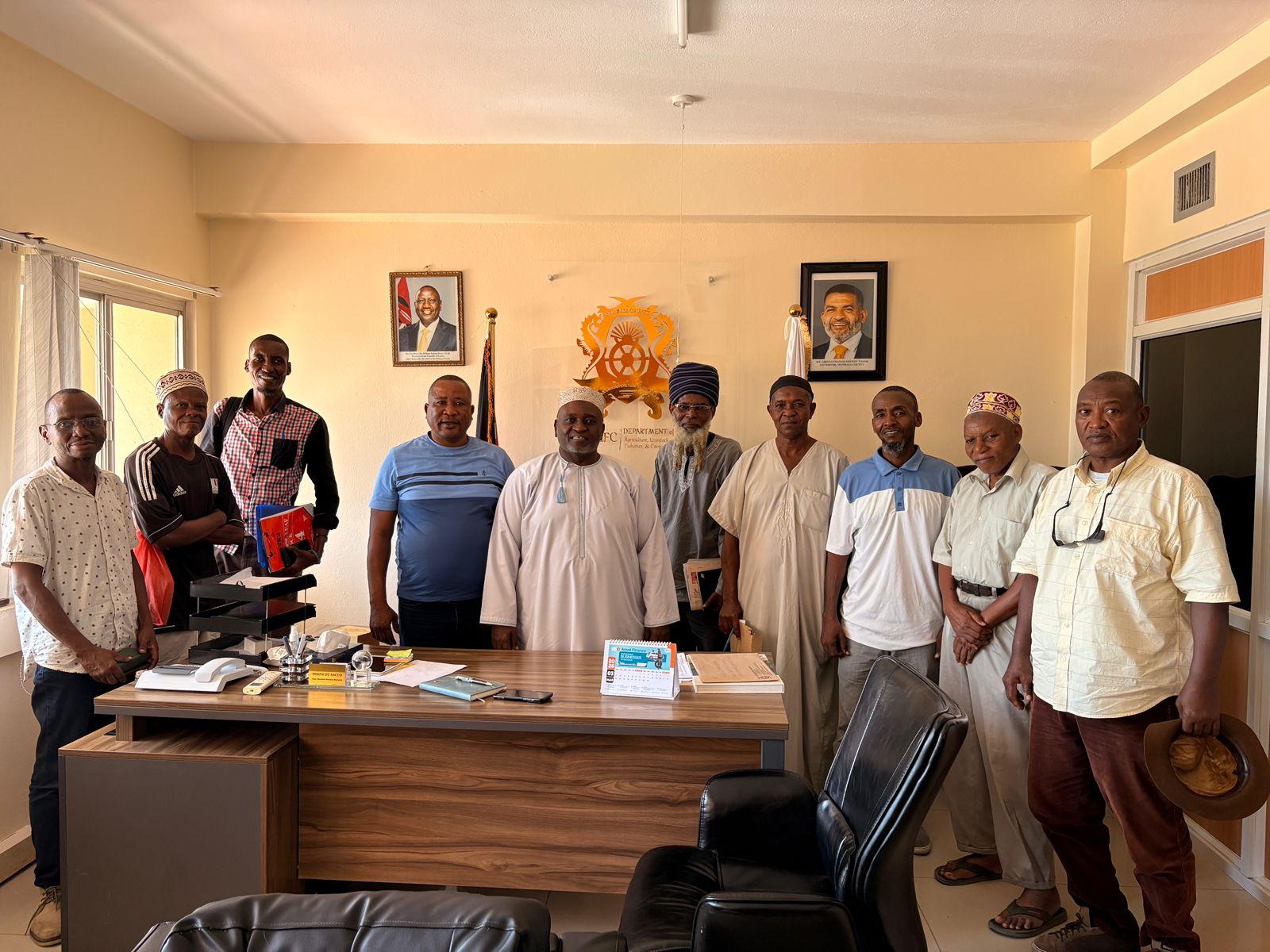
In the heart of Kenya’s coastal capital, a quiet but profound exchange has just taken place—one that could reshape how Mombasa governs its most precious resource, the ocean.
Leaders from the Veteran Seafarers of Kenya recently paid a courtesy call on Mr Ibrahim Khamis Mutwafy, the County Executive Committee Member (CECM) for Blue Economy, Cooperatives, Agriculture and Livestock.
Far from routine protocol, this meeting signals a powerful reconnection between the accumulated wisdom of generations who have sailed the Indian Ocean and the ambitious, devolved governance now driving Kenya’s blue economy agenda.
What makes this encounter especially poignant is Mr Mutwafy’s own deep maritime heritage. He hails from a family of merchant mariners whose seafaring legacy stretches back by generations.
In 1948, his grandfather, Sheikh Khamis, generously donated 34 acres of prime land in the Tudor area—where the main campus of the Technical University of Mombasa now stands—to help establish the Mombasa Institute of Muslim Education (MIOME).
That visionary act laid the foundation for technical and maritime training that has since benefited thousands of coastal youths. Today, as CECM, Mr Mutwafy continues this family tradition of investing in the ocean’s human capital, ensuring that the blue economy builds upon, rather than forgets, its historical roots.
For decades, Kenyan seafarers—especially those from Mombasa and the wider coast—have been the invisible engine of local livelihoods and international maritime trade. They crewed vessels linking East Africa to the world, endured harsh conditions at sea, and built the practical knowledge underpinning everything from traditional fishing to modern port operations.
As the sector evolves, many veterans have watched with concern: young aspirants struggle to gain sea-time experience, certification pathways remain cumbersome, and the human dimension of maritime work—welfare, fair labor practices—sometimes receives less attention than infrastructure headlines.
CECM Mutwafy’s warm reception of the delegation is therefore both timely and deeply symbolic. Appointed to lead this critical docket under Governor Abdullswamad Sherrif Nassir, the CECM has already demonstrated energy through tangible actions: purchasing over 30 deep-sea fishing boats for local fishermen, converting Beach Management Units (BMUs) into cooperatives, AND procuring deep freezers to reduce post-harvest losses.
Other achievements include training dozens in STCW and Coxswain courses, and advancing mariculture initiatives such as cage farming and seaweed production in areas like Tudor Creek and Wajomvu.
By opening his door to veteran seafarers—and drawing on his own family’s legacy of maritime philanthropy—he signals that experience from the past will inform these forward-looking programs, not be overlooked.
This engagement matters deeply as Kenya prepares to host the 11th Our Ocean Conference in Mombasa and Kilifi from 16–18 June 2026 under the theme “Our Ocean, Our Heritage, Our Future.” This global event—the first on African soil—will spotlight sustainable fisheries, marine conservation, climate resilience, and equitable blue growth.
If Mombasa is to shine as a credible host and long-term leader, it must demonstrate an inclusive blue economy rooted in local heritage. Listening to veterans is not sentimental; it is strategic.
These seasoned professionals understand the real-world gaps: the need for expanded local maritime training facilities (building on the very institution his grandfather helped found), better protection against crew abandonment and wage delays, stronger integration of traditional knowledge into modern aquaculture, and practical measures to enhance maritime safety and security along the coast.
The veterans bring more than nostalgia. They offer institutional memory of Mombasa Port’s heyday, insights into challenges faced by small-scale fishers, and hard-earned lessons on what works—and what fails—when scaling ocean-based enterprises.
Their input, combined with Mutwafy’s personal connection to maritime education, could strengthen ongoing county efforts—such as value-addition equipment for community groups and modern fish markets in Timbwani and Likoni—ensuring these initiatives deliver lasting livelihoods rather than short-term gains.
We commend Hon. Mutwafy for this gesture of openness and for embodying a living bridge between Mombasa’s maritime past and its blue economy future. In Kenya’s devolved system, such direct stakeholder engagement—especially by a leader whose family has contributed land and legacy to maritime training—embodies the spirit of the 2010 Constitution.
However, symbolism must now give way to substance. We urge the CECM’s department to move swiftly beyond the courtesy visit by establishing a formal Maritime Veterans Advisory Forum. This platform could provide regular, structured input into policy, feed directly into Our Ocean Conference preparations, support mentorship programs pairing veterans with youth cadets, and help design re-skilling pathways for experienced seafarers who still have much to contribute on land or in advisory roles.
Critics may argue that veteran voices are secondary to attracting large-scale investment or building new infrastructure. We counter that sustainable success demands balance. Nations with thriving blue economies—from Norway’s responsible fisheries management to Singapore’s maritime training excellence—have consistently honored experienced practitioners while investing in the next generation.
Kenya, with its strategic location, rich marine biodiversity, youthful population, and leaders like Mutwafy whose families have long supported maritime education, has every advantage to do the same.
As Mombasa readies itself to welcome the world in June, this courtesy visit can become a foundational moment. The ocean has sustained coastal communities for centuries.
By deliberately weaving the hard-won knowledge of veteran seafarers into county strategies—and honoring the philanthropic legacy that helped establish institutions like the Technical University of Mombasa— Hon. Mutwafy and the Mombasa government can ensure the blue economy becomes a genuine driver of shared prosperity
That is by creating dignified jobs for fishers and cadets alike, safeguarding marine ecosystems, and positioning Kenya as a continental leader in ocean governance.
The veterans have sailed many voyages. Now it is time for county leadership to chart the next one with them—not behind them. If this partnership is nurtured, Mombasa’s blue economy will not only grow; it will endure: rooted in heritage, guided by experience, and owned by the people who call the coast home.