


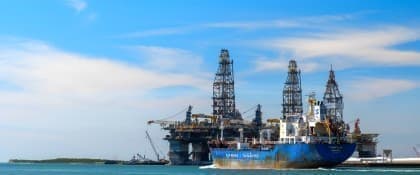
Petrobras has renewed its expansion of activities in West Africa creating new interest on likely changes in the Atlantic energy axis.
Just a few years after retreating from several international ventures, Brazil’s oil giant is re-entering Africa’s hydrocarbon frontier with purpose in terms new corporate strategy and anticipation of the future global energy flows.
At the core of this shift lies a simple but powerful imperative: reserves. Like all major oil companies, Petrobras must continually replenish its resource base to sustain long-term production. Africa—and West Africa in particular—offers precisely that opportunity.
The region’s offshore basins share geological similarities with Brazil’s prolific pre-salt fields, giving Petrobras a technical and operational advantage rooted in decades of deepwater expertise.
This is no speculative interest. It is a structured, deliberate expansion. Petrobras has declared interest in multiple offshore blocks in Côte d’Ivoire, marking a formal entry into one of West Africa’s emerging oil frontiers. Simultaneously, it is positioning itself across a broader arc that includes Nigeria, Angola, and Namibia—countries explicitly identified as pillars of its international growth strategy.
What is unfolding is less a return and more a reinvention.
For much of the past decade, Petrobras pursued a defensive strategy—divesting overseas assets to manage debt and refocus on domestic production. Today’s outward push reflects a company that has regained its financial footing and strategic confidence. Acquiring stakes in offshore blocks from São Tomé and Príncipe to Namibia signals a willingness to re-engage globally, but on more selective and technologically aligned terms.
In this context, West Africa is not just another region—it is a mirror of Brazil’s own geological fortune. The deepwater basins of the Gulf of Guinea are often described as geological “analogues” to Brazil’s pre-salt formations.
Petrobras is not entering unfamiliar territory; it is extending a proven model across the Atlantic. This symmetry reduces exploration risk and enhances the probability of commercially viable discoveries.
Yet the implications go far beyond geology. Petrobras’ expansion also tells a story of shifting global energy alliances. As Europe seeks to diversify away from Russian energy and Asia’s demand continues to grow, West Africa is emerging as a strategic supplier.
By embedding itself early in this evolving landscape, Petrobras is positioning Brazil as a transatlantic energy bridge—linking South American expertise with African resources and global markets.
This has profound consequences for African states as well. Countries like Côte d’Ivoire and Nigeria are not passive recipients of foreign investment. They are increasingly sophisticated actors, negotiating partnerships that include technology transfer, local content development, and infrastructure investment.
Petrobras’ deep water capabilities—particularly in subsea engineering and floating production systems—offer African nations access to technologies that can unlock previously inaccessible reserves.
In Nigeria, for instance, the company’s planned return is framed not only around oil extraction but also broader energy cooperation, including gas development and potential synergies with renewable initiatives. This hybrid approach reflects a subtle but important evolution: even as Petrobras doubles down on hydrocarbons, it is also aligning with the global narrative of energy transition.
Still, this expansion is not without risks and contradictions.
The global energy discourse is increasingly shaped by decarbonization, climate commitments, and the gradual shift toward renewables. Against that backdrop, a renewed scramble for offshore oil might appear anachronistic. Yet the reality is more nuanced. Oil and gas remain central to global energy systems—especially in developing economies, where energy security often outweighs environmental considerations.
For Petrobras, the calculus is pragmatic. Its long-term business plan balances continued investment in oil and gas with a measured entry into low-carbon technologies, including biofuels and carbon capture. The African expansion, therefore, is not a rejection of the energy transition but an acknowledgment that the transition itself will be prolonged, uneven, and still deeply dependent on hydrocarbons.
Another layer of complexity is competition.
Petrobras is not alone in its African ambitions. Major international oil companies—Shell, TotalEnergies, and others—are already entrenched in the region. The recent surge in exploration activity across West Africa underscores a broader “mini-boom” in offshore drilling, with multiple players racing to secure acreage and first-mover advantage.
In this crowded field, Petrobras’ differentiator is its deepwater pedigree. Few companies possess its level of experience in ultra-deep offshore environments, and this technical edge could prove decisive in frontier basins where operational challenges are significant.
However, success will depend not only on technical capability but also on political navigation. West Africa’s energy landscape is shaped by regulatory uncertainties, governance challenges, and, in some cases, security concerns. Petrobras must therefore balance ambition with caution, ensuring its investments are resilient to both market volatility and political risk.
From a maritime perspective, the implications are equally significant.
Increased offshore exploration and production inevitably drive demand for support vessels, port infrastructure, and logistics services. For coastal states, this creates opportunities to develop maritime clusters that can service the oil and gas industry while catalyzing broader economic growth. Ports in the Gulf of Guinea could see increased traffic—not only from drilling operations but also from export activities as new fields come online.
In this sense, Petrobras’ expansion is not just an energy story—it is a maritime and economic story as well. It speaks to the reconfiguration of trade routes, the evolution of port economies, and the growing interdependence between Africa and South America. The Atlantic, long overshadowed by the Pacific and Indian Oceans in global trade narratives, is reasserting itself as a vital corridor of energy and commerce.
Ultimately, Petrobras’ West African strategy reflects a deeper truth about the global energy system: it is in flux, but not in retreat. The transition to cleaner energy is underway, yet demand for oil and gas remains robust, particularly in emerging markets. Companies that can navigate this dual reality—investing in hydrocarbons while preparing for a lower-carbon future—will define the next phase of the industry.
Petrobras appears determined to be one of them.
Its expanding footprint in West Africa is both a calculated bet on the region’s untapped potential and a statement of intent: the future of energy will not be dictated by a single geography or a single fuel, but by a complex interplay of resources, technologies, and partnerships spanning continents.
For Africa, the challenge is to ensure this renewed interest translates into sustainable development—not another chapter of resource extraction. For Petrobras, the test is whether it can turn geological promise into enduring value in a region as promising as it is complex.
What is certain, however, is that the Atlantic energy map is being redrawn—and Petrobras is holding the pen.