


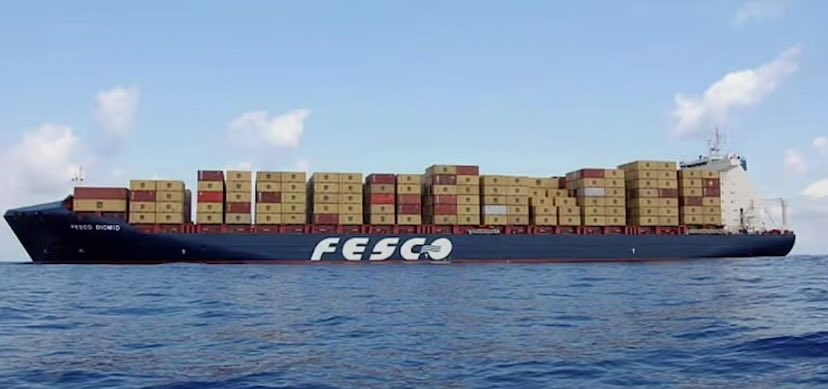
Russian container carrier FESCO has decided to expand its Africa operations into Tanzania’s Port of Dar es Salaam, which implies continuation of a geopolitical and commercial realignment unfolding quietly and steadily across the Global South.
For East Africa, this development carries far greater significance than the arrival of a few containers carrying Russian plastic products and spare parts. It signals the emergence of new maritime corridors, fresh commercial alliances, and a shifting global trade architecture.
Russia understands that maritime trade is ultimately about access, influence, and resilience. Since Western sanctions intensified following the Ukraine conflict, Moscow has aggressively sought alternative markets and shipping partnerships beyond Europe. Africa—with its growing consumer base, strategic mineral reserves, agricultural potential, and expanding port infrastructure—naturally became a priority.
Tanzania’s inclusion in FESCO’s Indian Ocean network is therefore reflects a deliberate Russian strategy to deepen commercial engagement with Eastern and Southern Africa through practical logistics solutions rather than political rhetoric.
The chosen route is strategically clever. By linking Russian ports such as Novorossiysk and Saint Petersburg with Durban and now Dar es Salaam—via India’s Nhava Sheva port—FESCO reduces over-reliance on traditional European maritime gateways while leveraging India’s growing role as a neutral commercial hub between East and West.
The importance of Dar es Salaam cannot be overstated. The port has evolved into one of Africa’s fastest-growing logistics gateways, serving not only Tanzania but also the hinterland economies of Zambia, Rwanda, Burundi, Uganda, Malawi, and parts of the Democratic Republic of Congo. Any shipping line seeking meaningful influence in East Africa must eventually establish a foothold there. Russia appears to have grasped this reality earlier than many expected.
Critics should avoid framing this development purely through the lens of geopolitics or sanctions evasion. There is nothing extraordinary about BRICS-aligned economies strengthening trade connectivity among themselves. BRICS members are increasingly building parallel commercial systems designed to reduce dependence on traditional Western financial and shipping structures. South Africa is already a BRICS member, while Tanzania’s growing integration into the Southern African Development Community (SADC) enhances its strategic relevance within the regional trade ecosystem. What is unfolding is not isolationism—it is diversification.
For Tanzania, the gains are immediate and practical. Expanded liner connectivity increases competition, broadens export opportunities, and improves access to alternative markets for agricultural commodities such as coffee and tea. The inclusion of Tanzanian exports on the return leg to Russia demonstrates that the route is intended to support two-way trade rather than simple cargo dumping. This matters greatly for African economies that have historically struggled with trade imbalances.
The ongoing negotiations toward a bilateral investment treaty between Russia and Tanzania also deserve close attention. Trade relationships become sustainable only when supported by banking systems, insurance frameworks, and investment protections. Russian officials appear keenly aware that logistics alone cannot sustain long-term commercial engagement without financial infrastructure capable of mitigating risk for investors and traders.
The reported 20 percent increase in bilateral trade between the two countries, reaching $200 million, may appear modest by global standards, but the trajectory is what matters. Trade corridors typically begin with niche commodities and limited volumes before scaling rapidly once confidence, frequency, and institutional support mature.
East Africa should therefore interpret this development as a signal of broader changes ahead in Indian Ocean commerce.
For Kenya, the rise of alternative maritime corridors should not trigger anxiety but strategic reflection. The Port of Mombasa remains the region’s dominant gateway, but competition is intensifying. Dar es Salaam’s rapid modernization, aggressive investment promotion, and expanding shipping connectivity are steadily reshaping regional cargo dynamics. This is healthy. Competition between African ports should drive efficiency improvements, infrastructure modernization, and lower logistics costs. The real danger lies not in Tanzania’s success, but in complacency elsewhere.
There is also an important lesson for African maritime policymakers. Global shipping is becoming increasingly multipolar. The future will not be controlled exclusively by traditional Western liners or legacy trade routes. Asian, Middle Eastern, and now Russian logistics players are all competing for influence across African waters. Ports that position themselves as politically neutral, commercially efficient, and operationally reliable will attract this emerging traffic.
Ultimately, FESCO’s expansion into Tanzania is not merely about containers moving between Russia and East Africa. It is about the gradual reconfiguration of global trade relationships in a world where sanctions, geopolitical rivalries, and economic nationalism are pushing nations to develop alternative commercial ecosystems. Africa is no longer standing on the sidelines of that transformation—it is becoming one of its central arenas.