


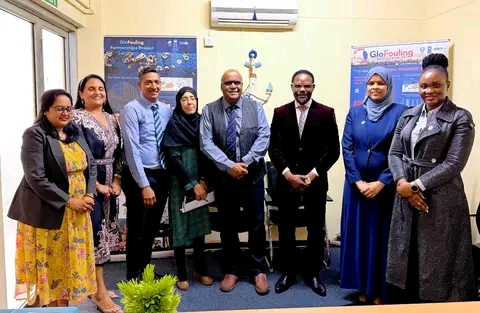
The recent courtesy call between Captain Asiva Coopen, Director of Shipping at Mauritius’s Ministry of Agro-Industry, Food Security, Blue Economy and Fisheries, and the Secretary-General of the Maritime Organization for Eastern, Southern and Northern Africa (MOESNA) in Port Louis carries significance far beyond diplomatic protocol. It signals a growing recognition among African maritime leaders that the continent’s maritime future will be shaped not by isolated national efforts, but through stronger regional cooperation, shared expertise, and coordinated action.
At a time when global shipping routes are undergoing profound transformation, maritime security threats remain persistent, and environmental sustainability has become a defining priority, Africa can no longer afford fragmented approaches to maritime development. The discussions in Mauritius touched on several of the most critical issues facing the continent’s maritime sector today: connectivity, security, education and training, and decarbonization.
Mauritius occupies a unique position in the Indian Ocean. As an island nation whose economic prosperity is intrinsically linked to maritime trade and ocean resources, it has consistently demonstrated leadership in advancing the Blue Economy agenda. Its commitment to sustainable ocean governance, maritime services, fisheries management, and port development has made it an important voice in regional maritime affairs.
The engagement with MOESNA underscores the strategic value of regional institutions in creating common frameworks that enable African states to maximize the benefits of their maritime domains. Africa possesses over 30,000 kilometers of coastline, vast Exclusive Economic Zones (EEZs), and some of the world’s most important shipping lanes. Yet the continent continues to capture only a fraction of the economic value generated from maritime trade and ocean-based industries.
A key area highlighted during the discussions was maritime connectivity. Despite Africa’s extensive coastline and growing economies, intra-African maritime transport remains underdeveloped. Cargo moving between African countries often relies on transshipment through ports outside the continent, increasing costs and reducing competitiveness. Strengthening maritime connectivity is therefore essential to realizing the aspirations of the African Continental Free Trade Area (AfCFTA).
Improved shipping links between African ports would not only facilitate trade but also stimulate industrialization, tourism, fisheries, and logistics services. Regional maritime organizations such as MOESNA can play a pivotal role in harmonizing regulations, promoting shipping partnerships, and supporting infrastructure development that enhances connectivity across the continent.
Equally important is maritime security. The safety of Africa’s sea lanes is fundamental to economic growth and regional stability. Threats ranging from piracy and armed robbery at sea to illegal fishing, smuggling, trafficking, and marine pollution continue to challenge many coastal states. No single country can effectively address these threats alone.
The meeting’s focus on maritime security reflects a growing understanding that collaborative surveillance, intelligence sharing, capacity building, and coordinated enforcement mechanisms are indispensable. Regional cooperation offers the most effective pathway to securing maritime domains and protecting the economic interests of coastal and island nations.
The discussions on maritime education and training deserve particular attention. Africa’s maritime sector faces a significant shortage of skilled seafarers, maritime administrators, marine engineers, naval architects, and port management professionals. At the same time, global shipping continues to experience strong demand for qualified personnel.
Investment in maritime education and training represents one of the most promising opportunities for Africa’s youth. By strengthening maritime academies, expanding cadetship opportunities, promoting mutual recognition of qualifications, and enhancing collaboration among training institutions, African countries can position themselves as major suppliers of skilled maritime labor to the global shipping industry.
Mauritius and MOESNA have an opportunity to champion initiatives that create pathways for young Africans to access maritime careers while supporting the workforce needs of the international maritime sector. Such efforts would generate employment, transfer skills, and contribute to economic development across the region.
Perhaps the most forward-looking aspect of the discussions was maritime decarbonization. The global shipping industry is entering a new era driven by increasingly ambitious environmental targets spearheaded by the International Maritime Organization. The transition toward greener shipping presents both challenges and opportunities for African nations.
African ports and shipping industries must prepare for alternative fuels, cleaner technologies, digital innovations, and sustainable maritime infrastructure. While the transition requires significant investment, it also offers opportunities for Africa to become a key player in emerging green maritime value chains.
Countries such as Mauritius can serve as important regional hubs for innovation, policy development, and capacity building in sustainable shipping practices. Through collaboration with organizations like MOESNA, African states can ensure that the continent’s interests are effectively represented in global maritime environmental discussions.
Ultimately, the meeting in Port Louis sends a powerful message: Africa’s maritime future depends on partnership. The challenges facing the continent’s maritime sector are shared, and so too must be the solutions. Regional organizations, national governments, maritime institutions, private sector stakeholders, and development partners must work together to unlock the immense potential of Africa’s oceans and waterways.
As the global maritime landscape continues to evolve, initiatives that strengthen dialogue and cooperation among African maritime leaders are not merely desirable—they are essential. The engagement between Mauritius and MOESNA exemplifies the strategic thinking needed to build a resilient, competitive, secure, and sustainable maritime sector—one capable of driving Africa’s economic transformation in the decades ahead.
The oceans have always connected nations. For Africa, they must now become the foundation upon which a new era of regional integration, economic prosperity, and maritime excellence is built.