


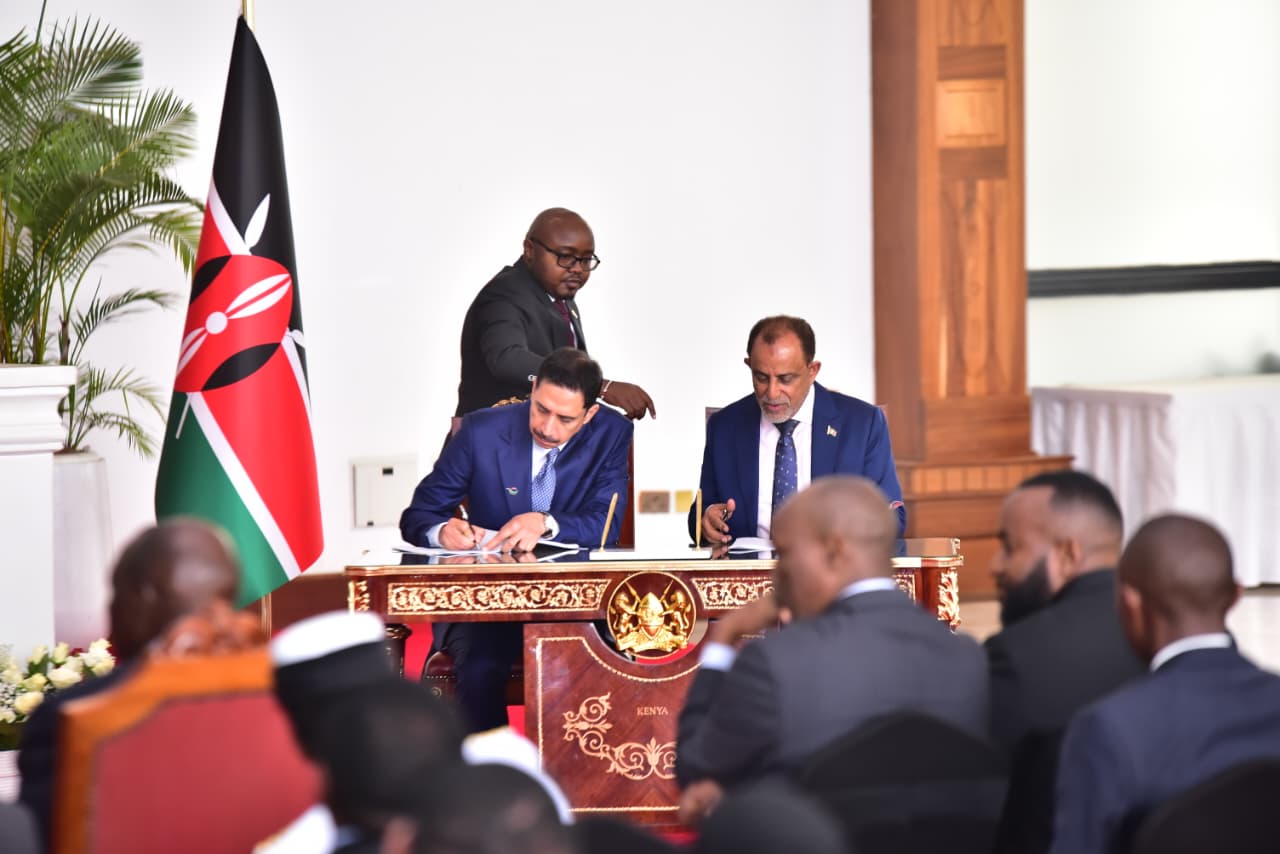
In September 2026, DP World and Kenya-based GulfCap Africa signed a shareholders agreement formally launching the 222-hectare Mombasa Industrial Park Special Economic Zone (SEZ), with a first phase spanning 40 hectares. More than 60 local and international companies have already expressed interest, and the full build-out is projected to support over 20,000 direct and indirect jobs.
To read this as “just another logistics facility” is to miss the point entirely.
What deserves closer scrutiny is the supply-chain model behind it. Traditional port economics follow a linear path: port → customs → delivery. The Mombasa Industrial Park attempts something different — a closed loop of port → logistics → industry → value addition → regional distribution. Manufacturing, warehousing, logistics and port connectivity are compressed into a single physical space, shifting the port’s role from “a place goods pass through” to “a place value is created.”
The deeper context for this shift is a painful course correction in Kenya’s port strategy.
Around 2017, the Kenyan government used administrative directives to force cargo onto the Standard Gauge Railway (SGR) for clearance at inland container depots in Nairobi and Naivasha — an attempt to justify the railway’s massive debt through mandated cargo flows. The policy triggered fierce backlash in Mombasa: container freight stations shed jobs on a large scale, and the informal economy built around the port — porters, warehousing, roadside commerce — was pushed to the brink. More damning still, the Naivasha ICD reportedly received not a single freight train in its first month of operation, even as Mombasa’s hinterland economy absorbed the damage. It took the Ruto administration to return port operations to Mombasa, ending an experiment that had tried to distort logistics geography by decree.
The Mombasa Industrial Park operates on the opposite logic: rather than forcing cargo flows, it aims to create reasons for cargo to stay.
Of course, a gap remains between institutional promise and ground reality. Just a month before the DP World signing, local media reported that Dongo Kundu SEZ — also in Mombasa — had spent two decades without taking shape. Only two major investors, Taifa Gas and Milly Glass, had made substantive moves, and tenants said plainly that without all-weather roads, raw material transport costs were simply unviable. The government subsequently announced KSh 74.1 billion for roads, power and water at Dongo Kundu, but investor confidence requires delivery, not announcements.
Under the SEZ tax framework, the incentives for the Mombasa Industrial Park are unambiguous: 10% corporate income tax for the first ten years, 15% for the next ten, permanent exemption on import duties and VAT for raw materials, and 100% capital deduction on equipment. Measured against the Dongo Kundu experience, the tax regime was never the problem — the last mile of infrastructure is.
DP World’s entry provides one critical differentiating variable. As a global port operator, DP World has accumulated decades of integrated port-free zone-industry experience at Jebel Ali. Its core competence is not construction speed but the ability to synchronise port throughput with industrial-zone inventory turnover and order fulfilment rhythms. That is precisely the capability Dongo Kundu lacks — the latter is led by the Kenya Ports Authority, with port operations and industrial-zone operations governed by separate logics.
For the chemical and liquid logistics sector, Mombasa’s evolution is especially worth watching. Kenya’s recent cluster of SEZ initiatives — from Dongo Kundu to the Olkaria geothermal industrial park — is creating a new demand layer: compliant, safe, traceable logistics for hazardous goods and liquid bulk serving manufacturers inside the zones. Mombasa’s traditional liquid bulk terminals have focused on import-re-export and local distribution. The rise of in-zone manufacturing will generate demand for intermediate chemicals, specialty gases and liquid feedstocks — an entirely new service category of “intra-zone logistics.”
Viewed from a broader trade geography, Mombasa’s move targets East African manufacturing hub status in the post-AfCFTA era. Kenya simultaneously enjoys EPA access to the EU, CEPA access to the UAE, and AfCFTA market access. Goods that undergo value addition in Mombasa can enter all three markets on preferential terms. That explains why more than 60 companies — not merely Kenyan ones — have expressed interest in the first 40 hectares.
Yet geopolitical-economic opportunity is never automatically realised. The core tension facing the Mombasa Industrial Park is this: it must prove itself not merely as a quality asset on DP World’s balance sheet, but as an organic extension of Mombasa’s economic body. The protests triggered by the 2018 port business relocation serve as a reminder that when the reshaping of logistics geography is perceived as “external forces extracting from the local economy” rather than “upgrading the local economy,” political resistance can rapidly consume economic logic.
In that sense, the Mombasa Industrial Park’s success metric should not be the occupancy rate of the first 40 hectares. It should be: Are in-zone manufacturers forming substantive procurement relationships with Mombasa’s local SMEs? Is the park’s logistics demand spurring upgrades among local transport and warehousing providers? Does port value-added revenue flow back into Mombasa’s urban economy in some form?
The future of ports may indeed be about more than handling more containers. But the authenticity of an “ecosystem” ultimately depends on whether it makes every node within the system — not just investors outside it — stronger.