


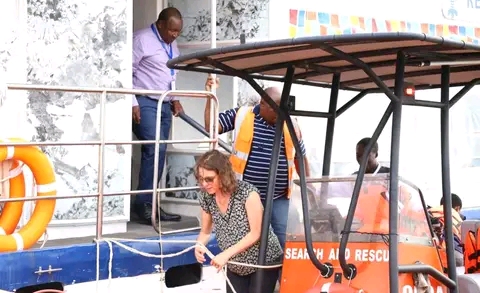
When Expertise France Deputy Director General Ms. Cassilde Brenière recently toured the Kenya Maritime Authority’s Search and Rescue (SAR) facilities in Mombasa, it was far more than a diplomatic courtesy. It was a testament to what international cooperation can achieve when development assistance aligns with national priorities, embraces local ownership, and delivers measurable impact.
The inspection of SAR boats donated through the European Union-funded GoBlue Project offered tangible proof that investments in maritime safety are not abstract development interventions—they save lives.
For a nation whose economic trajectory is increasingly tied to the Blue Economy, maritime safety transcends regulatory obligation. It is a strategic national asset. Kenya’s expansive coastline, surging maritime trade, growing fisheries sector, tourism activities, and expanding offshore economic opportunities demand a robust emergency response framework. Every vessel navigating Kenyan waters, every fisherman venturing out to sea, and every passenger travelling by water depends on the assurance that help will arrive swiftly when disaster strikes.
The five SAR boats provided through the GoBlue Project have significantly strengthened that assurance.
According to the Kenya Maritime Authority, these vessels have reduced emergency response times and enhanced coordination among multiple stakeholders—including the Kenya Coast Guard Service, county governments, local communities, and maritime safety agencies. In search and rescue operations, minutes often determine the difference between life and death. Reduced response times translate directly into lives saved, accidents averted, and confidence restored among maritime users.
This achievement underscores a critical lesson in maritime governance: equipment alone does not create safety—capacity does.
The GoBlue Project’s success stems not merely from the provision of rescue boats but from the comprehensive training of multi-agency personnel responsible for operating them. Across the globe, many donor-funded initiatives falter because assets are delivered without adequate investment in human capital, maintenance systems, and institutional coordination. Kenya’s experience demonstrates a better path. By pairing modern rescue equipment with professional training and operational collaboration, the project has established a sustainable model for maritime emergency response.
The leadership demonstrated by Kenya Maritime Authority Director General CPA Omae Nyarandi and his team deserves recognition. Their commitment to effective implementation has ensured that donor resources generate genuine public value. Equally commendable is the willingness of Expertise France and the European Union to invest in practical interventions that directly strengthen maritime governance and community resilience.
Yet the visit also illuminated a larger opportunity.
Ms. Brenière’s encouragement for Kenya to submit a proposal for additional European Union funding should be viewed as a strategic invitation, not a routine suggestion. Kenya has proven its capacity to successfully absorb, implement, and maximise international maritime assistance. The logical next step is to scale these gains nationally.
Despite notable progress, significant gaps persist in Kenya’s maritime emergency response architecture. Extensive stretches of coastline, inland water bodies, and remote fishing areas still require enhanced rescue capabilities. Climate change is intensifying extreme weather events, exposing coastal communities and maritime operators to greater risks. Growing maritime traffic—driven by port expansion and regional trade integration—further elevates the need for advanced emergency preparedness.
Additional investment could support the establishment of more rescue stations, acquisition of specialised equipment, deployment of modern surveillance systems, enhancement of communication networks, and development of advanced training programmes. Such investments would not only improve emergency response but also strengthen maritime security, environmental protection, and economic resilience.
The timing is particularly opportune.
As Kenya positions itself as a regional maritime hub and leader in the Blue Economy agenda, safety and security infrastructure must keep pace with commercial ambitions. The expansion of the Port of Mombasa, development of the LAPSSET Corridor, growth in cruise tourism, offshore resource exploration, and increasing regional maritime trade all depend on reliable search and rescue capabilities.
International investors, shipping companies, insurers, and maritime operators assess safety standards when making operational and investment decisions. A strong SAR system enhances Kenya’s reputation as a responsible maritime nation capable of protecting lives, property, and marine resources.
The partnership between Kenya Maritime Authority, Expertise France, and the European Union therefore represents more than a development project. It is an investment in confidence, credibility, and national competitiveness.
Perhaps the most encouraging aspect of the initiative is its emphasis on community inclusion. Effective maritime safety begins long before professional rescuers arrive at an incident scene. Local fishermen, beach management units, coastal communities, and county authorities often serve as the first line of response during maritime emergencies. Strengthening these networks cultivates a culture of safety that extends beyond government institutions and becomes embedded within society.
As the world increasingly turns toward sustainable ocean-based development, Kenya’s experience offers a valuable model for other African coastal states. Strategic partnerships, local ownership, capacity building, and measurable outcomes can transform maritime safety from a chronic challenge into a development success story.
The visit by Ms. Cassilde Brenière should therefore be seen as both a celebration and a call to action. The GoBlue Project’s success has proven what is possible. The challenge now is to build on that foundation and create a comprehensive, world-class search and rescue system capable of serving Kenya’s growing maritime ambitions.
The boats launched through this partnership are doing far more than navigating coastal waters. They are steering Kenya toward a safer, more resilient, and more prosperous maritime future.
Ends