


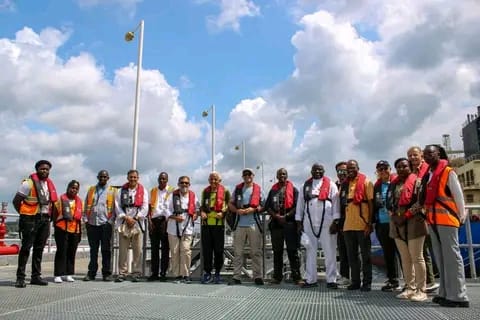
The recent visit by an international delegation of distinguished scholars and maritime experts to the Port of Mombasa may appear, at first glance, to be another routine institutional courtesy. It was anything but.
At a time when global shipping is being reshaped by artificial intelligence, digitalisation, climate obligations, cybersecurity, autonomous systems, and increasingly sophisticated supply chains, the meeting between the Kenya Ports Authority (KPA) and leading academic minds from around the world represents a strategic moment. Traditional approaches to port management are no longer sufficient. The world’s leading ports compete not only through infrastructure but through knowledge, innovation, research, and the ability to anticipate the future.
This is precisely why the engagement between KPA and the international academic delegation deserves national attention.
A Glimpse into the Future
The delegation’s tour of the Vessel Traffic Management and Information System (VTMIS) and the Kipevu Oil Terminal II (KOT II) showcased far more than modern infrastructure. It demonstrated that the Port of Mombasa is steadily embracing the technologies that define twenty-first-century maritime transport. Investments in digital vessel traffic management, enhanced navigational safety, automated operations, and modern energy infrastructure are positioning Kenya as a serious maritime player within the Western Indian Ocean and beyond.
These developments reinforce the growing recognition that ports are no longer merely gateways for cargo. They have become technology platforms, innovation laboratories, and strategic assets that influence national competitiveness.
Technology Alone Is Never Enough
KPA’s continued investment in digital technologies deserves particular recognition. Around the world, artificial intelligence is transforming vessel scheduling, predictive maintenance, cargo planning, customs processing, and port security. Data analytics now enable ports to optimise berth allocation, reduce waiting times, lower operational costs, and minimise environmental impacts. Ports that fail to embrace these technologies risk becoming obsolete.
Fortunately, Kenya appears determined not to be left behind. The Authority’s modernisation program reflects an understanding that future competitiveness will depend not simply on expanding physical infrastructure but on integrating digital intelligence into every aspect of port management.
Yet technology alone is never enough.
Modern maritime economies are ultimately powered by people—engineers, maritime lawyers, data scientists, logistics specialists, naval architects, cybersecurity experts, environmental scientists, and policy professionals whose expertise drives innovation. This is where academia becomes indispensable.
Bridging Academia and Industry
The participation of Professor Luis G. Franceschi, Lydia Ngugi of the Maritime Technology Cooperation Centre–Africa, and an accomplished team of scholars from Europe, Asia, North America, and Africa demonstrates the immense value of connecting universities with industry. Academic institutions generate research, develop talent, and challenge conventional thinking. Ports provide practical environments where ideas can be tested, refined, and commercialised. When these two worlds work together, innovation accelerates.
Indeed, every globally competitive maritime nation has built its success upon such partnerships. The Port of Rotterdam works closely with Dutch universities on digital shipping, artificial intelligence, and sustainable port development. Singapore’s Maritime and Port Authority collaborates extensively with the National University of Singapore and Nanyang Technological University to develop smart port technologies and autonomous shipping solutions. Similar models exist in South Korea, Norway, and Japan.
Kenya should aspire to nothing less.
Addressing a Longstanding Weakness
The visit also highlights a longstanding weakness within Kenya’s maritime ecosystem: the disconnect between academic research and industry practice. Many universities produce valuable studies that never influence operational decision-making. Equally, many operational challenges faced by ports, shipping companies, and maritime regulators remain unexplored by researchers. Bridging this gap would unlock enormous opportunities for innovation and evidence-based policymaking.
Joint research programs, innovation laboratories, student internships, faculty exchanges, and industry-funded research could significantly strengthen Kenya’s maritime knowledge ecosystem.
Equally important is technology transfer. Developing countries often import advanced technologies without developing the local expertise needed to adapt, maintain, or improve them. Sustainable development requires more than purchasing sophisticated equipment; it demands investment in domestic scientific capacity and human capital. This is why exposing students and researchers to modern port operations is so valuable. Future maritime professionals must understand how digital systems, environmental management, marine engineering, logistics, and port governance operate in practice. Learning cannot remain confined to lecture halls.
The Decarbonisation Imperative
The visit also comes at a critical moment for global shipping’s decarbonisation agenda. International Maritime Organization targets require ports worldwide to support cleaner fuels, energy-efficient operations, and lower emissions. Achieving these ambitions will require extensive scientific research, engineering innovation, and policy development. Kenyan universities have an opportunity to become regional centres of excellence in green shipping technologies, marine environmental management, and climate-resilient port infrastructure.
Such ambitions will only become reality through sustained collaboration with institutions like KPA.
A Vision for Regional Leadership
The Authority’s willingness to open its operations to researchers signals institutional confidence and transparency. It demonstrates an understanding that knowledge sharing strengthens rather than weakens organisational performance. This culture of openness should be expanded further.
Kenya would benefit from establishing a National Maritime Research and Innovation Centre jointly supported by KPA, the Kenya Maritime Authority, Bandari Maritime Academy, universities, and private industry. Such a centre could coordinate research on digital ports, maritime safety, marine environmental protection, blue economy development, logistics optimisation, and emerging technologies. It could also attract international research funding while positioning Kenya as the intellectual hub of maritime innovation in Eastern Africa.
The broader economic implications are equally significant. As Africa implements the African Continental Free Trade Area (AfCFTA), regional ports will compete more intensely for cargo, investment, and logistics services. Competitive advantage will increasingly depend upon innovation rather than geography alone. Countries that cultivate research ecosystems alongside modern port infrastructure will lead this transformation.
The Path Forward
Kenya possesses many of the ingredients necessary for success: a strategic location, an expanding port system, growing universities, experienced maritime professionals, and increasing political recognition of the Blue Economy. What has often been missing is stronger integration among these institutions. This week’s engagement offers an encouraging glimpse of what such integration could achieve.
It is particularly noteworthy that the visiting delegation represented diverse disciplines spanning law, engineering, maritime technology, international development, and public policy. The maritime sector itself is inherently multidisciplinary. Effective port governance requires legal expertise, environmental science, economics, digital technology, engineering, and diplomacy working together. No single institution can provide all these capabilities independently.
As global maritime trade becomes increasingly interconnected, partnerships like these will become not exceptional but essential.
Conclusion
Ultimately, the significance of this visit lies less in the facilities toured than in the relationships initiated. Infrastructure can be built within years. Knowledge partnerships, once nurtured, generate innovation for generations.
Kenya Ports Authority has demonstrated that it understands this reality. The challenge now is to transform this promising engagement into enduring programs of collaborative research, student development, technology transfer, and policy innovation.
If that happens, the Port of Mombasa will not merely remain East Africa’s leading gateway for trade. It will emerge as one of Africa’s leading centres of maritime knowledge, innovation, and intellectual leadership. That would be an achievement measured not only in tons of cargo handled, but in ideas generated, technologies developed, and generations of maritime professionals empowered to navigate the future.
Andrew Mwangura is a maritime affairs commentator and former Executive Director of the East African Seafarers Assistance Program. He writes on maritime policy, blue economy, and port development in the Western Indian Ocean region.