


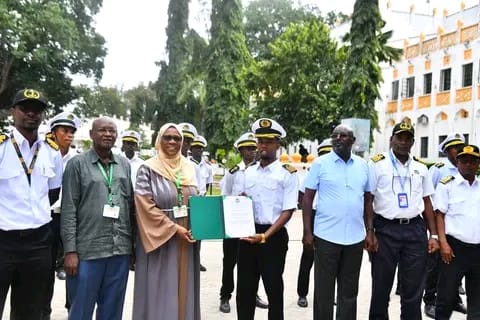
The graduation of marine pilots at the Technical University of Mombasa (TUM) should not be allowed to fade into the routine procession of university ceremonies and congratulatory speeches.
It deserves scrutiny because it exposes one of Kenya’s most persistent maritime contradictions: the country has invested heavily in ports, ships, terminals, roads, and logistics, yet it has not invested with the same urgency in the people required to operate this maritime economy.
TUM’s successful completion of a three-month competency-based Marine Pilot Training Program is therefore more than a training milestone. It is a warning—and an opportunity.
The warning is that Kenya’s ambition to become a serious maritime power will remain incomplete so long as it remains excessively dependent on external expertise. The opportunity is that Mombasa now has the foundation for something far more strategic: a regional centre for advanced maritime training capable of supplying Kenya and its neighbours with the specialized human capital needed to run modern ports.
TUM’s achievement as the first institution in the region to train and graduate marine pilots under this model is particularly significant because pilotage sits at the intersection of safety, efficiency, and national economic security. A marine pilot operates in an environment where a single navigational error can affect a ship, cargo, port infrastructure, the marine environment, and thousands of livelihoods. For Mombasa, competent pilots are as critical as cranes, berths, and channels.
Yet Kenya’s maritime story has too often been about infrastructure first, and human capital later. That approach is increasingly dangerous.
The Uncomfortable Truth About Kenya’s Maritime Skills Gap
Kenya likes to describe itself as a maritime nation because it possesses the Port of Mombasa, a long coastline, shipping companies, and a Blue Economy agenda. But having a coastline does not automatically make a country a maritime power. A true maritime nation requires a deep pool of competent seafarers, pilots, shipbrokers, engineers, naval architects, port managers, surveyors, lawyers, and educators. It also requires the ability to continuously produce, certify, and upgrade these professionals domestically.
Herein lies Kenya’s Achilles heel
The country has historically produced professionals in an environment characterized by inadequate training capacity in specialized fields, limited access to sophisticated simulation, a shortage of experienced instructors, and, most critically, insufficient opportunities for practical sea-time and industry exposure. This creates a peculiar contradiction: Kenya trains people for the industry while simultaneously struggling to provide the pathways for them to acquire the operational experience required to become fully competent.
The sea-time bottleneck is one of the most serious structural weaknesses in Kenya’s maritime education. It is difficult to build a globally competitive workforce when young professionals obtain academic qualifications but struggle to secure the practical exposure needed to convert those into operational competence.
This is not just an education problem; it is an economic problem. Every Kenyan professional who fails to progress due to a lack of practical opportunities represents lost human capital. Every specialized position subsequently filled by foreign expertise represents an opportunity Kenya has failed to capture.
The Foreign-Dependence Question
Kenya must also confront a politically uncomfortable truth: why should a country seeking to be the maritime gateway to East and Central Africa remain dependent on foreign expertise for critical functions?
Foreign expertise has a role to play—partnerships, technical cooperation, and knowledge exchange are essential. But partnership is not permanent dependency.
Kenya should be importing expertise to transfer knowledge, not because it failed to develop its own. This distinction must become central to national maritime policy. The objective should be to ensure that international cooperation leaves behind stronger institutions, better simulators, stronger certification systems, and a larger pool of competent Kenyan professionals.
This is why the TUM-Kenya Ports Authority (KPA) relationship deserves particular attention.
KPA-TUM: From Collaboration to Strategic Asset
The involvement of KPA practitioners in developing the Marine Pilot Training curriculum is one of the program’s strongest aspects. Captain Suleiman Bakari, KPA Senior Marine Pilot and Chief Pilot, also serves as an Adjunct Senior Lecturer at TUM. His involvement illustrates exactly what Kenya’s maritime education system needs more of: the deliberate transfer of operational knowledge from the port into the classroom. The participation of Captain Habib Mahmud, Manager of Pilotage, Vessel Traffic Services, and Port Inspectorate, alongside other senior pilots, reinforces the point.
Universities cannot manufacture maritime competence in isolation. Neither can port authorities. Together, they can create a national maritime professional-development pipeline. TUM possesses the academic infrastructure; KPA possesses the operational environment, experienced pilots, ships, and real-world knowledge.
But this is where the hard questions begin. Will this collaboration remain dependent on individual champions and goodwill, or will it become a formal, properly funded institutional partnership with measurable targets for producing pilots, vessel traffic specialists, and other highly specialized professionals? Kenya should choose the latter.
TUM should be developed into a regional centre of excellence, with KPA as a core industry partner. The relationship should extend beyond teaching to encompass research, simulator development, pilotage safety studies, and continuing professional development. This would transform Mombasa from a mere port city into a maritime knowledge hub.
The Dar es Salaam Factor
This matters because Mombasa is not competing in a vacuum. Across the border, Dar es Salaam is aggressively positioning itself as a dominant gateway. The competition is no longer simply about who handles more cargo. It is about which gateway offers the most efficient, reliable, and professionally managed maritime ecosystem.
Infrastructure is central to this contest, but it is increasingly replicable. A terminal can be expanded. A berth can be deepened. Cranes can be purchased. Human competence is different. It takes years to produce an experienced pilot, shipmaster, or port manager.
That is why Kenya’s human-capital strategy could ultimately become its greatest competitive advantage—or its greatest weakness. If Dar es Salaam combines infrastructure expansion with faster operational efficiency and stronger professional capacity, Mombasa cannot afford complacency. Port competitiveness is measured not only in tonnes and TEUs, but in the confidence of shipowners, turnaround times, navigational safety, and the ability to solve problems without constantly relying on external consultants.
The race is no longer simply Mombasa versus Dar es Salaam. It is a race between maritime ecosystems.
The Somalia Opportunity
The participation of trainees from Mogadishu Port Management provides another important clue. Somalia is rebuilding its maritime infrastructure, and its demand for trained pilots is likely to increase. Instead of viewing Somalia simply as a competitor, Kenya should view it as part of a potential regional training market. The same logic applies to Tanzania, Uganda, Rwanda, and Ethiopia.
Mombasa can train the people who will operate the maritime infrastructure of the region. That is an export opportunity. Why should Mombasa not become the place where a Somali pilot, a Tanzanian port officer, or a South Sudanese shipping professional comes to acquire advanced skills? The foundation is being laid at TUM, but it requires deliberate policy.
A National Maritime Human-Capital Revolution
The government must stop treating maritime education as a collection of isolated institutional programs. Kenya needs a national human-capital strategy linking universities, KPA, the Kenya Maritime Authority, shipping companies, and international partners.
Such a strategy must establish clear pathways from entry-level education to advanced qualifications. It must address the sea-time crisis, expand simulation capacity, strengthen instructor development, and ensure that graduates acquire demonstrable competence, not just certificates. The real prize lies in developing advanced professionals. The training should not end at Class III. TUM and KPA should establish a structured pathway enabling professionals to progress through Class II and I qualifications, supported by mentorship and continuing development.
The Real Test Begins Now
TUM has demonstrated that Kenya can produce marine pilots. The real question is whether Kenya has the political and institutional courage to scale this up.
The country cannot claim to be pursuing a Blue Economy while leaving critical maritime skills underdeveloped. It cannot celebrate Mombasa as the gateway to East and Central Africa while failing to build the human capital required to operate that gateway. And it cannot expect to defeat increasingly capable regional competitors by relying indefinitely on imported expertise.
The next phase must be ambitious: invest in advanced simulation, expand regional recruitment, and strengthen R&D in port operations. The government should recognize specialized maritime training as strategic infrastructure and fund it accordingly.
Ultimately, the future of Mombasa will not be determined only by how many berths it has. It will be determined by who operates them, who navigates the ships, who manages the traffic, who maintains safety, and who possesses the competence to keep the entire system moving.
That is the lesson hidden inside TUM’s marine pilot graduation. Kenya has spent decades building a gateway. It must now build the people capable of making that gateway indispensable.
TUM has opened the door. KPA has the operational experience. Kenya has the talent. What is missing is the national commitment to put all three together—and finally stop treating maritime human capital as an afterthought.
The author is a public intellectual and maritime affairs analyst.