


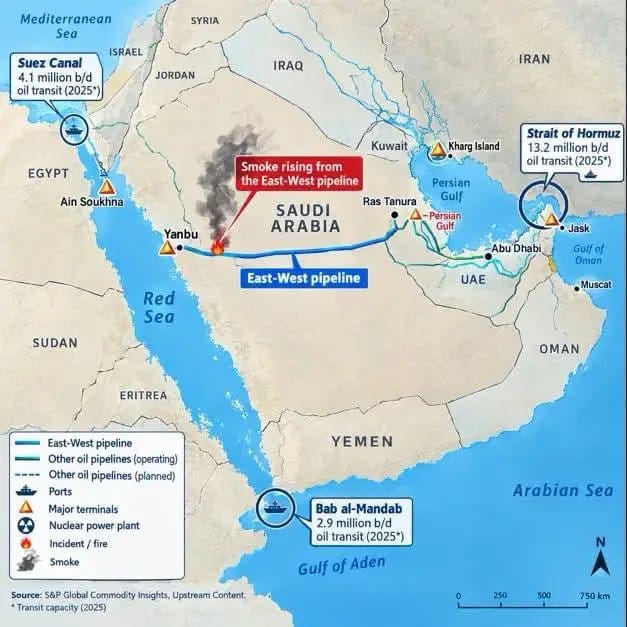
American oil executives have been sounding the alarm for months. Now they say, in plain terms, that the great fuel crisis has arrived. Chevron CEO Mike Wirth and others warn that the buffers which once softened the blow of the prolonged Strait of Hormuz disruption are largely exhausted. Commercial inventories have been drawn down for more than half a year. Strategic reserves have limited remaining flexibility. And last week’s attacks, which knocked a key Saudi bypass pipeline offline, stranded an estimated 2.5 million barrels a day from an already tight market. The result: diesel has hit record highs near or above $6 a gallon, gasoline has rebounded above $4.30, and crude is hovering near or above $100 a barrel, with upside risks still dominant.
Trump administration officials continue to describe the disruption as temporary. That framing is politically understandable and, in a narrow sense, partially true—wars eventually end, pipelines get repaired, and tankers eventually move. But the physical reality of depleting stocks and constrained spare capacity does not care about talking points. When the industry’s most informed operators say the shock absorbers have played out and they see no near-term reason for prices to ease quickly, policymakers and the public should listen carefully rather than dismiss the warning as self-interested.
How We Got Here
The root cause is the sustained disruption of the world’s most critical oil chokepoint. The Strait of Hormuz normally handles a large share of global seaborne crude. Its effective prolonged closure, tied to the broader Iran conflict that escalated in early 2026, removed millions of barrels per day from reliable flows. Markets initially absorbed the shock through inventory draws, releases from strategic petroleum reserves, some easing of restrictions on previously sanctioned oil, and workarounds such as overland pipelines. Those mechanisms bought time. They did not create new supply.
That time has now largely run out. Global commercial fuel stocks have been declining for over six months. Strategic reserves cannot be drained indefinitely without risking operational or geological limits. The recent Saudi pipeline outage compounded the tightness at a moment when Chinese buying has resumed after earlier draws on its own stocks, further pressuring the remaining floating and onshore inventory. Diesel markets, already strained by refining disruptions—including attacks on Russian capacity—have been particularly exposed. The International Energy Agency and other trackers have documented large cumulative stock draws since the conflict began, hundreds of millions of barrels, leaving the system with thinner cushions than at the outset.
This is not primarily a U.S. production problem. American shale and conventional output remain substantial, and refiners have been running hard. The issue is the global balance: a large, persistent shortfall in a market that still relies heavily on Middle Eastern volumes for both crude and products, combined with the slow speed at which new supply—or demand destruction—can respond.
Economic and Political Stakes
High fuel prices act as a broad tax on households, trucking, aviation, agriculture, and manufacturing. Diesel at record levels raises freight costs that feed into nearly everything consumers buy. Gasoline above $4.30 hits discretionary spending and voter sentiment, especially with midterms approaching. Airlines and shipping face margin pressure; some energy-intensive industries confront demand destruction if prices stay elevated long enough. Governments already carrying heavy debt loads have limited fiscal room to cushion the impact through subsidies or tax holidays without adding further strain.
Politically, the situation creates tension between the White House’s messaging and industry assessments. Officials have emphasized temporary disruption, pointed to efforts to boost supply from places like Venezuela, and urged companies to lower retail prices. Executives, operating closer to the physical market, describe depleted buffers and persistent upside risk. The gap is not merely rhetorical. Prolonged high prices risk economic slowing precisely when political incentives favor optimism. Accusations of price gouging or calls for investigations may score short-term points, but they do not refill inventories or reopen maritime routes.
China’s role adds another layer. After drawing on its large stockpile, renewed Chinese imports tighten the remaining global pool. If Beijing prioritizes domestic security of supply by limiting product exports, the squeeze on middle distillates intensifies further.
The Heavy Toll on African Countries
While the crisis dominates headlines in the United States and Europe, its negative side effects fall disproportionately hard on African economies. Of Africa’s 54 countries, roughly 43 are net importers of crude oil and refined petroleum products. Many depend heavily on Middle Eastern supplies that once moved through Hormuz or related routes. The result has been sharply higher import bills, currency pressure, inflation, fiscal strain, and risks to food security and growth.
Between March and August 2026 alone, 32 African fossil-fuel importers paid a combined additional $21.9 billion for energy imports, according to analysis of the Hormuz-related shock. Egypt faced the largest extra cost at about $5.2 billion, followed by South Africa ($3.5 billion), Morocco ($2.2 billion), Tanzania ($2.1 billion), and Kenya ($1.7 billion). Even though a handful of exporters such as Nigeria and Angola recorded revenue gains, the continent as a whole still faced a net additional burden.
Diesel price spikes have been especially damaging. In some countries, local-currency diesel prices rose 40 percent or more in the early months of the shock—86 percent in Nigeria, more than 50 percent in places such as Tanzania, Ethiopia, Lesotho, and Liberia. Because diesel powers trucking, generators, agriculture, and industry across much of the continent, these increases quickly raise the cost of moving food from farms to markets, operating irrigation and processing equipment, and keeping businesses and clinics running. In several East African markets, diesel shocks historically transmit into higher staple-food prices independent of global grain markets.
Fertilizer supplies have compounded the pain. Gulf producers supply a substantial share of Africa’s nitrogen fertilizers. Disruptions through Hormuz and related routes drove sharp price increases during critical planting seasons, threatening yields and raising the risk of higher food prices and greater food insecurity for households that already spend a large share of income on food.
Fiscal and macroeconomic pressures are acute. Many governments lack the fiscal space to fully subsidize fuel or absorb the higher import bills. Allowing full pass-through raises pump prices and inflation; attempting to hold prices down expands deficits and can deplete foreign-exchange reserves. Currency depreciation then makes every subsequent import more expensive, creating a feedback loop. East Africa, which relies on the Gulf for a large share of its crude and fertilizer, has seen projected growth marked down. Across the continent, higher energy and input costs are expected to shave growth in several regions while pushing inflation higher in already vulnerable economies.
Even oil-producing nations are not immune. Nigeria, for example, exports crude but has historically imported large volumes of refined products. High global refined-product prices and logistics disruptions raise costs for households and businesses even when the country benefits from higher crude revenues. Limited domestic refining capacity in many places means the continent pays both the crude-price premium and the refining-margin premium during shortages.
The human and developmental consequences are severe. Higher transport and energy costs squeeze household budgets, raise the price of basic goods, constrain small businesses, and can stall construction and agricultural activity. In extreme cases, fuel shortages have left fishing vessels idle, hammer mills offline, and taxis waiting days for scarce supplies. These effects hit the poorest hardest and risk reversing hard-won gains in poverty reduction and food security. The African Development Bank has responded with a multi-billion-dollar framework to help countries manage the energy and fertilizer shocks, underscoring the scale of the vulnerability.
In short, a crisis centered on a distant chokepoint is not distant in its effects for Africa. It translates into higher living costs, tighter budgets, slower growth, and greater hardship for millions who have the least capacity to absorb another external shock.
Longer-Term Lessons
This episode underscores several structural realities that transcend any single administration or conflict:
First, energy security remains inseparable from geopolitical risk. Diversification of supply sources, routes, and storage matters. Heavy reliance on a single chokepoint is a vulnerability that markets and governments underpriced for years.
Second, strategic and commercial inventories are finite shock absorbers, not permanent substitutes for production and transit. Drawing them down without a clear path to restoring flows simply shifts the crisis later and potentially deeper.
Third, refining capacity and product markets can become binding constraints even when crude is available. Diesel tightness has been especially acute, reflecting both lost Middle Eastern product exports and secondary disruptions elsewhere.
Fourth, the transition narrative does not erase the near-term physics of liquid fuels. Demand for oil products remains robust enough that large, sustained supply losses still produce sharp price responses. Wishful thinking about rapid demand destruction or instantaneous alternative capacity does not fill tanks.
Finally, credible communication matters. When executives who manage real molecules and real logistics say the buffers are gone, treating that assessment as partisan or temporary may erode trust precisely when clear-eyed realism is most needed. For African economies, the lesson is sharper still: dependence on distant supply chains for both energy and fertilizer is a structural vulnerability that must be reduced through domestic refining, renewable power where feasible, and regional production of critical inputs.
What Comes Next
No single lever will quickly reverse the current tightness. Repairing the Saudi pipeline will help but will not restore Hormuz volumes. Venezuelan expansion, even if accelerated, is a multi-year story, not an immediate offset for millions of barrels per day. Further strategic releases risk hitting operational floors. Demand destruction will eventually occur if prices stay high long enough, but that is a painful and blunt instrument—one that falls most heavily on lower-income regions least able to absorb it.
The most constructive path combines realism about the physical constraints with focused efforts to restore transit security, encourage maximum safe production and refining utilization, and avoid policies that further discourage investment in the very capacity the system needs. Markets will ultimately clear—through higher prices, reduced demand, or restored supply. The question is how much economic and political damage occurs in the meantime, and how unevenly that damage is distributed.
Oil executives are not infallible, and companies have their own interests. Yet when the people closest to the barrels and the pipelines say the great fuel crisis is here, the prudent response is not denial. It is to treat the warning with the seriousness the physics of supply and demand demand. The tanks do not care about messaging. They care about molecules. And right now, the molecules are running short—with consequences that stretch far beyond the United States and Europe to the households, farms, and budgets of Africa.
Andrew Mwangura is a Mombasa based maritime analyst.