


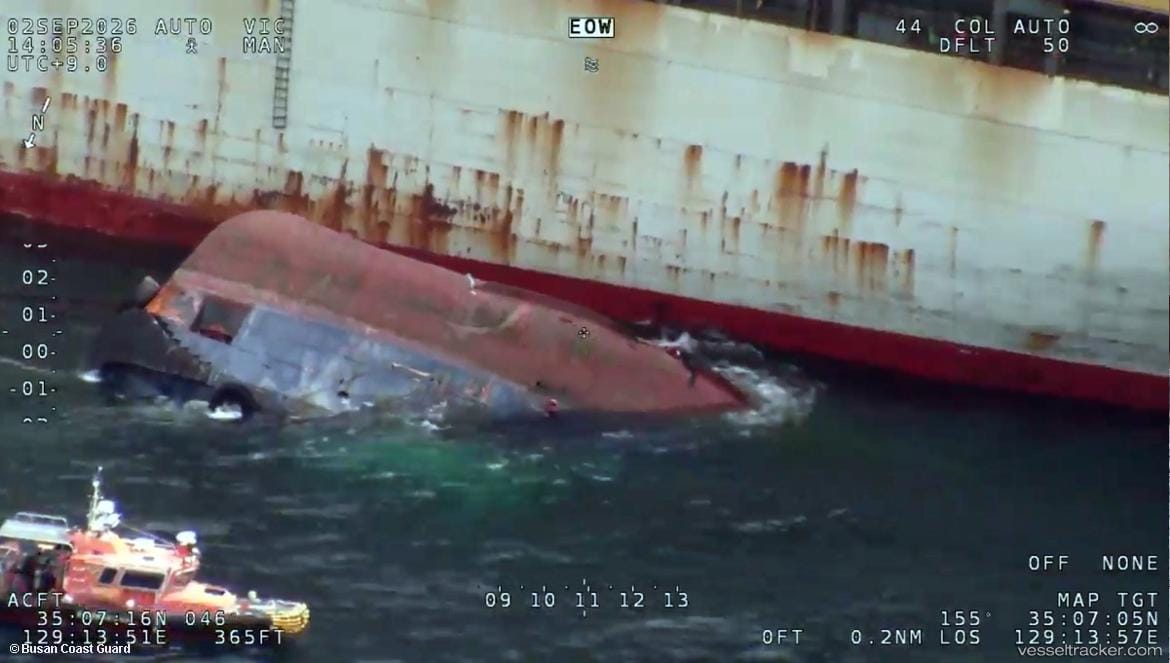
On the afternoon of September 2, 2026, the 286-tonne South Korean tugboat TNS Catcher capsized and sank while assisting a large container ship roughly 9 kilometers east of Oryukdo Island, off the coast of Busan. One crew member is confirmed dead, one survived, and six remain missing. The tragedy underscores the persistent dangers of commercial towing, the severe limitations of deep-water search-and-rescue, and the systemic pressures that continue to compromise safety across the global shipping industry.
The Incident
The TNS Catcher—a 2007-built vessel with approximately 3,600 bhp, operated by Busan-based TNS Oceantowing—departed a government pier at Busan Port around 10:15 a.m. to assist the Liberia-flagged container ship MSC Ikaria VI (roughly 66,000 tonnes / 5,576 TEU), which had suffered a prior mechanical failure and was unable to maneuver under its own power. Three tugs were deployed: two pulling from either side of the bow, and one pushing from the stern. The TNS Catcher was positioned on the starboard bow.
At approximately 1:29 p.m., while executing a starboard turn, the tug rolled sharply to port and capsized. Investigators from the Coast Guard have indicated that a mismatch in speed and timing during the course change, combined with excessive tension or possible entanglement of the towline (hawser), is the leading working theory. CCTV footage from the container ship reportedly shows the tug initiating its turn before overturning. No collision occurred.
The vessel remained inverted on the surface for roughly two hours before sinking completely at 3:27 p.m. It was later located on the seabed at a depth of about 87 meters, approximately 6.5 kilometers east of Songjeong Port, having drifted after the incident. Eight crew members were aboard: six South Korean and two Indonesian nationals.
The Human Toll
A 53-year-old Indonesian cook was rescued by the container ship’s crew approximately 20 minutes after the capsizing. He escaped quickly while cooking and sustained no serious injuries. A 57-year-old South Korean second mate was found unconscious inside the inverted wheelhouse by Coast Guard divers, who entered through a broken window—which family members believe he may have shattered in a desperate attempt to escape. He was transported to a hospital but later pronounced dead. The remaining six crew members—five South Korean and one Indonesian—are still missing.
Search and Response
Search-and-rescue operations mobilized Coast Guard vessels, Navy assets (including the salvage ship ROKS Gwangyang and remotely operated vehicles), aircraft, and local fire and municipal resources. President Lee Jae Myung ordered the full mobilization of available assets. However, conditions were prohibitive: waves of 1–1.5 meters, winds of 4–6 m/s, strong currents, and the significant depth limited diver access and severely reduced underwater visibility for ROVs. As of early September 4, the formal investigation remains ongoing, with recovery of the wreck and any remaining crew technically challenging given the depth.
Context and Contributing Factors
Tugboat operations—particularly deep-sea or harbor-assist towing of large vessels—are inherently high-risk. Sudden changes in direction or speed generate enormous dynamic loads on towlines. If a tug’s heading, speed, or hawser angle is not precisely coordinated, the resulting force can capsize the smaller vessel. Stability can be further compromised by free-surface effects, deck openings, or uneven fuel and cargo distribution. The TNS Catcher was engaged in a coordinated multi-tug maneuver on a disabled, large container ship—an operation that demands precise communication, real-time load monitoring, and rigorous procedural discipline.
Busan’s southeastern waters are among the busiest commercial corridors in the region. The presence of foreign crew (Indonesians are common in the local maritime labor market) highlights the multinational nature of modern shipping, where language barriers, divergent training standards, and fatigue management can vary significantly. The fact that the container ship was already compromised by a prior mechanical failure added further complexity to the towing plan.
Broader Implications
This tragedy is a grim reminder that maritime casualties are rarely the result of a single catastrophic equipment failure; they typically emerge from the interaction of human factors, procedural gaps, and unmanaged physical forces. Towing operations worldwide continue to produce capsizings when load monitoring, communication protocols, or risk assessment during turns are inadequate. Advances exist—real-time tension sensors, automated load alarms, improved bridge resource management for multi-tug operations, and stricter limits on high-load maneuvers—yet adoption remains uneven, particularly among smaller operators.
The human cost is stark. Six families await news in desperate circumstances; one death is confirmed, and the survival window in 87-meter water is effectively closed. The sole survivor’s account and the deceased crew member’s apparent attempt to escape through the wheelhouse window illustrate both individual courage and the terrifying speed with which a vessel can become a deathtrap.
South Korea’s rapid multi-agency response—including presidential-level direction—reflects the seriousness with which such incidents are treated. Yet depth and current conditions repeatedly stymie underwater recovery in coastal accidents. This underscores the persistent need for better autonomous underwater search tools, pre-positioned salvage assets, and clearer international standards for towing safety in congested shipping zones.
Opinion
The sinking of the TNS Catcher must not be treated as an isolated operational mishap. It is a predictable outcome in an industry that still depends heavily on small, high-powered vessels applying extreme forces to much larger ships under imperfect conditions. Commercial pressure to clear disabled vessels quickly, combined with the economic realities facing tug operators, routinely compresses safety margins. Coordinated multi-tug towing of large container ships demands the same procedural rigor and technological investment expected in offshore oil and gas operations—yet it seldom receives it.
Regulators, classification societies, and operators must treat dynamic towline loads and turning maneuvers as critical risk points requiring mandatory real-time monitoring, standardized communication protocols (including language safeguards for multinational crews), and more conservative operational limits when vessels are already compromised. Training must emphasize the physics of sudden load shifts—not merely routine checklists.
The families of the missing deserve transparent, sustained recovery efforts, even when the probability of survival is low. The maritime community owes them that much. Accidents of this type will continue until the industry treats the physics of towing with the same gravity it applies to navigation and cargo securing. The TNS Catcher incident is a costly, preventable demonstration of that gap.