


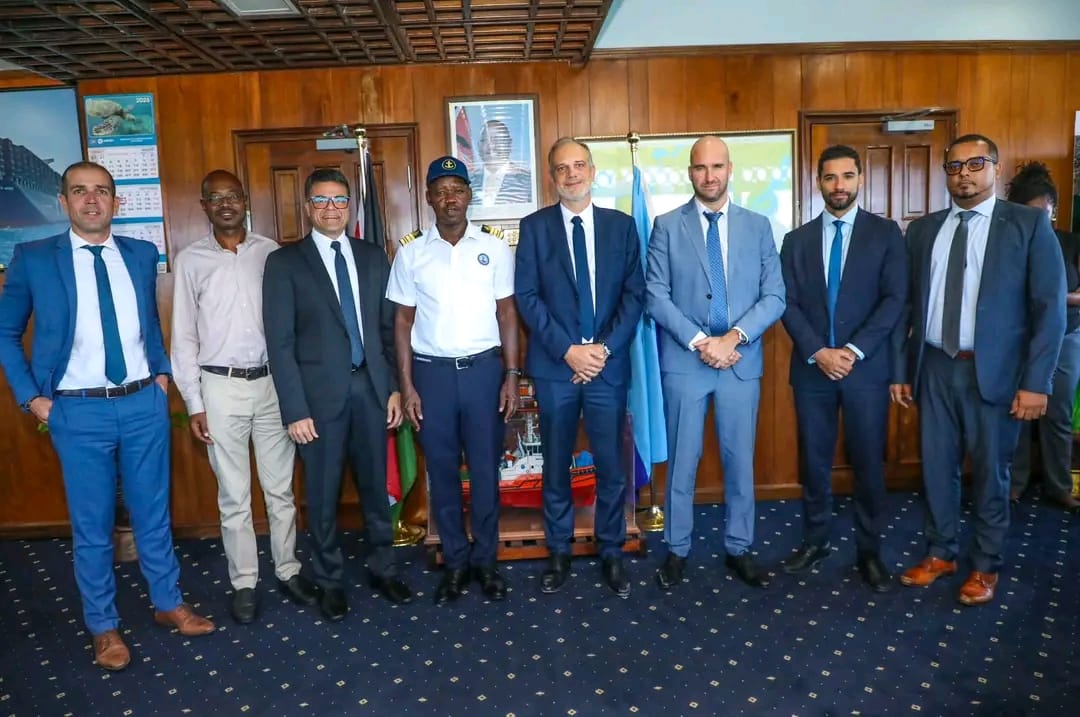
The recent visit by Frederick Tatin, Senior Vice President for Africa Lines at CMA CGM, to the Kenya Ports Authority (KPA) headquarters was far more than a diplomatic courtesy. It was a public validation of the Port of Mombasa’s ongoing transformation—and a clear signal that one of the world’s largest container shipping companies views Kenya’s maritime gateway as a strategic asset worthy of deeper, long-term partnership.
Tatin’s discussions with KPA Chief Executive Captain William K. Ruto centred on operational efficiency, logistics performance, and accelerated cooperation. The French executive commended sustained improvements in service delivery, describing Mombasa as an increasingly significant regional trade gateway. He specifically highlighted infrastructure expansion and modernisation at both Mombasa and Lamu, framing these investments as tangible evidence of growing confidence in Kenya’s ports and the broader East African market. These developments, he noted, are unlocking new opportunities for trade, connectivity, and investment.
Captain Ruto responded by reaffirming KPA’s commitment to maintaining Mombasa’s competitiveness and reliability on the global stage. He pointed to sustained capital expenditure on infrastructure and operational upgrades designed to cut vessel turnaround times and expand cargo-handling capacity—measures intended to keep the port responsive to the evolving needs of shipping lines, importers, exporters, and the wider supply chain. The CMA CGM delegation, which included senior regional and procurement executives, underscored the commercial seriousness of the engagement.
This endorsement does not occur in a vacuum. Mombasa has posted solid volume growth even as it operates near capacity. In 2025, the port handled 45.45 million metric tonnes of cargo, a 10.9 per cent increase from the previous year, with container traffic reaching 2.11 million TEUs, up 5.5 per cent. Transit cargo, critical for landlocked neighbours, grew even faster. Recent operational milestones—such as a single-shift discharge of 863 containers—demonstrate that process improvements, equipment modernisation, and workforce coordination are delivering measurable results. These gains matter because shipping lines measure ports by reliability, speed, and cost. Endorsements from carriers of CMA CGM’s scale translate into more vessel calls, better schedule integrity, and a greater willingness to route cargo through the Northern Corridor.
The timing also aligns with a larger strategic bet. In May 2026, CMA CGM committed approximately $820 million (€700 million) to modernise and expand two terminals at Mombasa under a cooperation framework with the Kenyan government. Announced on the sidelines of the Africa Forward Summit, the investment aims to raise handling capacity, accommodate larger vessels through dredging, and integrate multimodal logistics deeper into East and Central Africa via CMA CGM’s CEVA Logistics arm. Kenya has been actively courting private capital for berths and terminals; this deal fits squarely within that public-private partnership push and signals that global operators are prepared to put substantial capital behind the modernisation narrative—rather than merely offering polite praise.
Mombasa’s significance extends well beyond Kenya’s borders. It remains the primary deep-water gateway for Uganda, Rwanda, South Sudan, the eastern Democratic Republic of Congo, and parts of Ethiopia. Efficiency gains therefore reduce the landed cost of goods across a vast hinterland and strengthen the competitiveness of the Northern Corridor relative to alternatives such as Dar es Salaam. Parallel development at Lamu Port, the maritime anchor of the LAPSSET corridor, adds strategic depth. Lamu has recorded rapid volume growth from a low base and is positioning itself for transshipment and northern trade routes. Coordinated modernisation of both ports reduces the risk that congestion or capacity constraints at one facility undermine the entire system.
Yet recognition from a major carrier is not a finished achievement; it is an invitation to sustain the pace. Historical challenges—periodic congestion, lengthy cargo dwell times, and coordination frictions among agencies—have not vanished. Recent joint reforms by KPA and the Kenya Revenue Authority aimed at clearing long-stay containers, improving empty-container management, and deepening digital integration are necessary responses. Hinterland connectivity, including road and rail links, remains decisive. Without reliable cargo evacuation, terminal capacity expansions simply shift bottlenecks inland. Continuous investment in equipment, terminal operating systems, automation of gates, and skills development will be required if Mombasa is to handle the larger volumes that the CMA CGM investment and regional growth are expected to generate.
The broader economic stakes are clear. Efficient ports lower trade costs, support manufacturing and agribusiness exports, attract foreign investment into logistics and special economic zones, and create direct and indirect employment. They also strengthen Kenya’s position as a regional logistics hub at a time when African container trade is expanding and carriers are recalibrating global networks. For landlocked economies dependent on Mombasa, reliable access to global shipping routes is a development imperative, not a commercial convenience.
Tatin’s visit and the accompanying statements therefore mark more than diplomatic goodwill. They reflect a commercial assessment that Kenya’s ports are moving decisively in the right direction and that deeper partnership can unlock mutual value. Captain Ruto’s emphasis on infrastructure, turnaround times, and stakeholder responsiveness is the correct operational posture. The test now is execution: translating capital commitments, process reforms, and regional coordination into consistently lower costs and higher reliability for every shipper who chooses Mombasa.
If Kenya continues to treat modernisation as a continuous programme rather than a series of discrete projects, the Port of Mombasa can consolidate its role as East Africa’s premier maritime gateway. Global shipping lines are already signalling their readiness to meet that ambition halfway. The opportunity is substantial; the responsibility to deliver rests squarely with those who manage the quays. The world is watching—and, increasingly, it is investing.