


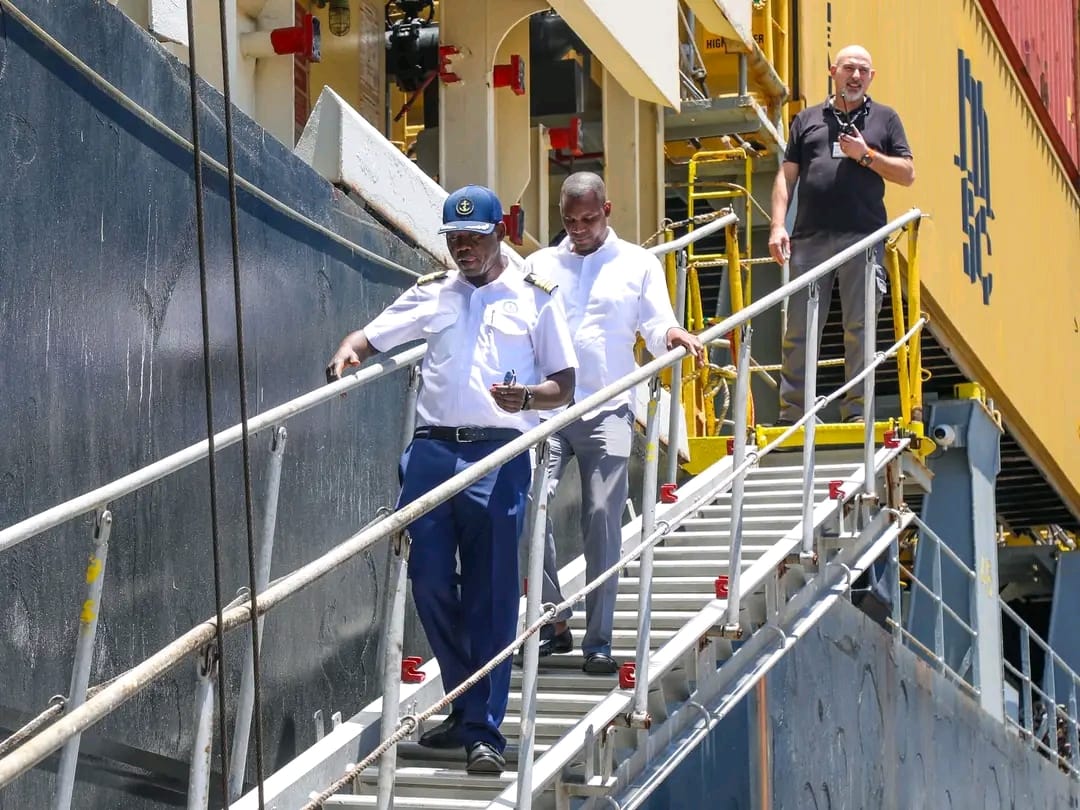
On Monday, the Port of Mombasa did something deceptively simple and quietly consequential: it set a new internal benchmark for container discharge. A coordinated team of vessel planners, crane operators, truck drivers, yard staff, and supervisors offloaded 863 containers from the MV Aniello in a single shift. By 2:40 a.m. the following morning, they had cleared the entire load of 1,005 containers—work completed in roughly one and a half shifts. Operations began around 3 p.m. after Kenya Ports Authority Managing Director Capt. William Ruto personally piloted the vessel through the Kilindini Channel and berthed it at Berth 22.
The numbers are impressive on their own. What makes them significant is the context in which they were achieved and the message they send about the trajectory of East Africa’s premier gateway.
Efficiency as Competitive Currency
Global shipping lines measure ports by turnaround time more ruthlessly than almost any other metric. Every extra hour a vessel spends at berth compounds fuel costs, schedule risk, and opportunity cost. In an era of larger ships, tighter schedules, and persistent supply-chain fragility, ports that can consistently empty a vessel quickly gain leverage with carriers. Mombasa’s latest performance demonstrates that the combination of modern equipment, disciplined teamwork, and process refinement can compress handling times in commercially meaningful ways.
Capt. Ruto attributed the result to four interlocking factors: modern cargo-handling equipment, a skilled and motivated workforce, technology-driven operational systems, and continuous process improvement. This is not empty managerial language. Over the past three years, the port has added equipment, expanded yard capacity, upgraded its terminal operating system, and automated gates. Those investments are now translating into measurable productivity gains at the quay.
The achievement also reflects leadership visibility. When the chief executive of the authority pilots a vessel himself and remains engaged through the operation, it signals that operational excellence is not delegated to middle management—it is owned at the top. Culture follows example.
The Broader Performance Backdrop
The single-shift record did not occur in isolation. In 2025, the Port of Mombasa handled a record 45.45 million metric tonnes of cargo, up roughly 11 percent from the previous year, while container throughput reached 2.11 million TEUs. Transit cargo—critical for landlocked neighbours—grew even faster, rising nearly 20 percent. Uganda remains the dominant transit market, but volumes to South Sudan, the Democratic Republic of Congo, and Rwanda continue to expand. Vessel calls have also increased, reflecting growing confidence among shipping lines.
These aggregate numbers matter because they show that the port is absorbing higher volumes while simultaneously raising the productivity ceiling on individual vessels. Capacity utilisation and operational intensity are rising together—an encouraging combination.
Regional Competition Is Real and Intensifying
Mombasa does not operate in a vacuum. Dar es Salaam has invested heavily in berth deepening, equipment, and corridor links, and has recorded sharp improvements in certain efficiency rankings. Djibouti continues to consolidate its position as a Horn of Africa hub. Lamu is gradually attracting regular services. The competitive pressure is healthy: it forces continuous improvement. Shipping lines and cargo owners will route traffic to whichever gateway offers the best combination of speed, reliability, cost, and inland connectivity.
In that contest, single-shift discharge records and faster overall turnarounds are tangible differentiators. They reduce the total logistics cost for Ugandan manufacturers, Rwandan exporters, and Congolese importers. They also strengthen Kenya’s claim as the natural maritime gateway for the Northern Corridor.
Yet volume growth and operational records alone will not secure long-term dominance. Persistent challenges remain: container dwell times that still exceed ambitious targets, occasional congestion during peak periods, the need for deeper inland logistics integration (rail and road), and the requirement to keep expanding berth and yard capacity ahead of demand. Projects such as the rehabilitation of Berth 19B and the planned construction of Berths 23 and 24—expected to add substantial TEU capacity—are therefore essential, not optional.
Why This Matters Beyond the Quay
Faster vessel turnaround is not merely a technical achievement. It lowers the cost of trade for the entire hinterland. For landlocked economies whose imports and exports must pass through a coastal gateway, every efficiency gain at Mombasa translates into more competitive pricing for consumer goods, industrial inputs, and agricultural exports. In a region still working to industrialise and deepen intra-African trade under the African Continental Free Trade Area, reliable and efficient ports are strategic infrastructure, not just commercial facilities.
The record also reinforces a broader narrative about institutional performance. Kenya Ports Authority has demonstrated that sustained investment, operational focus, and leadership accountability can deliver measurable results. That matters for public confidence in state-owned enterprises and for the credibility of Kenya’s blue-economy ambitions.
The Path Forward
One record does not define a port. Sustained excellence does. The challenge for Mombasa is to convert episodic peaks into a new baseline: consistently high productivity across shifts, across berths, and across vessel types. That requires continued capital investment, relentless attention to process discipline, deeper digital integration, and close collaboration with shipping lines, freight forwarders, and inland operators.
It also requires realism. Global trade volumes will keep growing, ships will keep getting larger, and competitors will keep improving. Complacency is the only real threat. The workforce that cleared 863 containers in a single shift has shown what is possible when systems, equipment, and people align. The task now is to make that performance the expected standard rather than the celebrated exception.
In doing so, the Port of Mombasa will not merely defend its position as East Africa’s leading gateway. It will strengthen the economic arteries of an entire region. That is the deeper significance of Monday’s achievement.