


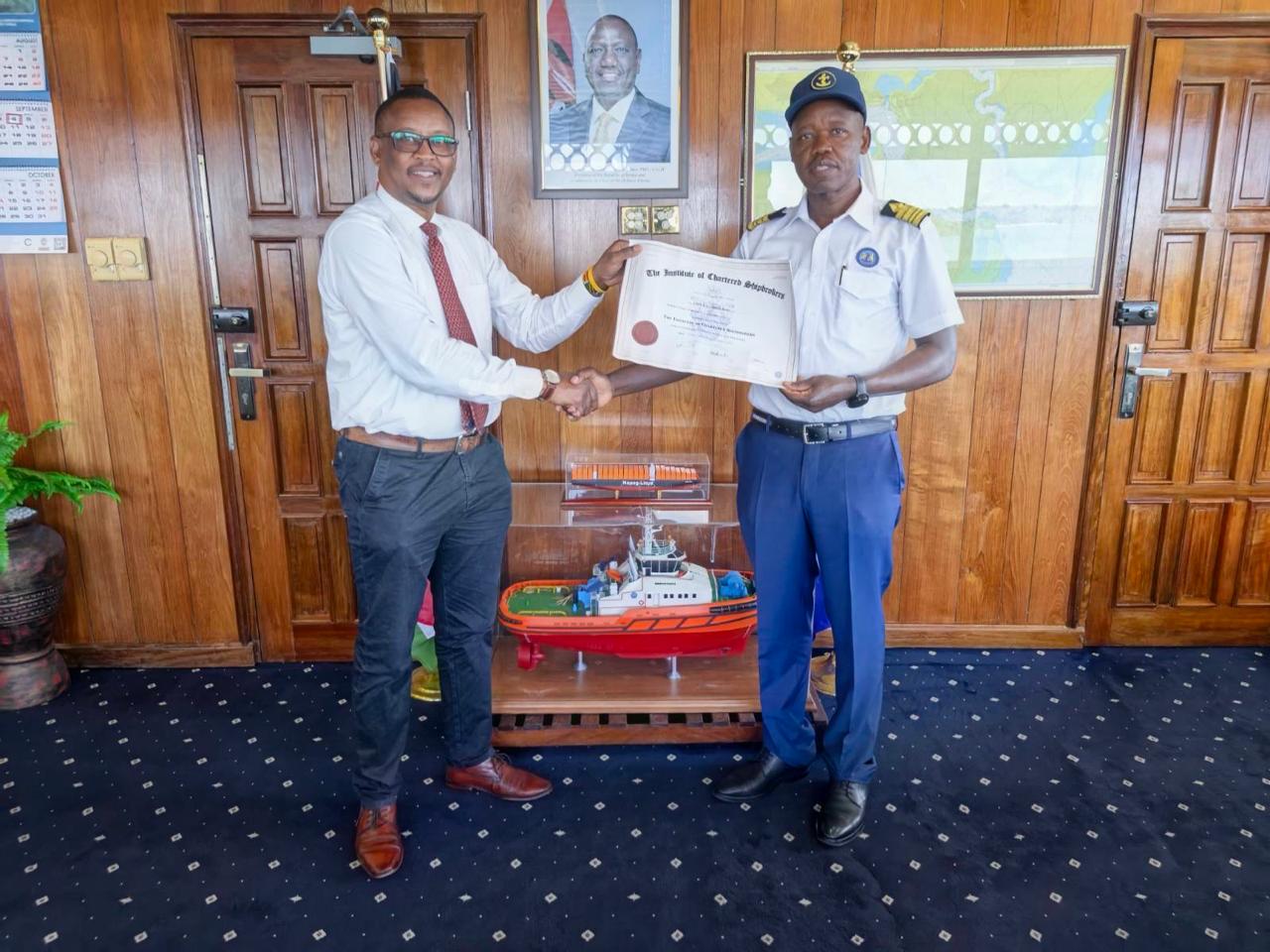
The Institute of Chartered Shipbrokers East Africa Branch’s conferment of an Honorary Fellowship upon Capt. William Kipkemboi Ruto, Managing Director of the Kenya Ports Authority, is more than a ceremonial accolade. It is a timely affirmation of professional leadership in a sector that underpins Kenya’s economy and East Africa’s trade arteries. Presented by Branch Chairman Elijah Mbaru FICS and fellow members, the recognition celebrates Ruto’s career, institutional stewardship, and tangible support for maritime education and professional standards.
In an industry still navigating post-pandemic supply-chain recalibrations, geopolitical pressures, and intensifying regional competition, this honour carries strategic weight. It signals that excellence in port management—measured by efficiency gains, trade facilitation, and investment in people—is being noticed by the global commercial shipping community.
From Master Mariner to Port Steward
Capt. Ruto’s trajectory embodies the pathway the Institute champions. A Class 1 Master Mariner trained at South Tyneside Marine College in the United Kingdom, he rose through the ranks from marine deck officer and pilot to Harbour Master, General Manager of Port Operations, and ultimately Managing Director of KPA. His experience spans both seafaring and port administration, private and public sectors. He is an Associate Fellow of the Nautical Institute and a member of the International Harbour Masters Association. This practical grounding informs a leadership style that prioritises operational realism over abstract strategy.
Under his stewardship, the Port of Mombasa and associated facilities have recorded measurable progress. Cargo throughput reached a record 45.45 million tonnes in 2025, a 10.9 percent increase over the previous year. Container volumes climbed to approximately 2.11 million TEUs. Operational milestones—such as the recent discharge of 863 containers from a single vessel in one shift, completing 1,005 containers in roughly one-and-a-half shifts—illustrate gains in berth productivity and coordination. Infrastructure advances, including the Second Container Terminal Phase Two, the Kipevu Oil Terminal, and ongoing work on additional berths and systems upgrades, have expanded capacity while supporting Lamu Port and inland facilities. Partnerships with major shipping lines have reinforced Mombasa’s position as a preferred gateway for the Northern Corridor and beyond.
These results did not occur in a vacuum. They reflect deliberate focus on equipment modernisation, process digitisation, customer engagement, and workforce motivation—areas that directly affect vessel turnaround times, demurrage costs, and the competitiveness of Kenyan trade routes relative to neighbouring ports.
Professionalism as Infrastructure
The Institute of Chartered Shipbrokers exists to raise standards in commercial shipping through education, ethics, and professional qualification. Honorary Fellowship is sparingly awarded to individuals whose contributions advance the industry beyond their immediate institutional roles. Ruto’s support for the East Africa Branch—championing maritime education, professional development, and stakeholder engagement—aligns precisely with this mission.
A strong maritime industry is not built solely on concrete berths, cranes, and digital platforms. It requires a cadre of knowledgeable, ethical professionals who understand chartering, operations, risk, and the commercial logic of global trade. By creating space for students, practitioners, and stakeholders to learn and connect, Ruto has helped reinforce the link between operational leadership and the professional pipeline. In a region where skilled seafarers, brokers, and port managers remain in demand, this investment compounds over time.
The recognition also arrives as Kenya advances its Blue Economy agenda. Ports are no longer mere cargo-handling nodes; they are platforms for value addition, green shipping transitions, and regional integration. Initiatives around sustainability—such as mangrove restoration recognised by the International Association of Ports and Harbours—and moves toward cleaner equipment and smarter systems position KPA within a broader global conversation. Professional bodies like the ICS provide the knowledge networks and ethical frameworks necessary to navigate these shifts effectively.
Broader Stakes and Enduring Questions
Kenya’s ports serve landlocked neighbours and compete for transshipment and transit cargo. Efficiency, reliability, and cost remain decisive. Leadership that delivers volume growth while containing costs and improving service quality strengthens the country’s negotiating position with shipping lines and inland logistics players. It also supports national goals around trade facilitation, industrialisation, and foreign exchange earnings.
At the same time, the sector operates within Kenya’s public institutional environment, where appointments, tenure, and accountability attract legitimate scrutiny. Recent legal questions surrounding the duration of Ruto’s term illustrate the importance of clear governance processes. Professional recognition of the kind conferred by the ICS does not resolve such matters, but it does underscore a different metric of value: sustained contribution to operational performance and capacity building. Institutions thrive when both political accountability and professional excellence are taken seriously.
Looking ahead, the real test lies in translating recognition into durable systems. Continued progress on automation, further berth development, deeper integration of Lamu and inland facilities, and sustained investment in human capital will determine whether current gains become structural advantages. Partnerships with global shipping lines, technology providers, and educational bodies must deepen. And the professional community—shipbrokers, agents, mariners, and port managers—must keep raising the bar on competence and ethics.
A Signal Worth Amplifying
Capt. William Ruto’s Honorary Fellowship is a well-deserved personal milestone. More importantly, it is a public signal that leadership grounded in maritime expertise, focused on measurable performance, and committed to developing the next generation of professionals advances both institutional and national interests.
Kenya’s maritime future will be shaped by infrastructure projects, policy choices, and market forces. It will also be shaped by the quality of people who design, operate, and govern those systems. By celebrating a leader who has demonstrated the value of that combination, the Institute of Chartered Shipbrokers East Africa Branch has performed a useful public service: reminding the industry, and the country, that professionalism is not a soft add-on. It is a competitive necessity.
Congratulations to Capt. Ruto. The recognition is merited. The work of turning recognition into lasting regional advantage continues.
Andrew Mwangura is a Mombasa based maritime analyst.