


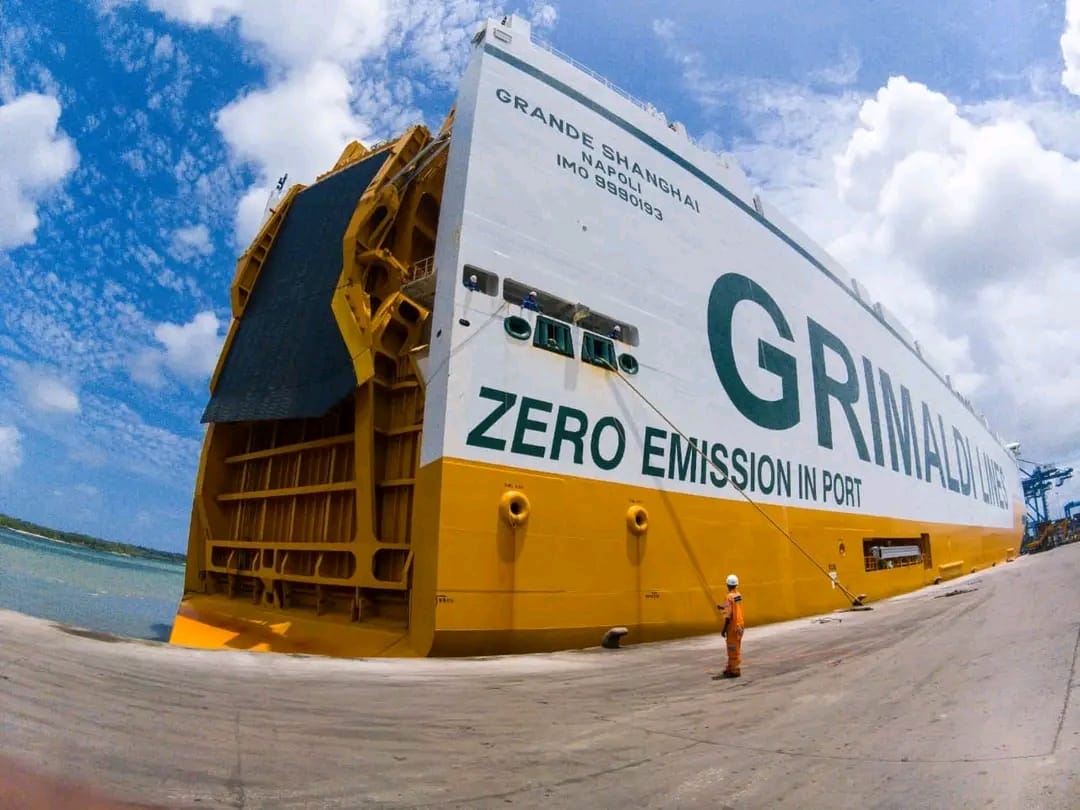
The Port of Mombasa has once again opened its berths to a vessel that represents more than just another cargo call. The MV Grande Shanghai—the eco-friendly pure car and truck carrier that first arrived on her maiden voyage last year—is back. Operating on the increasingly vital East Asia–East Africa route, she is discharging 812 motor vehicle units along with 111 packages of project cargo and spare parts.
This is not routine shipping news. It is a tangible signal that the global maritime industry’s slow, uneven pivot toward decarbonization is beginning to touch Africa’s busiest gateway—and that Kenya’s port is positioning itself to meet that future rather than merely react to it.
A Bridge Vessel for a Transitioning Industry
The Grande Shanghai is no ordinary Ro-Ro. Built as a first-generation zero-emission capable vessel, she incorporates ammonia-ready systems, solar panels, high-capacity batteries, and drag-reducing hull coatings. She can maintain a service speed of 19 knots while sharply cutting sulfur oxides, nitrogen oxides, and particulate emissions compared with conventional car carriers.
These are not marketing flourishes. They are engineering responses to the International Maritime Organization’s tightening greenhouse-gas targets and to the commercial reality that cargo owners—especially vehicle manufacturers—face growing pressure to clean up their logistics chains.
Layered Significance for Mombasa
For the Port of Mombasa, the vessel’s return carries layered significance.
First, it underscores the strength of the East Asia–East Africa trade corridor. Chinese and other Asian manufacturers continue to supply vehicles, machinery, and industrial components to a region whose middle class and infrastructure needs are expanding. Reliable, higher-capacity Ro-Ro services reduce logistics costs and delivery times for importers in Kenya, Uganda, Rwanda, the Democratic Republic of Congo, and beyond. The Grande Shanghai’s presence reinforces Mombasa’s role as the primary gateway for this traffic at a time when regional ports are competing more aggressively for volume and investment.
Second, the ship’s green credentials align with Kenya Ports Authority’s own 2024–2028 Green Port Policy. Shore-power readiness, renewable energy integration, and lower-emission cargo-handling equipment are no longer optional aspirations; they are becoming competitive necessities. When vessels designed for cold ironing and reduced emissions call at a port that can accommodate them, both sides benefit. The ship avoids burning fuel at berth; the port demonstrates it can host the next generation of tonnage. Over time, this alignment can attract more modern fleets, improve air quality for coastal communities, and strengthen Kenya’s case in regional and international climate discussions.
The Distance Still to Be Covered
Yet the arrival also exposes the distance still to be covered.
Ammonia readiness is a forward-looking design choice, not yet operational reality. The global bunkering infrastructure for ammonia, methanol, and other alternative fuels remains thin—particularly in African ports. Battery and solar systems help in port and during low-power operations, but deep-sea passages still rely on conventional or transitional fuels. Drag-reducing coatings and efficient hull forms deliver measurable efficiency gains, yet they cannot alone deliver the absolute emissions reductions the industry has promised.
The Grande Shanghai is a bridge vessel—proof that serious engineering progress is possible, while reminding us that the bridge is incomplete.
Economic and Strategic Stakes
Economically, the stakes are high. Vehicle imports remain a significant source of revenue and employment around Mombasa. Project cargo and spare parts support infrastructure and industrial activity inland. A more efficient, lower-emission shipping service can lower the total cost of ownership for imported assets and improve the reliability of supply chains that feed construction, agriculture, and manufacturing. At the same time, ports that lag in green infrastructure risk becoming second-tier destinations as cargo interests and regulators increasingly factor carbon intensity into routing decisions.
There is a broader strategic dimension. East Africa’s maritime future will be shaped by how well its ports adapt to two simultaneous pressures: rising trade volumes driven by Asian manufacturing and African demand, and the regulatory and commercial push for lower emissions. Mombasa’s ability to handle advanced Ro-Ro tonnage efficiently—while steadily building shore power and cleaner operations—will influence whether it consolidates its position or cedes ground to competitors. The Grande Shanghai’s return is evidence that the port is already on the map for operators investing in greener fleets. Sustaining that status will require consistent investment, regulatory clarity, and close coordination with shipping lines and cargo interests.
Transformation Is Cumulative
Critics may argue that one advanced car carrier does not transform an industry or a port. They are correct.
Transformation is cumulative. It is the product of successive vessel designs, incremental infrastructure upgrades, clearer policy signals, and commercial incentives that reward lower emissions. The Grande Shanghai is one data point in that longer process. Its significance lies in what it demonstrates: that the technology exists, that major operators are deploying it on Africa-serving routes, and that Mombasa is capable of receiving it.
The Real Work Has Only Just Begun
As the vessel works cargo and prepares for the next leg of its voyage, the quieter message is the more important one. Sustainable shipping is no longer an abstract aspiration confined to European or Asian trades. It is arriving—in steel and solar panels—on the Indian Ocean coast.
The question for East African policymakers, port authorities, and private operators is not whether green vessels will become the norm, but how quickly local infrastructure, skills, and policy can keep pace.
The Grande Shanghai has returned. The real work of ensuring that more ships like her find a ready, efficient, and competitive home in Mombasa has only just begun.
Andrew Mwangura is a maritime analyst based in Mombasa, Kenya.