


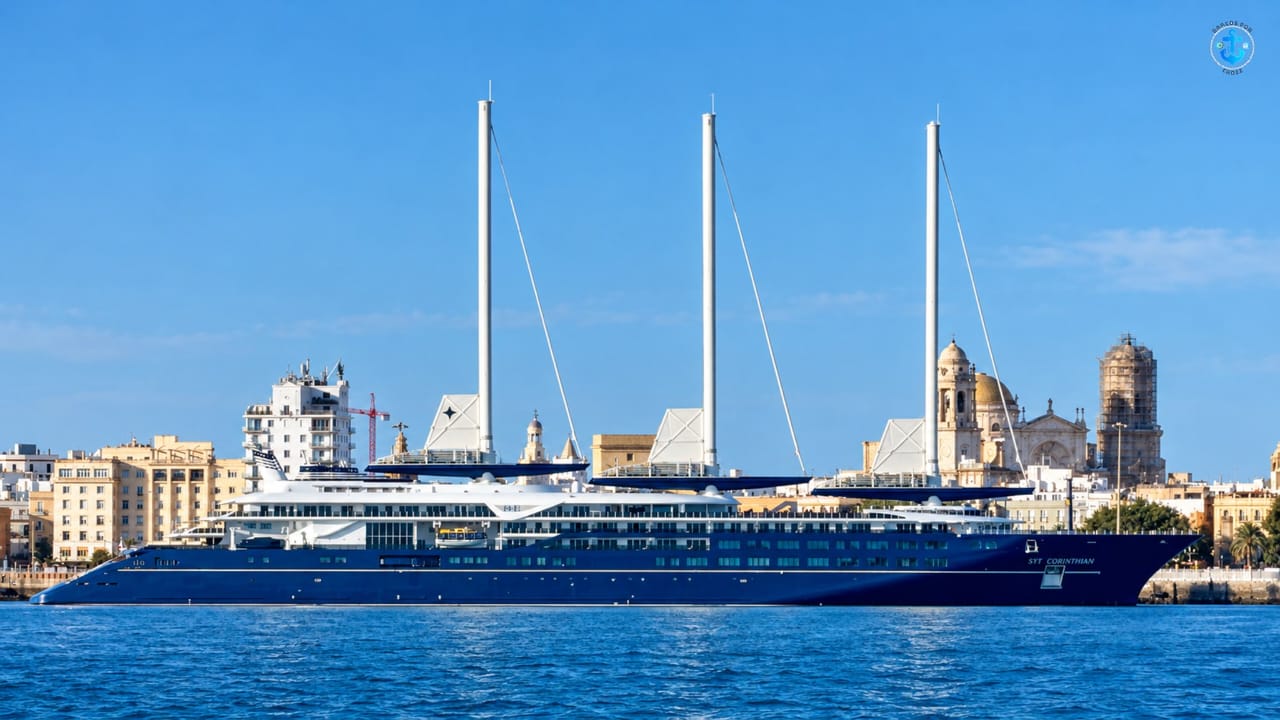
On an otherwise unremarkable October day in 2026, the Port of Málaga accomplished something industry observers had anticipated for years: the first ship-to-ship liquefied natural gas bunkering of a cruise vessel in its waters. Axpo’s Alisios LNG transferred roughly 300 cubic metres of LNG to the hybrid sailing cruise ship OE Corinthian. The volume was modest. The optics—two vessels rafted together in a Mediterranean harbour—were almost routine. The implications are not.
This was no mere incremental fuel delivery. It was a practical demonstration that the cruise sector’s slow, uneven shift toward lower-emission operations is beginning to intersect with the more mature LNG bunkering infrastructure built primarily for container ships and tankers. And it happened in a secondary Spanish port that has deliberately positioned itself as a Mediterranean alternative-fuels hub.
From Truck-to-Ship to Ship-to-Ship: Closing the Capability Gap
Málaga’s LNG journey has been methodical. In November 2023, the port supplied LNG to Silver Nova by truck-to-ship. In March 2025, it achieved its first ship-to-ship LNG operation—for an MSC container vessel, again with Axpo. The October 2026 operation for OE Corinthian simply extended that capability to the passenger segment.
The progression matters. Truck-to-ship is flexible but volume-constrained and logistically cumbersome for larger cruise ships. Ship-to-ship transfers scale better, reduce dock congestion, and align with the operational rhythms of modern ports that already handle simultaneous cargo operations.
The choice of vessel is equally revealing. OE Corinthian is no conventional mega-ship. At approximately 220 metres and equipped with three large rigid sails plus dual-fuel LNG engines, it embodies the hybrid philosophy currently in vogue among premium operators: use wind when conditions allow, LNG when they do not. Supplying it via STS validates that this new generation of vessels can be supported without forcing ports into expensive, dedicated infrastructure that sits idle between infrequent calls.
Why Cruise Ships Lagged—and Why That Is Changing
Cruise lines have been slower than container operators to adopt LNG at scale, for understandable reasons. Their itineraries are more rigid, their public image more sensitive, and their fuel consumption profiles different. LNG requires cryogenic tanks, specialised crew training, and careful boil-off management—costs that are harder to justify when ships spend significant time in port or steam at moderate speeds. Methane slip remains a legitimate concern: unburned methane is a potent greenhouse gas, and older dual-fuel engines performed poorly on this metric. Newer engines and better operational practices have narrowed the gap, but the criticism has not disappeared.
Yet regulatory and commercial pressure is intensifying. FuelEU Maritime, the extension of the EU Emissions Trading System to shipping, and tightening port emission rules in the Mediterranean are making conventional heavy fuel oil increasingly expensive and reputationally toxic. Passengers—especially on the luxury and expedition end of the market—are beginning to ask harder questions about the carbon intensity of their holidays. Hybrid designs that combine wind assistance with LNG offer a pragmatic bridge: lower emissions today without waiting for methanol, ammonia, or hydrogen infrastructure that remains years away for most ports.
Málaga’s operation shows that the infrastructure side of this bridge is becoming available in more places. Ports that can offer reliable STS LNG—and, increasingly, bio-LNG—will capture a growing share of calls from operators seeking both compliance and marketing advantages.
Strategic Positioning in a Crowded Mediterranean
Spain has been deliberate about LNG bunkering. Axpo’s presence with Alisios LNG (12,500 m³) and earlier vessels reflects a broader European push to create a network of small-scale LNG carriers capable of serving multiple ports. Málaga’s location—close to the Strait of Gibraltar, with strong cruise traffic and growing container volumes—makes it a natural node. Competing ports in Italy, France, and elsewhere are making similar moves. The winners will be those that combine regulatory predictability, operational competence, and the ability to handle both fossil LNG and its renewable variants without friction.
There is also a quieter industrial policy dimension. Every successful STS operation trains crews, refines safety protocols, and builds institutional knowledge inside the port authority. That knowledge compounds. Ports that treat alternative-fuel bunkering as a core competence rather than an occasional special event will find themselves better positioned when the next wave of fuels arrives.
The Limits of the Milestone
Honesty requires acknowledging what this operation does not prove. Three hundred cubic metres is a small delivery relative to the daily consumption of a large cruise ship on a busy itinerary. One successful transfer does not constitute a robust supply chain. Bio-LNG and synthetic LNG remain scarce and expensive. And LNG itself is a transitional fuel; its climate benefit depends heavily on upstream methane leakage rates and the carbon intensity of the electricity used in liquefaction. Claiming that every LNG bunkering is an unqualified environmental win is marketing, not analysis.
Moreover, the cruise industry’s emissions problem is not solely a fuel problem. It is also a volume problem. As long as the sector continues to add capacity faster than it improves efficiency, absolute emissions will remain stubborn. Hybrid sails and LNG help at the margin; they do not rewrite the growth trajectory.
What Comes Next
The real test will be frequency and scale. Can Málaga—and ports like it—routinely bunker cruise ships with LNG or bio-LNG while maintaining tight turnaround times? Will operators of conventional diesel-electric mega-ships follow the hybrid pioneers, or will they wait for methanol-ready designs and corresponding bunkering networks? Will the European regulatory framework continue to reward early movers, or will it create perverse incentives that favour waiting for perfect solutions?
Málaga’s October operation will not answer those questions by itself. What it does is remove one practical objection: that cruise ships cannot be supplied efficiently with LNG via ship-to-ship methods in a working Mediterranean port. That objection is now obsolete.
In an industry often criticised for incrementalism dressed up as transformation, this was a concrete, operational step. It deserves neither breathless celebration nor cynical dismissal. It deserves to be recognised for what it is: evidence that the pieces of a lower-emission maritime system are beginning to fit together in real ports, with real ships, under real commercial conditions. The quiet competence of a successful STS transfer may ultimately prove more consequential than many of the grand announcements that precede it.
Andrew Mwangura is a maritime safety and security analyst based in Mombasa, Kenya.