


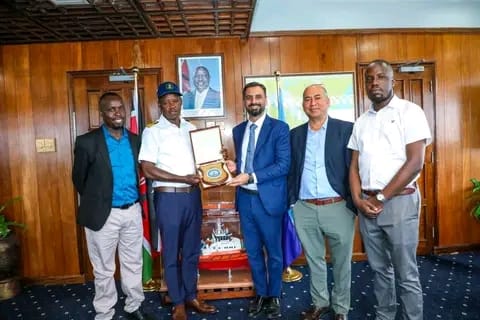
The recent visit by the National Assembly’s Departmental Committee on Transport and Infrastructure to the Port of Mombasa was more than a routine oversight exercise. It was a timely checkpoint on East Africa’s busiest maritime gateway—at a moment when record cargo volumes collide with rising regional competition and the hard realities of project execution.
Led by Ndia MP Hon. George Kariuki, the committee rightly recognised the port’s centrality to Kenya’s economy and to the wider region. The Port of Mombasa has long served as the primary artery for Kenya’s imports and exports and as the dominant Northern Corridor gateway for Uganda, Rwanda, South Sudan, eastern Democratic Republic of Congo and beyond. That role is not sentimental; it is commercial. In 2025, the facility handled a record 45.45 million metric tonnes of cargo, up 10.9 per cent from 40.99 million tonnes the previous year. Container traffic rose to 2.11 million TEUs (up 5.5 per cent), while transit cargo surged 19.5 per cent to 15.88 million tonnes. These figures reflect both recovering regional demand and the tangible effects of earlier reforms and equipment investments.
Yet growth of this magnitude is a double-edged sword. It validates the port’s competitive position while simultaneously exposing capacity and efficiency constraints. The committee’s emphasis on efficient operations and strong stakeholder coordination is therefore not bureaucratic language; it is the difference between sustaining leadership and watching cargo quietly migrate to alternative corridors.
The Kenya Ports Authority, represented during the visit by General Manager for Internal Audit and Risk Assurance Dr. Fred Oyugi on behalf of CEO Capt. William Ruto, outlined its response: capacity expansion, modernisation and productivity gains. Three strands stand out. The construction of Dongo Kundu Berth One is intended to serve the Special Economic Zone and lower logistics costs for investors locating there. Recent official updates place the project at roughly 16 per cent complete, with a target operational date of December 2028 and a price tag of approximately KSh 41 billion. Berth 19B—a 240-metre quay extension with a 15-metre draft designed to handle larger vessels and add around 300,000 TEUs of annual capacity—has advanced further; reports earlier in 2026 put it at 30 per cent, while the committee briefing cited 51 per cent. Parallel work continues on the Terminal Operating System upgrade and gate automation.
These projects are strategically sound. Larger ships, higher volumes and the need for predictable turnaround times require deeper drafts, longer berths and digital systems that reduce dwell times and improve yard planning. The TOS upgrade—moving away from a system whose roots stretch back more than a decade—is particularly important: modern terminal software underpins real-time decision-making, better integration with the national single window and smoother interfaces with shipping lines, truckers and inland operators.
Delivery, however, is where ambition meets scrutiny. Infrastructure projects of this scale in Kenya frequently encounter delays, cost pressures and coordination gaps between KPA, other agencies and private stakeholders. The Dongo Kundu SEZ itself has been years in the making; berth progress is welcome, yet complementary utilities, access roads and investor facilities must move in tandem if the zone is to attract the manufacturing and logistics activity it promises. Parliamentary oversight that questions value for money—as the same committee has done regarding a reported KSh 8.3 billion, 1.8-kilometre internal road project—is healthy when it focuses on procurement transparency and outcomes rather than mere political theatre. Public resources are finite; every shilling spent on port infrastructure must demonstrably expand capacity or cut costs for users.
Regional competition sharpens the stakes. Tanzania’s Port of Dar es Salaam has invested heavily in deeper berths, equipment and corridor improvements. Efficiency metrics and customer experience increasingly influence routing decisions by landlocked shippers. Mombasa still handles substantially higher volumes and retains strong institutional relationships, especially with Uganda, but complacency is not an option. Empty-container backlogs, yard congestion during peak seasons and any perception of high logistics costs along the Northern Corridor can erode market share. Digitalisation, reliable rail and road evacuation, and predictable dwell times are now as important as quay length.
The path forward requires disciplined prioritisation. First, accelerate completion of Berth 19B and the TOS upgrade while maintaining rigorous quality and cost controls. Second, ensure the Dongo Kundu berth and supporting SEZ infrastructure advance on a coordinated timeline so that the zone becomes a genuine demand generator rather than an isolated port project. Third, deepen multi-agency and private-sector coordination—customs, revenue authorities, truckers, shipping lines and inland container depots—so that efficiency gains inside the terminal are not lost at the gate or on the hinterland corridors. Fourth, maintain transparent parliamentary and public oversight that rewards measurable improvements in vessel turnaround, cargo dwell times and customer satisfaction.
The Port of Mombasa remains East Africa’s most important maritime asset. Record 2025 volumes prove its continuing relevance. The committee’s visit correctly highlighted both that achievement and the unfinished business of capacity, efficiency and coordination. Sustained growth and regional integration will not be secured by announcements alone. They will be secured by completing projects on time, controlling costs, digitising operations and treating every stakeholder interface as a competitive advantage. Anything less risks turning today’s record throughput into tomorrow’s cautionary tale of opportunity partially seized.