


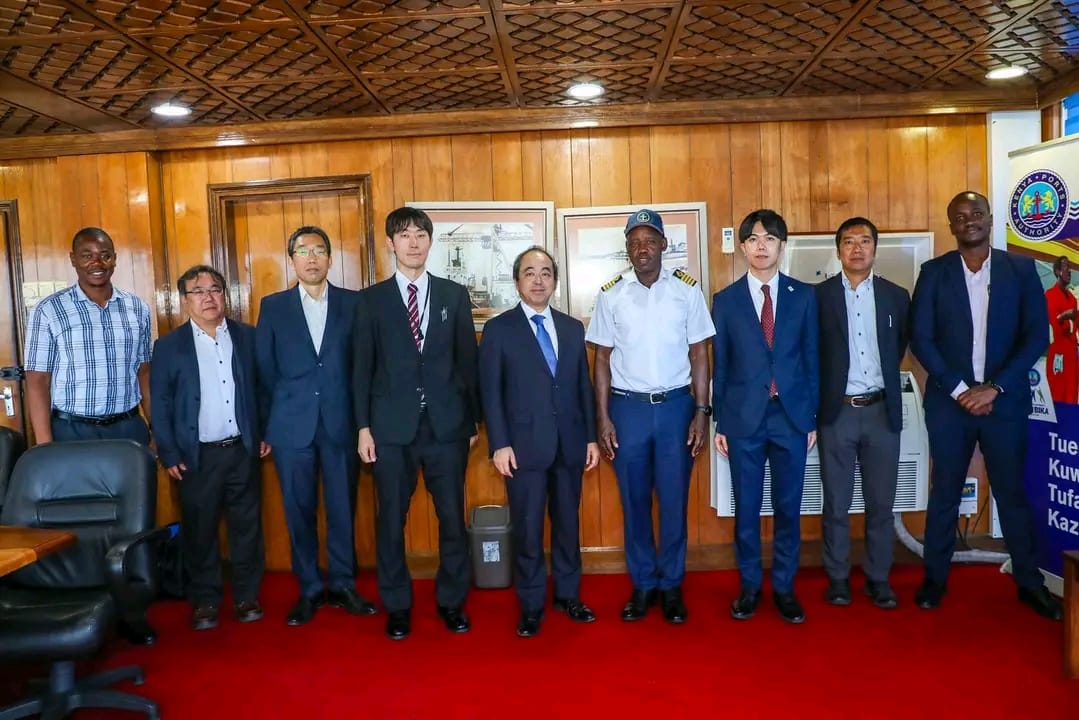
When Kenya Ports Authority Managing Director Capt. William Ruto hosted Mr. Imafuku Takao, Director-General of the International Cooperation Bureau in Japan’s Ministry of Foreign Affairs, at the Port of Mombasa, the occasion was more than diplomatic courtesy. It was a reaffirmation of one of the most consistent and consequential development partnerships in East Africa’s infrastructure landscape. Capt. Ruto rightly described the long-standing Kenya-Japan cooperation as a key driver of ports infrastructure growth and development. That assessment is not ceremonial rhetoric; it is grounded in decades of tangible results that have expanded capacity, improved efficiency, and positioned Mombasa as a leading regional maritime hub.
The Port of Mombasa serves as the primary maritime gateway for Kenya and a critical logistics artery for landlocked neighbours including Uganda, Rwanda, South Sudan, eastern Democratic Republic of Congo, and parts of Burundi and Ethiopia. Congestion, limited berth capacity, and rising container volumes once threatened its competitiveness. Sustained collaboration with the Japan International Cooperation Agency (JICA) has been central to reversing those pressures and modernising the facility.
The Second Container Terminal: Capacity That Matches Ambition
The flagship Mombasa Port Development Project, financed through Japanese ODA loans and implemented in phases, stands as the clearest illustration. Phase 1, completed and commissioned around 2016 at a cost of approximately KSh 26 billion, involved significant land reclamation and delivered roughly 550,000 TEUs of additional annual capacity. Phase 2, financed similarly under a government-to-government facility and executed by Japanese contractor Toyo Construction, added another 450,000 TEUs through three new berths (lengths of 230m, 320m, and 350m) capable of handling Panamax and post-Panamax vessels. Recent completion and handover of Phase 2 have pushed overall container capacity toward 2.1 million TEUs, placing Mombasa among Africa’s higher-capacity ports.
These are not abstract numbers. Larger vessels can call with greater frequency and reliability. Turnaround times improve. Hinterland connectivity—bolstered by complementary road projects also supported by Japanese financing—moves cargo more efficiently along the Northern Corridor. The result is lower logistics costs for regional importers and exporters, stronger competitiveness against rival ports, and greater resilience against global supply-chain shocks. Capt. Ruto’s appreciation for Japan’s commitment to KPA’s modernisation agenda reflects this operational reality.
Beyond Berths: Dongo Kundu and the Shift to Value Addition
Equally strategic is the Dongo Kundu Special Economic Zone (SEZ) initiative. JICA supported the foundational master planning that identified the site’s potential as a port-linked industrial and logistics hub on Mombasa’s southern mainland. Subsequent grant assistance has targeted enabling infrastructure—water supply facilities, drainage, land development—while KPA advances dedicated berth construction, notably Berth One, a multi-billion-shilling project currently under way. The vision is deliberate: move Kenya beyond raw commodity transit toward manufacturing, assembly, value addition, and logistics services that capture more of the economic upside of trade flows.
Projections of tens of thousands of jobs—with earlier estimates reaching as high as 100,000 at full build-out, and more recent figures highlighting several thousand direct positions as operations scale—underscore the stakes. Industrial parks, free trade zones, and integrated port facilities create the conditions for investors to locate production closer to regional markets. This aligns directly with Kenya’s Vision 2030 industrialisation goals and the broader African Continental Free Trade Area ambition. Japan’s approach—patient technical cooperation followed by financing and implementation support—has helped translate planning documents into physical progress rather than leaving them on shelves.
A Model of Development Partnership
What distinguishes the Kenya-Japan relationship in the ports sector is its longevity, technical depth, and focus on systems rather than isolated projects. Capacity building, master planning, equipment supply, and knowledge transfer have accompanied civil works. Japanese contractors have delivered on schedule in complex marine environments. Complementary investments in access roads and regional logistics have amplified the impact of terminal expansion. In an era when many infrastructure partnerships emphasise speed or geopolitical signalling, this model prioritises functionality, sustainability, and institutional strengthening.
The benefits extend beyond Kenya’s borders. Efficient operations at Mombasa reduce the cost of goods for millions of consumers and producers across East and Central Africa. They support regional integration and help Kenya retain and expand its role as a gateway economy. For Japan, the partnership advances long-standing priorities under the TICAD framework: quality infrastructure, connectivity along economic corridors, and mutually beneficial growth.
Challenges and the Work Ahead
Challenges remain. Sustaining high utilisation rates requires continued operational reforms, digitalisation, hinterland efficiency, and competitive pricing. Maintenance of newly built assets, local skills development, and transparent management will determine whether capacity gains translate into lasting competitiveness. Environmental and social safeguards around expansion and SEZ development must remain rigorous. Competition from other regional ports and evolving global shipping patterns demand constant adaptation. Yet the foundation laid through JICA-supported projects gives Mombasa a stronger platform from which to meet these demands.
Conclusion
Capt. Ruto’s remarks during Mr. Imafuku’s visit correctly frame the relationship as a driver of growth rather than mere donor assistance. The Second Container Terminal and Dongo Kundu SEZ are concrete expressions of that partnership. As Kenya continues modernising its maritime infrastructure and as regional trade volumes rise, the value of reliable, technically grounded cooperation becomes clearer. Japan’s consistent engagement offers a practical blueprint: long-term vision, high standards of execution, and alignment with national development priorities.
The Port of Mombasa’s evolution into a leading regional maritime hub is unfinished. Further phases of terminal development, full operationalisation of Dongo Kundu, and deeper integration of port, rail, road, and industrial assets lie ahead. Continued Kenya-Japan collaboration—rooted in the mutual recognition of shared interests—will be essential to converting today’s capacity into tomorrow’s prosperity. In an increasingly contested infrastructure landscape, partnerships that deliver measurable results and institutional strength remain the most valuable of all.
Andrew Mwangura is a maritime security analyst based in Mombasa, Kenya.