


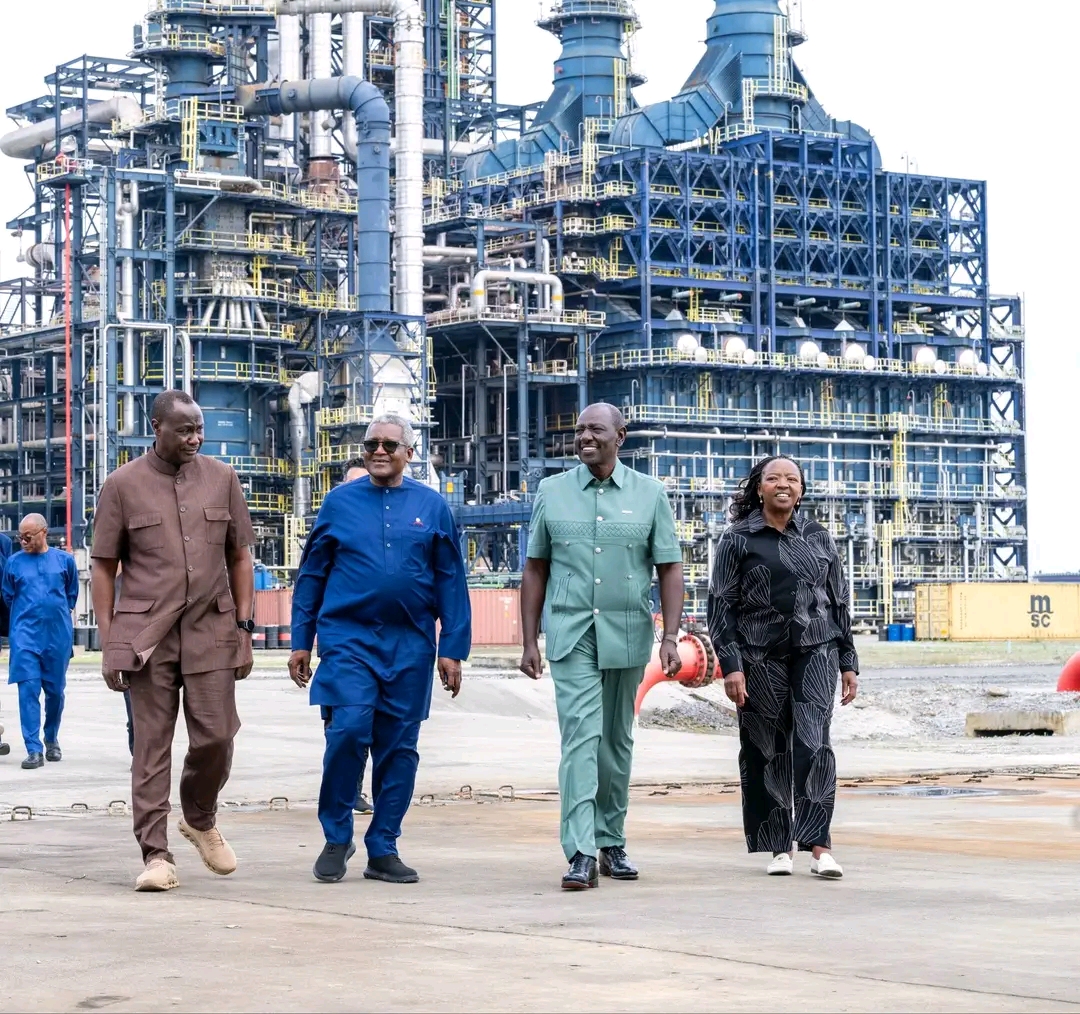
Tomorrow, September 30, 2026, Kenya plans to break ground on what could become one of the most consequential industrial projects in East African history: a 700,000-barrel-per-day oil refinery and petrochemical complex in Lamu, backed by Nigerian industrialist Aliko Dangote. The Chams Media documentary The Dangote Lamu Oil Refinery: The Site, the Significance & the Expected Impact captures the moment with on-the-ground footage and official optimism—foundation stone, 5,000-acre site in Magogoni within the Lamu Special Economic Zone, dual-carriageway access from Mokowe, and the promise of a “game-changer.” The video’s tone is celebratory, and understandably so. Yet a sober analysis must weigh the transformative potential against the hard realities of crude supply, financing, execution risk, and regional politics.
The Scale and the Site
The numbers are staggering. Capacity is pegged at up to 700,000 barrels per day—comparable to Dangote’s Lagos plant, currently the continent’s largest single-train refinery, and larger than East Africa’s entire current refined-product demand of roughly 450,000 bpd. Cost estimates range from $15–20 billion (approximately KSh 2–2.6 trillion). Construction is projected at three to four years, targeting operations around 2030. The complex will include a roughly 1,000 MW power plant fueled by petroleum coke, with half the output potentially sold to Kenya’s grid. Downstream products will extend beyond fuels to LPG, bitumen, plastics, fertilizers, and other petrochemicals—precisely the industrial linkages Kenya has long sought.
Ownership is structured with Dangote Group holding a majority (reported around 70 percent), while East African governments have been offered a combined 30 percent stake—Kenya, Ethiopia, and Rwanda each eyed for about 10 percent. Kenya has already allocated seed capital of roughly $165 million and appointed a high-level committee under the Deputy President to de-risk implementation. Heavy machinery has already begun arriving at Lamu Port. Engineers India Limited, which worked on the Lagos refinery, has been engaged for project management under a contract exceeding $450 million.
Lamu was chosen over earlier candidates—Tanga in Tanzania, then Mombasa—for practical reasons: a deep-water port already under development as part of the long-stalled Lamu Port–South Sudan–Ethiopia Transport (LAPSSET) Corridor, available land in a special economic zone, and Kenya’s relatively advanced regulatory and logistical environment. The project is explicitly positioned as a regional asset, not a purely Kenyan one.
The Promise: Energy Security and Industrial Multipliers
East Africa has lived with a structural absurdity for more than a decade. The region holds significant hydrocarbon resources—South Sudan’s production, Uganda’s imminent output, Kenya’s own discoveries in Turkana, and potential in other basins—yet imports nearly 100 percent of its refined fuels after Kenya Petroleum Refineries Limited shut down in 2013. Every geopolitical tremor in the Middle East or Red Sea shipping disruption translates directly into higher pump prices, foreign-exchange pressure, and inflation.
A domestic mega-refinery changes the arithmetic. Import costs fall. Price volatility dampens. The foreign-exchange drain eases. More importantly, the project anchors downstream industry. Primary chemical plants, fertilizer production, plastics manufacturing, and bitumen for roads create the kind of industrial ecosystem that development economists have advocated for decades. The employment dimension is equally significant: roughly 60,000 direct and indirect jobs during construction and operations, plus demand for engineers, technicians, welders, electricians, and logistics specialists. Kenya still retains institutional memory and trained personnel from the old Mombasa refinery; the Petroleum Institute of East Africa and technical colleges can accelerate certification.
Infrastructure synergies are equally material. LAPSSET—long criticized as underutilized—gains an anchor tenant. The Lamu–Garissa–Ethiopia road is already largely complete; a railway and refined-product pipeline to Ethiopia are planned; crude pipelines from Turkana (Lokichar) and South Sudan become commercially more viable. Power generation of this scale in a region still struggling with electricity access is itself transformative.
For Dangote, the project extends the model proven in Lagos: build large-scale, integrated refining and petrochemical capacity inside Africa, reduce the continent’s dependence on imported fuels and intermediate chemicals, and capture value that previously leaked to Asia, Europe, and the Middle East. Combined with the Lagos expansion toward 1.4 million bpd, Dangote’s refining footprint would approach 2.1 million barrels per day—an African industrial statement of global scale.
The Risks: Crude, Capital, and Complexity
Optimism must be tempered. The single largest vulnerability is feedstock. Kenya currently has no commercial crude production. Uganda’s output is only now approaching commercial volumes. South Sudan remains the region’s most reliable producer, yet political risk and pipeline logistics are non-trivial. Kenyan officials have floated figures of 600,000 bpd potentially available from regional sources; independent analysts are more cautious. If regional crude falls short, the refinery will import—reintroducing some of the very exposure it seeks to eliminate, albeit with the refining margin captured locally.
Financing is another test. Dangote intends to fund the project through internal cash, bonds, and IPO proceeds rather than heavy sovereign debt, with a reported 30:70 equity-to-debt split. That is prudent in principle, yet $15–20 billion is an enormous sum even for Africa’s richest man. Cost overruns plagued the Lagos project; lessons learned may help, but Lamu presents different terrain, logistics, and regulatory interfaces. Africa Finance Corporation’s involvement is encouraging, yet final financial close remains critical.
Environmental and social risks cannot be dismissed. Lamu is a UNESCO World Heritage site with sensitive ecosystems and communities whose livelihoods depend on fishing, tourism, and traditional land use. Large-scale industrial development of this magnitude requires rigorous impact assessments, transparent benefit-sharing, and genuine local content policies—not merely rhetorical commitments. History shows that mega-projects in coastal Kenya have sometimes generated more conflict than shared prosperity when community engagement is weak.
Political risk is real. Equity stakes offered to neighboring governments are intended to create shared ownership and political insurance. Whether those stakes materialize at the promised levels, and whether they translate into stable long-term offtake and transit arrangements, will determine whether the refinery functions as a true regional public good or becomes another source of bilateral friction.
A Broader African Ambition
This project is larger than one refinery. It is a stress test of whether African capital, African engineering capacity, and African political will can deliver complex industrial infrastructure at global scale without perpetual dependence on external contractors and lenders. Dangote’s Lagos refinery demonstrated that it is possible—albeit at high cost and with significant learning. Replicating that success on the opposite side of the continent, in a region with thinner crude production and less mature supporting infrastructure, is a higher degree of difficulty.
If it succeeds, East Africa gains energy security, industrial depth, and a credible path toward reducing the chronic fuel-import bill that has drained foreign exchange for decades. Lamu becomes more than a port; it becomes an industrial node. Kenya positions itself as the refining and petrochemical hub of the region. The multiplier effects—skills development, supplier industries, logistics, power—could compound for a generation.
If it falters, the costs will be measured not only in sunk capital but in dashed expectations and further skepticism about Africa’s ability to industrialize on its own terms.
Conclusion
The Chams Media documentary ends on a note of justified excitement. The site is secured. Machinery is arriving. Political commitment from Nairobi is high. The foundation stone is about to be laid. Those are necessary conditions. They are not yet sufficient. The real work—securing reliable crude, closing complex financing, executing on time and on budget, managing environmental and community impacts, and locking in regional offtake—begins the day after the cameras leave.
East Africa has waited long enough for energy sovereignty. Whether Lamu delivers it will be one of the defining industrial stories of the next decade.
Andrew Mwangura is a maritime security analyst based in Mombasa, Kenya.