


Dangote in Lamu: A Grand Vision Meets Ground-Level Reality
When Aliko Dangote touched down at Manda Airport on Tuesday, September 29, 2026, the symbolism was as potent as the ambition he carries. Africa’s richest man was received by Kenya Airports Authority (KAA) Managing Director and CEO Moses Wekesa, an official welcome confirming the high-stakes nature of his visit ahead of the groundbreaking for a proposed Sh2 trillion ($16 billion) East Africa Oil Refinery.
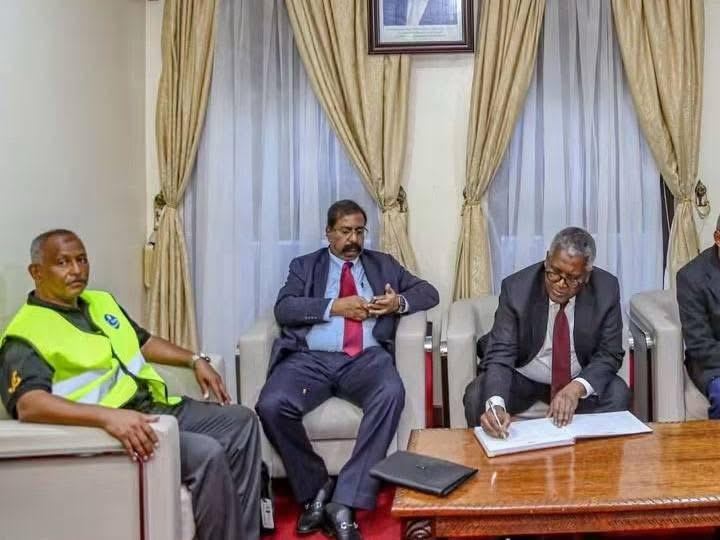
The tour continued at the Port of Lamu, where Dangote was received by Lamu Port General Manager Capt. Abdulaziz Mzee and signed the visitors’ book. For Capt. Mzee, a career maritime professional, the project represents a transformative boost for vessel traffic and revenue at a facility that has long operated below its potential. The port had already offered a tangible preview of this promise: just days earlier, the MV Da Yang delivered nearly 2,930 metric tonnes of heavy construction machinery.
From the official airport welcome to the symbolic signing at the port, the message is clear. Aviation upgrades at Manda and operational readiness at the Kililana berths are being tested in real time for a ceremony scheduled for September 30, with President William Ruto expected to preside. The machinery is on the ground, and the investor is in Lamu. The harder work of turning this powerful announcement into an operational reality, however, has only just begun.
The Scale and the Stakes
The proposed 700,000-barrels-per-day refinery is designed to process crude from Kenya’s Lokichar fields and other regional sources, supplying refined products across East Africa. Projections include tens of thousands of jobs, downstream petrochemical and fertiliser opportunities, and a linked power plant. Dangote has framed the investment as a quintessentially African endeavor, one with possible government stakes and eventual public participation via the Nairobi Securities Exchange.
At the heart of this vision is the Port of Lamu. Long under-utilised relative to Mombasa, its deep-water capacity is now being positioned as the natural gateway for crude imports and product exports. Capt. Mzee has emphasised that continuous calls by very large crude carriers and product tankers would fundamentally transform the port’s revenue profile—a capability demonstrated by the successful handling of the first machinery shipment.
Friction on the Ground
However, this wave of optimism collides with local realities. Residents in areas including Chandavai and Hindi/Manda Magogoni have lodged ancestral land claims. A Malindi Environment and Land Court order requires the maintenance of the status quo on disputed parcels pending a hearing on October 14. While the court did not stop the groundbreaking itself—both the Dangote Group and Energy Cabinet Secretary Opiyo Wandayi have confirmed the ceremony will proceed—the legal challenge casts a shadow. Dangote has characterised such challenges as routine on the continent.
Compensation, meaningful consultation, and environmental safeguards remain live issues in a region that already hosts military infrastructure, LAPSSET plans, and sensitive ecosystems. Large industrial projects in Kenya frequently face litigation; the true test will be whether the government and investors can convert court timelines into credible community agreements rather than prolonged uncertainty.
Broader Implications
Dangote’s presence—the airport reception, the port engagement, the arrival of equipment—accelerates a long-delayed vision for northern Kenya. For years, the LAPSSET corridor has promised connectivity and industrialisation. Tangible cargo and high-level visits make those promises more concrete.
For Kenya, the project is a test of the state’s ability to deliver land security, infrastructure coordination, and inclusive benefits. For the region, a modern large-scale refinery could reduce import dependence—provided it operates competitively and secures reliable crude supplies.
The visitors’ book at the port has been signed. The groundbreaking is set to proceed. But the grand vision for Lamu will be built not on ceremony, but on navigating the complex web of legal claims, community expectations, and commercial realities that lie ahead.