


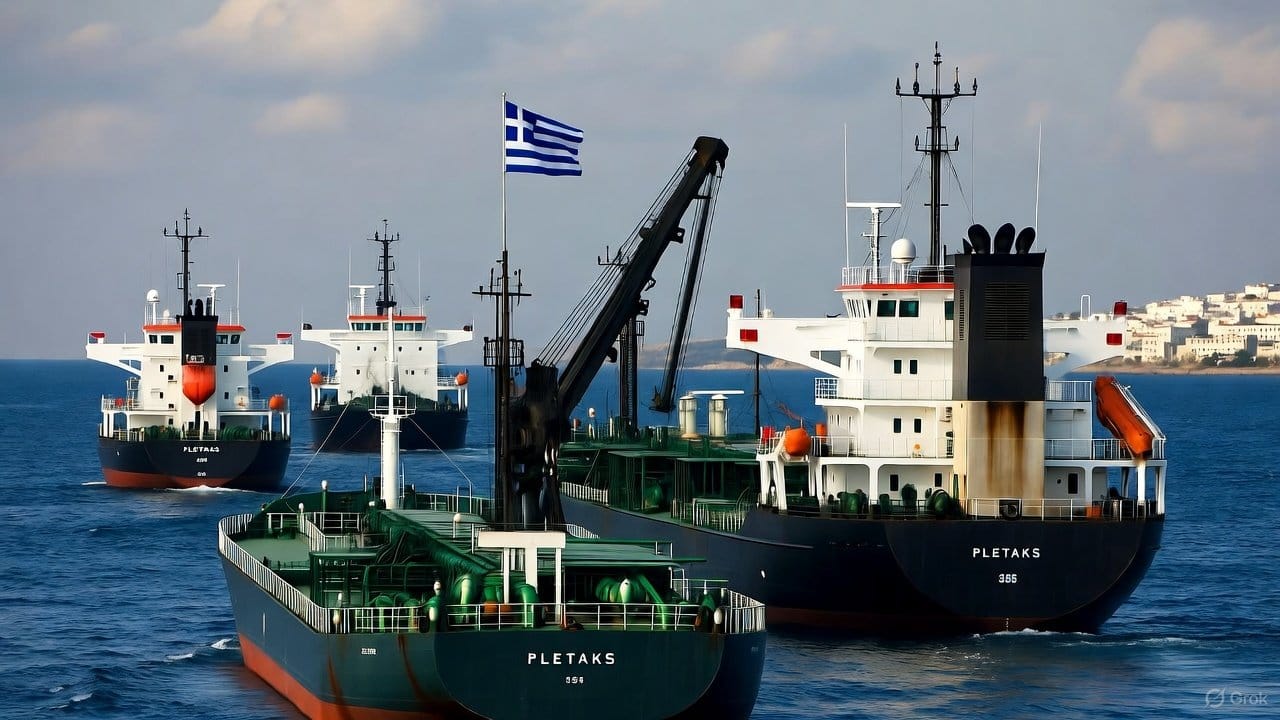
On World Maritime Day, the quiet dominance of Hellenic shipping once again stands in plain sight. While policymakers in Brussels debate maritime industrial strategy and strategic autonomy, the data show that Europe’s most formidable commercial fleet is not scattered across northern shipyards or state-backed operators. It is concentrated in Greek hands.
The Greek-owned fleet today numbers roughly 5,800 vessels. According to the Union of Greek Shipowners, it accounts for 61 percent of EU-controlled fleet capacity and 19.1 percent of global merchant fleet tonnage. Greece ranks first worldwide in oil tankers and LNG carriers, and second in bulk carriers—the very ship types that move the energy and raw materials on which modern economies depend. These are not abstract percentages. They represent the practical capacity that keeps oil, gas, grain, iron ore, and other bulk commodities flowing across oceans.
UNCTAD’s figures for the start of 2025 reinforce the picture. Greek owners controlled 5,124 vessels totalling 398 million deadweight tonnes, or 16.4 percent of the world total. China followed with 10,440 vessels, 347 million tonnes, and 14.4 percent. Japan held 4,083 vessels, 241 million tonnes, and 9.9 percent. Together, the three countries commanded more than 40 percent of global shipping capacity. Greece leads by carrying capacity even though China owns more individual ships—a reflection of the larger, more efficient vessels that Greek owners have long favoured.
This is not a recent accident of markets. Greek shipping has operated for generations as a global commercial network rather than a purely national register. Only a minority of Greek-owned ships fly the Greek flag; the great majority sail under foreign registries while remaining under Greek beneficial ownership and management, concentrated in Piraeus and the wider Athens maritime cluster. The model prioritises commercial flexibility, risk management across cycles, and service of third-country trade. More than 98 percent of Greek-controlled capacity moves goods between countries other than Greece. In a typical year, these ships make well over 170,000 port calls in more than 170 countries.
For Europe, the strategic implications are direct. Maritime transport carries the overwhelming majority of the EU’s external trade. Greek shipping supplies the bulk of Europe’s controlled capacity in the critical segments that underpin energy security: oil tankers, LNG carriers, and bulkers. In an era of disrupted sea lanes, longer voyages around Africa, and heightened geopolitical risk, that capacity functions as a form of commercial insurance. It does not require Brussels to operate a state fleet. It already exists—commercially driven and globally competitive.
As the European Union develops a maritime industrial strategy and pursues greater strategic autonomy, treating Greek shipping as a peripheral national industry would be a costly misreading of reality. It is one of the continent’s strongest existing maritime assets. It bolsters energy security by ensuring that tankers and gas carriers remain available under European beneficial control. It supports resilience by maintaining diversified, privately managed capacity that can respond to market signals rather than political directives. And it underpins competitiveness: efficient, large-scale Greek-owned tonnage helps keep freight costs disciplined for European importers and exporters.
The sector also carries weight at home. Shipping contributes an estimated 7–8 percent of Greek GDP directly and indirectly, and supports around 200,000 jobs. The maritime cluster in Piraeus and Athens—ship management, financing, insurance, legal services, technical expertise—forms one of Europe’s densest concentrations of specialised maritime knowledge. Greek owners continue to invest heavily in fleet renewal. Orderbooks have expanded significantly in recent years, with hundreds of new vessels on order, many incorporating energy-saving technologies, scrubbers, and alternative-fuel readiness. Greek-controlled fleets already rank among the leaders in the deployment of such technologies.
Challenges remain real. Decarbonisation requirements are tightening. Geopolitical disruptions have lengthened voyages and raised costs. Competition from Asian owners is intensifying, and questions of fleet value versus pure tonnage capacity continue to evolve. Yet Greek shipping has repeatedly demonstrated adaptability across market cycles, regulatory shifts, and geopolitical shocks. Its owners operate as pure commercial players serving global trade rather than national industrial policy. That orientation has produced the scale and specialisation Europe now relies upon.
World Maritime Day is an appropriate moment to state the obvious. Europe’s maritime strength is not evenly distributed, nor is it primarily a product of recent industrial policy. It runs—disproportionately and measurably—through Greece. Recognising that fact, and designing European maritime strategy around the competitive, privately owned capacity that already exists, would be more effective than attempting to reinvent it. The numbers, after all, speak for themselves.