


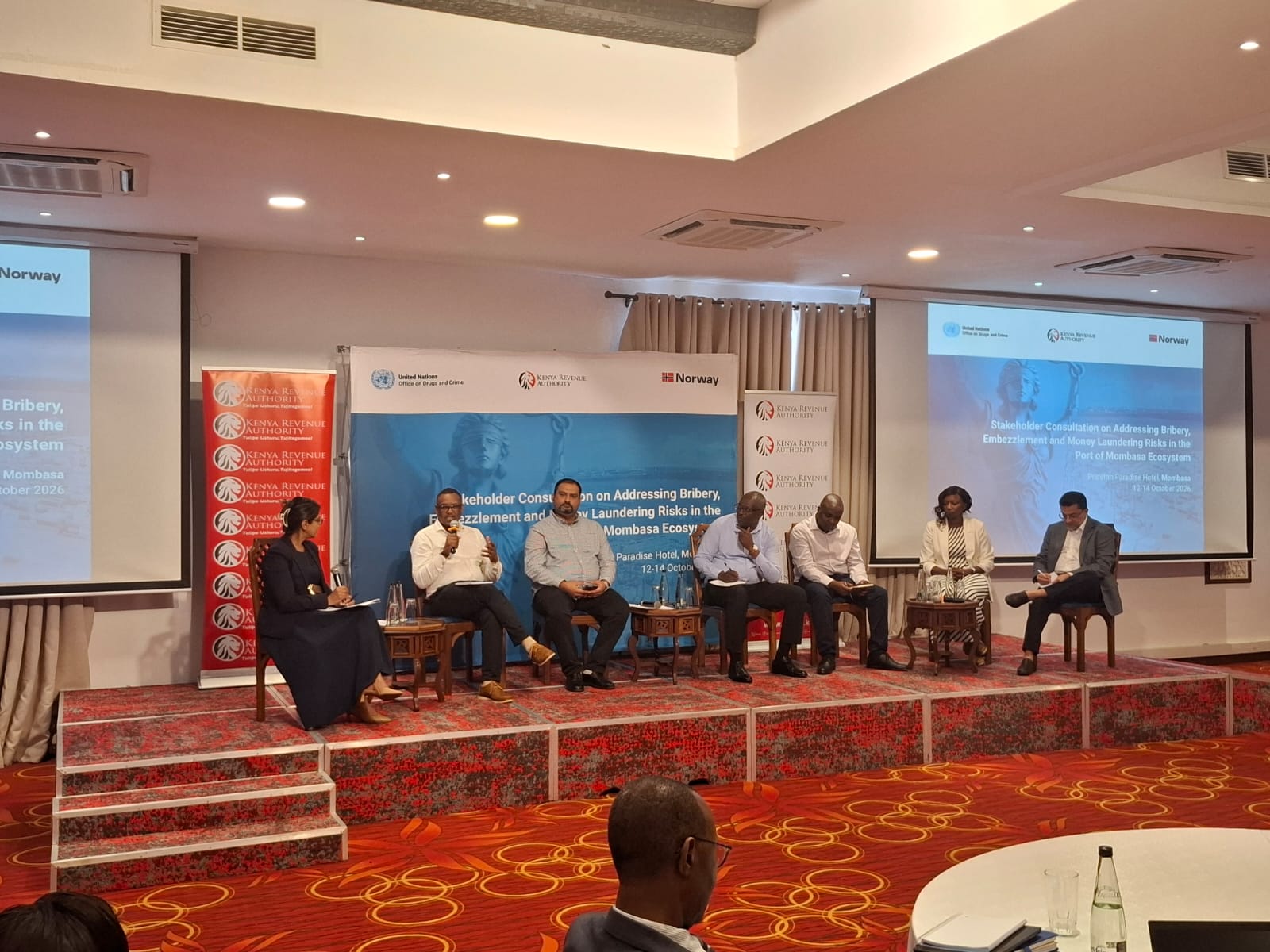
Kenya’s gateway to the world is leaking value. The Port of Mombasa and its inland trade corridors remain vital arteries for the East African economy, yet they continue to haemorrhage efficiency, investor confidence and public revenue through entrenched corruption, opaque procedures and outdated systems. The recent United Nations Office on Drugs and Crime (UNODC)-led stakeholder panel discussions in Mombasa delivered a rare moment of clarity: the Kenya Ships Agents Association (KSAA), speaking through its CEO Elijah Mbaru, placed the demand for a transparent, corruption-free operating environment at the centre of the national agenda. Mbaru’s direct engagement with the Head of Public Service, Felix Koskei, and the Principal Secretary for Trade was not polite industry lobbying. It was a pointed warning that without systemic overhaul, Kenya risks squandering both its logistical advantage and the multi-billion-dollar promise of its blue economy.
The core message from shipping agents was unambiguous: bribery, embezzlement and money-laundering risks along the Northern Corridor and at the port itself must be eradicated. In response, the Head of Public Service issued a firm 30-day mandate requiring government agencies to produce an actionable roadmap for simplifying border procedures and enforcing officer accountability. That deadline is significant. Previous reform announcements have often dissolved into studies, committees and eventual quiet abandonment. A public, time-bound directive from the highest levels of the civil service raises the political cost of inaction. If the roadmap materialises with measurable targets—reduced clearance times, digital audit trails, independent performance metrics for officers, and clear sanctions for misconduct—it could mark a genuine inflection point. If it becomes another paper exercise, the credibility of the entire anti-corruption push will suffer.
Beyond immediate anti-graft measures, Mbaru correctly framed the conversation around opportunity. Kenya’s blue economy master plan is not a slogan; it is a multi-billion-dollar proposition encompassing maritime trade, logistics, fisheries, tourism and energy. Unlocking that value requires more than public investment. Public-private partnerships and joint ventures are essential to bring capital, technology and operational discipline that pure state delivery has repeatedly struggled to sustain. Shipping agents sit at the commercial coalface. Their insistence that government actively pursue PPPs is practical, not ideological. International shipping lines and global terminal operators have already demonstrated that modern ports generate higher volumes, lower costs and stronger compliance when private expertise is properly contracted and regulated rather than shut out.
The third pillar of the discussion—adopting international best practices—cuts to the operational heart of the problem. Manual oversight, paper-based processes and discretionary decision-making create precisely the conditions in which rent-seeking thrives. Industry leaders called for fully integrated digital tracking, smart gates and advanced data mining to optimise berth capacity. These are not futuristic luxuries. Leading ports in Asia, Europe and the Middle East have already proven that real-time visibility of cargo movements, automated gate systems and predictive analytics reduce dwell times, cut demurrage costs and shrink the space for informal payments. Kenya does not need to invent the model; it needs the political will to implement and enforce it without watering it down through protective interests within the bureaucracy or among well-connected intermediaries.
The evening gathering at Tononoka, where stakeholders joined the Governor of Mombasa and the British High Commissioner for a toast and cocktail reception, illustrated another quiet truth. Reform is not only a technocratic exercise. It requires sustained coalition-building across government, industry, county leadership and international partners. Diplomatic and commercial networks matter. When senior national officials, county leadership, shipping agents and foreign missions share the same room, the conversation moves from complaint to coordination. That social capital should be converted into formal accountability mechanisms rather than left as polite networking.
Critics will argue that Kenya has heard these calls before. They are right. The difference this time lies in the combination of a tight public deadline, explicit private-sector pressure, and the framing of reform as a prerequisite for blue-economy growth rather than a moral afterthought. Shipping agents are not asking for special favours. They are demanding the basic conditions under which legitimate commerce can operate without the constant tax of corruption and inefficiency. For a country that positions itself as the logistics hub of East Africa, that demand is neither radical nor optional.
The next 30 days will reveal whether the mandate is serious. A credible roadmap must include concrete milestones: timelines for digital system integration, independent verification of officer performance, transparent reporting on clearance metrics, and clear consequences for non-compliance. Anything less will confirm the suspicion that Kenya prefers the appearance of reform to its substance. Mombasa Port can remain a strategic national asset that multiplies opportunity, or it can continue as a high-cost, high-friction bottleneck that quietly taxes every Kenyan consumer and exporter. The choice is no longer abstract. The shipping agents have drawn the line. The government now has a calendar.