


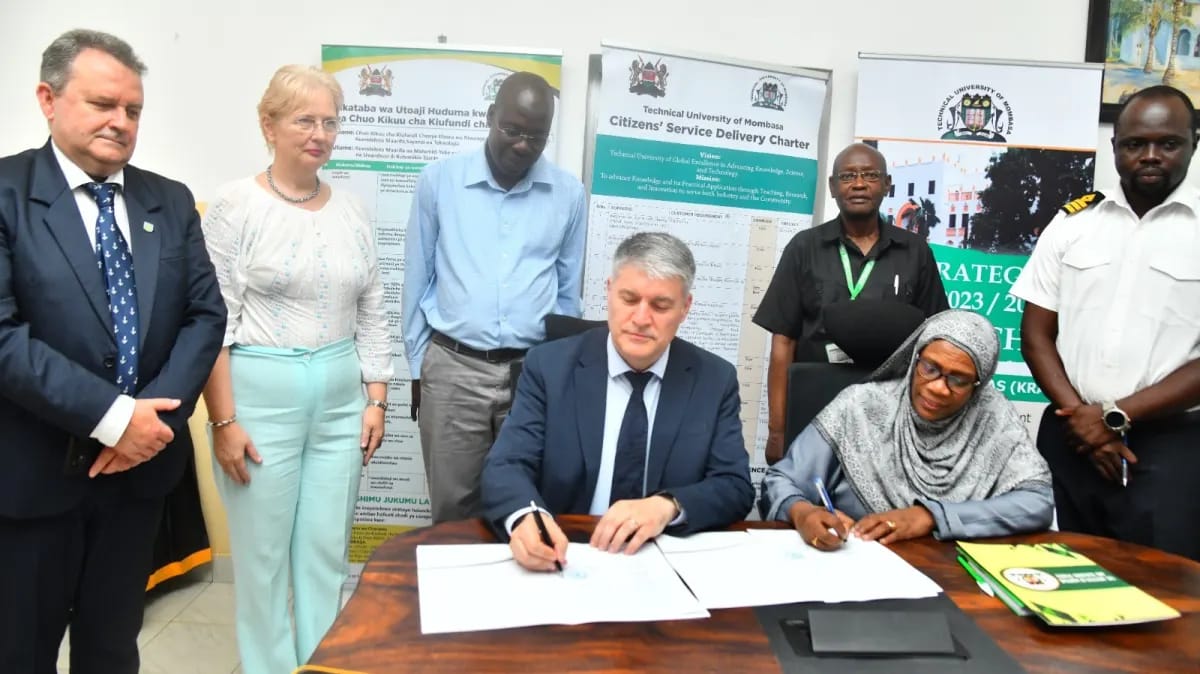
When Capt. Talib Mohammed, Director of the Institute of Maritime and Seafaring Studies at the Technical University of Mombasa (TUM), announced a Memorandum of Understanding with Constanta Maritime University in Romania, it would have been easy to file it away as just another academic formality. The listed objectives—academic exchange, collaborative research, curriculum development, and seafarer capacity building—are familiar refrains in the polite language of international university partnerships.
Yet, this specific pairing deserves closer scrutiny. It arrives at a moment when Kenya is aggressively repositioning itself as a maritime hub, when the global shipping industry is staring down a painful officer shortage, and when the definition of a “qualified seafarer” is being rewritten by decarbonization and digitalization. The TUM–Constanta MoU is not merely a bilateral courtesy. It is a strategic signal—and its value will depend entirely on whether it moves from paper to practice.
The Strategic Logic: Complementarity, Not Charity
The choice of Constanta is instructive. Constanta Maritime University is not a generic European partner; it is a Black Sea institution with a deep, IMO-aligned pedigree. It is a leading member of the Black Sea Association of Maritime Institutions (BSAMI) and has been training marine officers according to STCW provisions for decades. Its graduates are certified for international flags, and the university maintains active protocols with shipping companies for onboard cadet training. Romania’s maritime education ecosystem, in other words, understands the practical mechanics of getting cadets sea time—a chronic bottleneck in Kenya.
TUM, meanwhile, brings something equally vital: regional reach and an expanding infrastructure. The Institute of Maritime and Seafaring Studies (IMSS) has already demonstrated its capacity to attract international trainees, recently admitting the first cohort of marine pilots from Mogadishu for specialized, IMO-aligned training. It possesses simulators, qualified Master Mariners, and a mandate to evolve into the region’s leading maritime university. What TUM lacks in European pedigree, it compensates for in East African accessibility and a proven willingness to serve as a capacity-building anchor for neighboring states.
The partnership, therefore, is not a case of a developed institution “helping” a developing one. It is a complementarity play: Constanta offers depth in STCW-compliant curriculum design and industry integration; TUM offers a gateway to the Western Indian Ocean and a track record of delivering specialized professional training beyond initial certification.
The Context: Kenya’s Maritime Ambitions and the Talent Gap
This MoU must be read against Kenya’s broader maritime trajectory. The government is investing heavily in the sector’s human capital. A Sh2.4 billion Maritime Survival Training and Certification Centre is under construction at Bandari Maritime Academy, explicitly designed to serve not only Kenyan trainees but also regional seafarers from East and Central Africa. The Kenya Maritime Authority regulates curriculum and instructor approval to ensure STCW compliance, and Kenya sits on the IMO White List of countries implementing the convention.
Yet the gap between aspiration and output remains stark. Kenya currently has roughly 10,500 to 11,000 registered seafarers, with relatively few officers. The global industry, by contrast, faces a projected shortfall of approximately 89,000 qualified officers, a deficit expected to persist and deepen. The bottleneck is not ambition; it is the cost and availability of mandatory STCW training, the scarcity of qualified trainers, and the difficulty graduates face in securing the requisite sea-time experience to obtain a Certificate of Competency.
This is where a partnership like TUM–Constanta can create tangible value—if it is structured to address the sea-time and instructor-capacity problems, not just the exchange-of-papers problem.
The Wider Pattern: Africa–Europe Maritime Education Is Maturing
The TUM–Constanta agreement is not an isolated gesture. It is part of a discernible maturing of Africa–Europe maritime education partnerships. In early 2026, the World Maritime University (WMU) signed an MoU with the Dar es Salaam Maritime Institute explicitly framed around joint Africa–Europe training initiatives, curriculum enhancement, and institutional strengthening. The GEMS-TECH project, funded under Erasmus+, brings together 12 institutions from Europe, Egypt, and Kenya—including JKUAT—to integrate green technologies and sustainable maritime practices into higher education. Kenya’s Mount Kenya University has separately partnered with the Abu Dhabi Maritime Academy to address the global maritime personnel shortage.
The common thread is a shift from symbolic goodwill to structured capacity-building. The most effective of these partnerships will be those that treat African institutions as co-designers of curriculum and research, not merely as recipients of European expertise. TUM’s existing industry advisory committee and its recent IMO-aligned pilot training programme suggest it is positioned to play that co-designer role rather than remain a passive beneficiary.
The Uncomfortable Questions: Implementation, Brain Drain, and Green Skills
An OpEd that stops at praising the MoU would be doing a disservice to the seriousness of the challenge. Three uncomfortable questions must be asked.
First, implementation capacity. MoUs between universities are plentiful; measurable outcomes are rarer. Will the TUM–Constanta partnership produce joint certification pathways, faculty exchanges with defined deliverables, or co-supervised research with publication and policy outputs? Without a transparent monitoring framework, the risk of “MoU fatigue” is real.
Second, the brain drain dilemma. Enhancing the international competitiveness of Kenyan seafarers is a legitimate goal. But if the primary outcome is the export of trained officers to European and global fleets without a corresponding strategy to retain talent for Kenya’s own port, shipping, and offshore sectors, the domestic blue economy will subsidize foreign carriers. The partnership should be paired with deliberate career-pathway planning—cadetships with Kenyan-flagged or regionally based operators, and pathways into maritime administration, port management, and marine research.
Third, the green and digital skills gap. Constanta is already moving on green shipping and digital skills, as evidenced by its cooperation with Stödig Ship Management on alternative-fuel vessels, WAPS, and AI for maritime operations. If the TUM partnership does not explicitly incorporate these emerging competencies into the curriculum, Kenya risks training seafarers for the ships of the last decade rather than the ships of the next. The GEMS-TECH consortium’s focus on green maritime horizons offers a useful model for how this can be embedded.
The Road Ahead: From Ceremony to Substance
The TUM–Constanta MoU is a timely and strategically sensible step. It aligns a Kenyan institution with a European counterpart that understands the unglamorous mechanics of STCW compliance and industry-integrated training. It sits within a wider ecosystem of Kenyan maritime investment and Africa–Europe educational collaboration. But its significance will be judged not by the signing ceremony, nor by the breadth of its stated objectives, but by whether it produces a measurable increase in the number and quality of Kenyan—and regional—seafarers who can compete for the global officer roles that remain unfilled.
The test is simple: in three years, can TUM and Constanta point to a cohort of cadets who secured sea time through the partnership, a curriculum module co-developed with industry input, and a research output that informed a regulatory or operational decision? If the answer is yes, this MoU will have done more than most. If the answer is no, it will join the long list of well-intentioned academic agreements that never left the filing cabinet.
Kenya’s blue economy ambitions cannot be built on signed paper alone. They require the harder, slower work of institutional follow-through. The TUM–Constanta partnership has the right ingredients. Now it needs the discipline to turn them into capacity.