


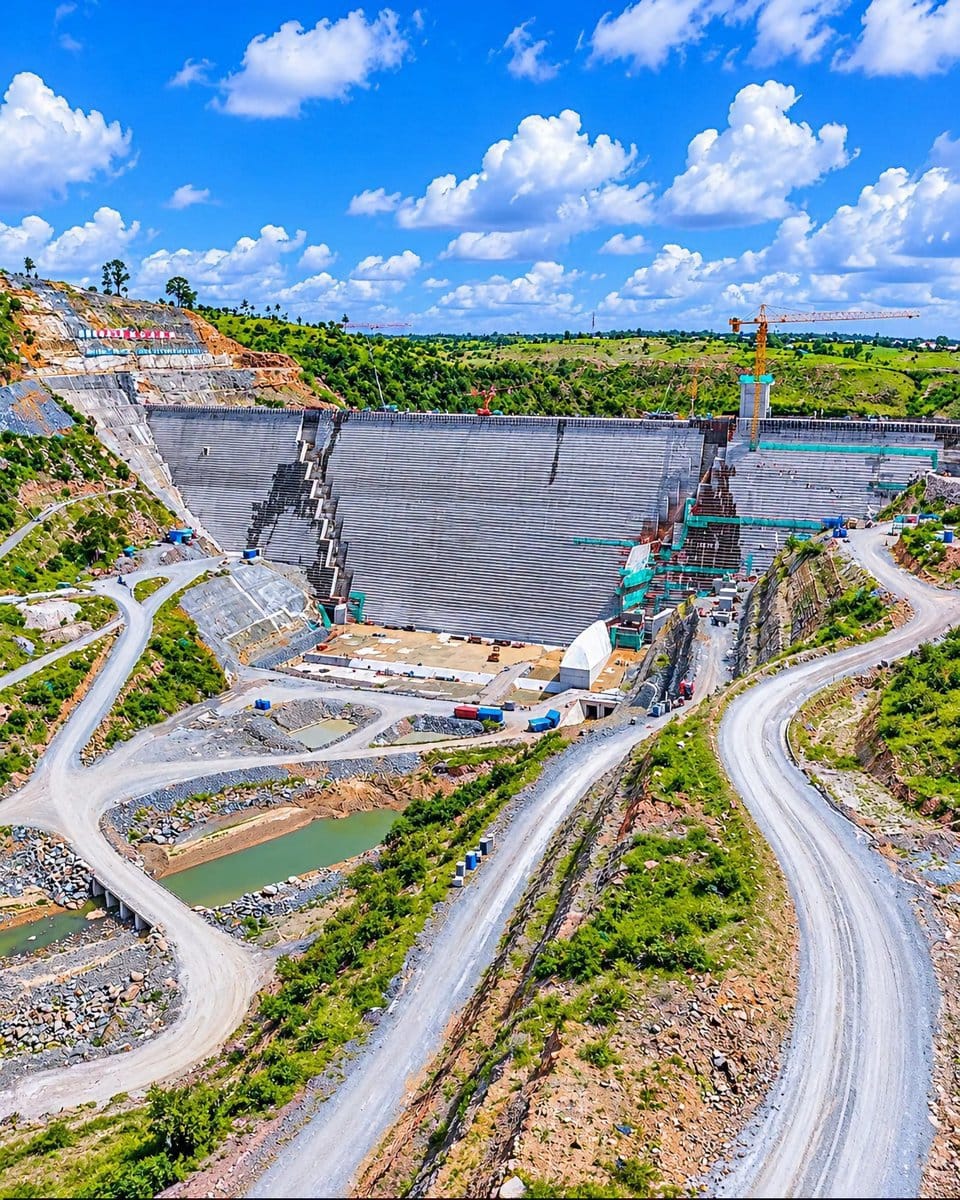
Kenya’s Coast is finally getting the infrastructure milestone it has needed for decades. The Mwache Multipurpose Dam in Kwale County’s Fulugani area has reached roughly 94 percent completion on its main structure, according to recent official updates. At 84 metres high and 526 metres long, the roller-compacted concrete dam will store about 136 million cubic metres of water and is designed to supply roughly 186,000 cubic metres (186 million litres) of treated water daily. That volume is projected to serve more than 1.6 million people across Mombasa and Kwale, closing a large share of a chronic deficit in which regional demand sits near 512,000 m³ per day against an available supply of only about 185,000 m³.
This is real progress. The Coast has long suffered unreliable water that constrains households, tourism, industry, and agriculture. Mwache, part of the broader Kenya Water Security and Climate Resilience effort co-financed with the World Bank, represents a strategic shift from scarcity management to storage and bulk supply. The main dam’s concrete placement has advanced rapidly, with targets for reservoir impoundment in late 2026. Supporting works such as check dams to manage siltation and community facilities like schools and clinics are also advancing. On paper, and increasingly on the ground, this is one of the more tangible large-scale water projects Kenya has delivered in recent years.
Yet the surrounding official commentary correctly flags the harder truth: a completed dam wall is not the same as water in taps. The critical path now runs through the water treatment plant—designed for 186,000 m³/day capacity—and the transmission and distribution pipelines that will move treated water to Mazeras storage and onward to South Mainland (including Likoni), West Mainland (Changamwe), North Mainland (Nguu Tatu), and local Kwale communities. Contracts for the treatment plant and some pipeline packages have been signed or are advancing, but financing, procurement, and construction timelines for the full downstream system remain the decisive variables. Without them, Mwache risks becoming another impressive reservoir whose benefits arrive late or incompletely.
This pattern is familiar. Large African infrastructure projects frequently celebrate the visible, photogenic asset—the dam, the power station, the highway—while the “last-mile” systems that convert storage into service lag. Comments on the original post rightly note the parallel with energy projects: generation without transmission creates stranded capacity. The same logic applies here. Impoundment can begin once the main structure and spillway are ready; reliable daily supply to households and businesses cannot.
Several practical risks remain visible. Funding discontinuities have already slowed the contractor, Sinohydro, at earlier stages when unpaid certificates mounted. Compensation and resettlement for project-affected persons required sustained attention and additional disbursements. Catchment siltation control via the check dams is essential for long-term reservoir life. And equity questions are legitimate: local Kwale communities that host the dam must see early, tangible benefits rather than watching water flow primarily to Mombasa. Officials have signalled prioritisation of surrounding areas and additional local water pans, but delivery will determine credibility.
The bigger picture is climate and economic resilience. Reliable bulk water underpins tourism, light industry, port-related activity, and potential irrigation expansion—thousands of acres have been discussed in project documents. It also reduces pressure on overstretched sources such as the Sabaki and Mzima systems. In a region already feeling climate variability, storage of this scale is a form of adaptation infrastructure. Success, however, will be measured not by the height of the wall or the volume stored, but by the volume treated and delivered every day, the reduction in rationing, and the extent to which local livelihoods improve.
Kenya has shown it can mobilise the engineering and the financing for the hard civil works. The test now is whether the same discipline can be applied to the less glamorous but more consequential downstream systems, and whether payment schedules, land processes, and inter-agency coordination keep pace. Mwache is close enough to delivery that complacency is the greater danger. Completing the dam is a genuine achievement. Turning that achievement into water security for the Coast is the real work still ahead.