


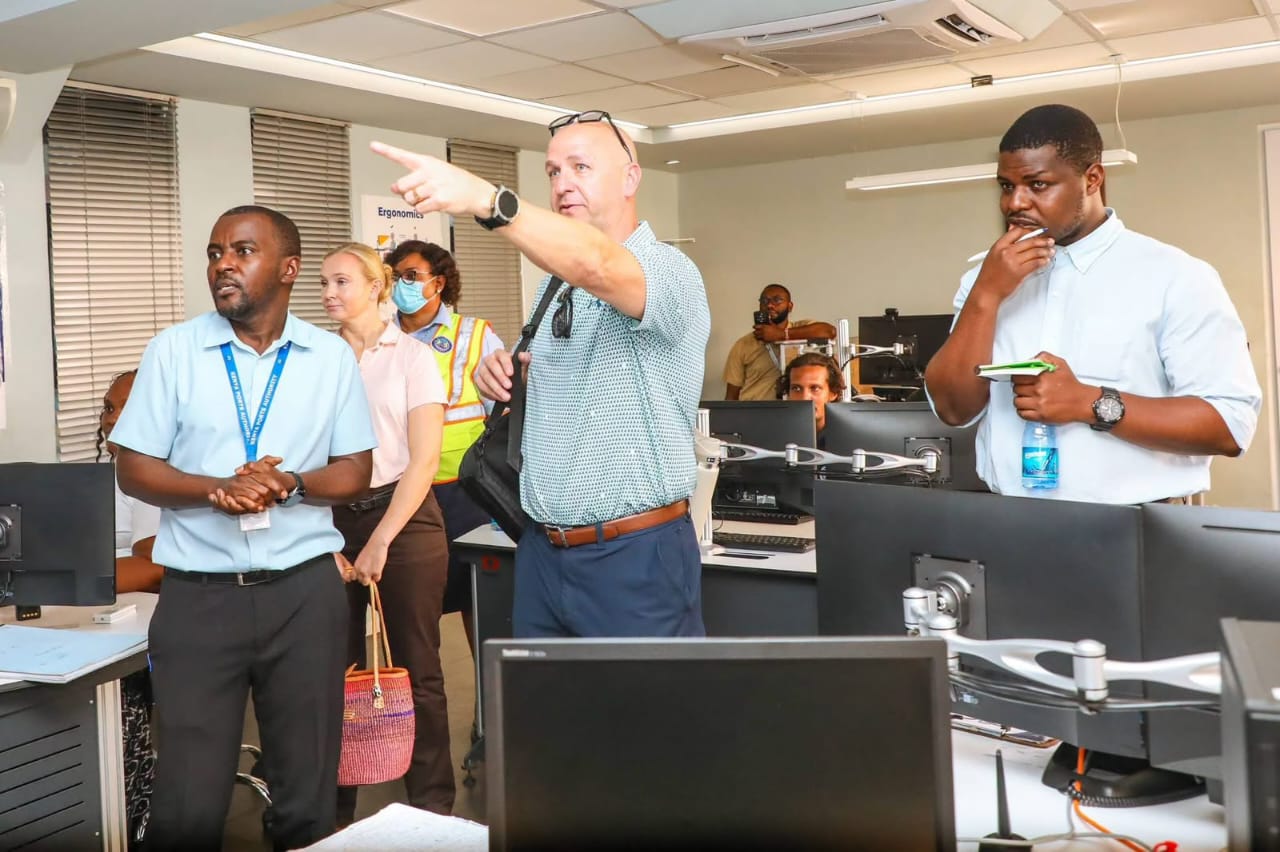
On 17 November 2026, a United States Coast Guard delegation led by Liaison Officer Lt. Keith Nichols concluded a familiarisation tour of the Port of Mombasa. The official readout was unremarkable: discussions with the Kenya Ports Authority and the Kenya Maritime Authority on port security and cooperation, acknowledgment of a longstanding partnership, and mutual appreciation for capacity-building initiatives that have strengthened institutional capabilities. In the annals of maritime diplomacy, such visits rarely make headlines.
But context is everything. This quiet engagement occurred on the same week that the 9th Association of African Maritime Administrations conference convened in Kampala to discuss Africa’s maritime transformation. It came months after the United States Coast Guard added Somalia to its port security advisory list, imposing enhanced entry requirements on vessels calling at Somali ports before reaching American waters . And it unfolded against a backdrop of renewed Somali piracy, shifting naval priorities, and Kenya’s accelerating alignment with Western maritime security partners . The Mombasa visit is not merely a courtesy call. It is a signal of where Kenya sits in an evolving maritime security architecture—and what that positioning means for the region.
The Strategic Logic of the Visit
The Port of Mombasa is not just Kenya’s gateway. It is the primary maritime outlet for Uganda, Rwanda, Burundi, the eastern Democratic Republic of Congo, South Sudan, and Ethiopia . Its security is inseparable from the economic stability of a vast hinterland. The Kenya Ports Authority has invested heavily in this proposition, launching a Vessel Traffic Management and Information System that integrates radar surveillance, automatic vessel tracking, meteorological monitoring, and oil spill detection across three interconnected control sites . More than forty security officers have been certified under the International Ship and Port Facility Security Code framework in recent months, with practical drills testing preparedness against evolving threats .
These are not cosmetic investments. They represent the kind of institutional capacity that the U.S. Coast Guard, through its Africa engagement, has long sought to cultivate. As U.S. Coast Guard Commander Danielle Shupe observed, African partners consistently identify the Coast Guard as their partner of choice for maritime training and development—a reflection of the recognition that most African maritime forces function more like coast guards than navies, enforcing sovereignty in territorial seas and exclusive economic zones rather than projecting blue-water power .
Lt. Nichols’ tour, therefore, serves a dual purpose. It affirms a partnership that has already delivered tangible results—KPA Manager of Security Services Tony Kibwana explicitly credited U.S. support with improving operational readiness and knowledge sharing—while laying groundwork for deeper coordination as threats evolve.
The Somali Shadow and the Southern Shift
The timing is not incidental. Since April 2026, Somali-linked pirate action groups have seized multiple commercial vessels, reversing more than a decade of relative quiet. The International Maritime Bureau recorded fifteen Somali piracy incidents in the first nine months of 2026, with Somali groups responsible for the overwhelming majority of crew hostages worldwide. Naval and intelligence assets that once concentrated on the Somali Basin were reallocated toward Houthi threats in the Red Sea and later toward tensions around the Strait of Hormuz.
Kenya has responded by deepening its Western alignment. The EastAfrican reported in August that Nairobi was strengthening maritime defence cooperation with the United States, the United Kingdom, and France to secure shipping lanes through the Indian Ocean and Red Sea . This is a pragmatic recognition that Kenya’s economic lifeline—the Mombasa gateway—depends on waters it cannot patrol alone.
The Mombasa visit also carries an implicit message about Somalia. Just weeks before Lt. Nichols arrived, the U.S. Coast Guard imposed additional security conditions on vessels that had called at Somali ports, designating Somalia as a jurisdiction with inadequate antiterrorism measures . The contrast is deliberate: Kenya, a partner investing in ISPS compliance and integrated vessel management systems, receives engagement and support. Somalia, mired in fragmentation and militant influence, faces restrictions. The message to regional administrations is clear. Security cooperation is earned through demonstrated institutional capacity, not asserted through sovereign claims.
What the Visit Reveals About Kenya’s Maritime Posture
The Mombasa engagement also illuminates Kenya’s broader strategy of positioning itself as a maritime security anchor in East Africa. The Kenya Coast Guard Service, operating through stations such as Kilindini, has embraced a multi-agency architecture that integrates enforcement, customs, immigration, fisheries, and sanitation functions . Academic research on maritime surveillance along the Mombasa coast has found that information sharing alone accounts for 37.1 percent of the variance in surveillance effectiveness, underscoring the centrality of coordination—precisely the domain where U.S. technical support has been concentrated .
Yet challenges persist. The same research identified organizational structure as a significant inhibitor of decision-making speed within the multi-agency framework. Bureaucratic friction, uneven resource allocation, and the perennial difficulty of sustaining training pipelines remain live concerns. The U.S. Coast Guard partnership can help address these gaps, but it cannot substitute for domestic political will and budgetary commitment.
The Larger Picture: Mombasa as a Test Case
What makes the Nichols visit noteworthy is what it represents rather than what it announced. In a region where maritime security rhetoric often outpaces delivery, Mombasa is emerging as a test case for whether the “from policy to practice” mantra—the theme of this week’s AAMA conference in Kampala—can be operationalised at the port level.
The ingredients are present. Kenya has a functioning port authority investing in technology and training. It has a coast guard service with multi-agency integration. It has a maritime administration engaged in international cooperation. And it has a Western partner willing to provide capacity-building support without the baggage of a large military footprint. The U.S. Coast Guard’s model—small, technically focused, and oriented toward enforcement and safety rather than combat—is well-suited to this environment .
But the test is whether these elements coalesce into something durable. Will the VTMIS system be maintained and upgraded? Will ISPS compliance remain a priority when budgets tighten? Will the partnership with the U.S. Coast Guard extend beyond familiarisation tours to joint operations, information sharing, and sustained training exchanges? Will Kenya’s maritime security investments be matched by similar commitments from its regional neighbours, or will Mombasa remain an isolated island of competence in a sea of fragility?
The answers will determine whether the Port of Mombasa becomes a genuine anchor for regional maritime security or merely a well-guarded enclave within an otherwise porous maritime domain.
A Quiet but Consequential Signal
Lt. Keith Nichols’ visit will not be remembered as a turning point in African maritime history. It was, by design, a low-profile engagement. But in the cumulative architecture of maritime security, such visits matter. They sustain relationships, signal commitment, and build the habits of cooperation that prove invaluable when crises erupt.
Kenya’s maritime moment—the one framed so ambitiously in Kampala this week—will not be secured by declarations alone. It will be secured by the unglamorous work of port security assessments, vessel traffic systems, trained officers, and trusted partnerships. The U.S. Coast Guard visit to Mombasa is a small but concrete instance of that work. In a region where the gap between policy and practice remains the central challenge, such quiet engagements may prove more consequential than the loudest conference speeches.