


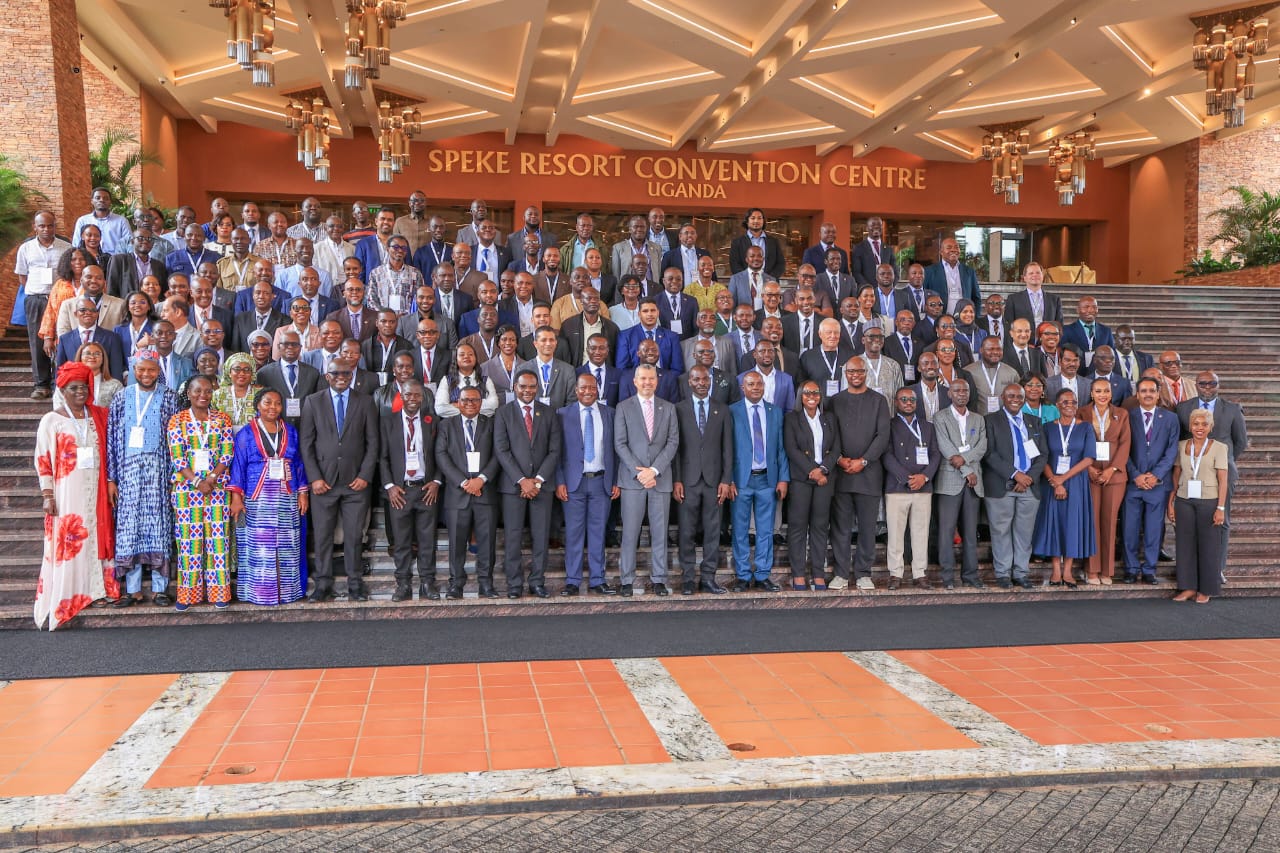
The 9th Association of African Maritime Administrations (AAMA) Conference, held in Kampala from November 17 to 19, 2026, was a triumph of diplomatic choreography. Maritime administrators from across the continent gathered under the theme “From Policy to Practice: Advancing Africa’s Maritime Transformation through Effective Governance, Innovation and Sustainable Blue Economy” . The IMO’s Secretary-General, Arsenio Dominguez, was present. New office bearers were elected. A workshop on domestic ferry safety preceded the main event, drawing 43 delegates from 17 countries .
And somewhere in the margins, a company called SECO Marine (U) sent a representative named Sujal Goswami to sit on a panel and contribute to discussions on the future of Africa’s maritime industry.
That detail—buried in a corporate social media post—is more revealing than the official communiqués. It tells us who is actually doing the work of building Africa’s maritime economy, and who is merely talking about it.
The Blue Economy Promise and the Delivery Gap
The numbers are intoxicating. The African Union projects that the continent’s blue economy could reach $405 billion by 2030, creating 57 million jobs . Africa’s container throughput grew from roughly 19 million TEUs in 2010 to nearly 35 million by 2022 . Ports from Lekki in Nigeria to Tanger Med in Morocco are attracting billions in investment. The narrative of Africa’s maritime renaissance has never been more seductive.
Yet the gap between promise and delivery remains stubbornly wide. Most Sub-Saharan African ports still rank beyond 300th globally in the World Bank’s Container Port Performance Index, with only a handful of North African ports approaching world-class efficiency . Intra-regional maritime connectivity remains weak, with shipping networks still oriented toward Europe and Asia rather than deepening African trade links . And despite a youthful population and growing interest in maritime education, African seafarers account for only about 4 percent of the global workforce .
The reasons for this gap are not mysterious. A 2026 study in the WMU Journal of Maritime Affairs identified a “polycentric incoherence trap” in African maritime governance, where frameworks for innovation, sustainability, and trade liberalization develop in isolation, creating regulatory fragmentation and implementation gaps . AAMA conferences produce resolutions and action plans. The 2024 Dar es Salaam meeting generated six priority areas, from decarbonization to gender diversity . The 2025 Monrovia gathering was pronounced the “best ever” by the outgoing chairman . Yet the structural constraints persist.
The View from the Panel
This is why SECO Marine’s presence at Kampala matters. The company, registered in Uganda as a shipbuilder and ship repairer, is not a policy think tank or a multilateral body . It is an engineering firm that builds things. In 2025, it delivered the Mpungu, a 96-meter roll-on/roll-off vessel capable of carrying 1,000 tonnes of containerized cargo on Lake Victoria, designed to cut transport times between Port Bell in Uganda and Mwanza in Tanzania from three or four days by road to 17 or 18 hours by water . The company supports oil and gas operations on Lake Albert, providing marine engineering and heavy lifting services .
In other words, SECO Marine is doing the unglamorous work that the blue economy rhetoric depends on but rarely celebrates: building the vessels, maintaining the equipment, and training the technicians that make maritime transport actually function.
Sujal Goswami’s panel contribution was not a policy pronouncement. It was an industry perspective—the view from a company that has to navigate the regulatory environment that AAMA members design, that has to find skilled workers from the training systems that maritime administrations oversee, and that has to compete for contracts against international firms with decades of incumbency.
What the Conference Didn’t Solve
The Kampala conference, for all its earnestness, did not resolve the fundamental tension in African maritime development: the continent has maritime administrations, but it lacks a maritime industry. Administrations regulate. Industries build. Africa has too much of the former and too little of the latter.
Consider the evidence. The IMO workshop on domestic ferry safety focused on implementing model regulations and building “safety culture” . These are necessary efforts. But they address the symptom, not the cause. The cause is that most African ferries are old, poorly maintained, and operated by companies with thin margins and weak technical capacity. Building safer ferries requires shipyards, classification societies, and skilled naval architects. Africa has SECO Marine and a handful of others. It needs dozens.
Similarly, the AAMA’s action plans call for “bankable proposals” and “sustainable financing frameworks” . But as industry experts have noted, “feasibility does not imply bankability” . A port project can be economically desirable and still fail to attract capital because of weak governance, uncertain demand, or inadequate hinterland connectivity. The missing ingredient is not policy language; it is operational competence and a track record of delivery.
The Case for Industry-Led Regional Integration
The most striking finding in recent scholarship on African maritime development is that intra-regional connectivity has not improved even as containerization has increased . West African container networks remain oriented toward Europe and Asia, not toward each other. AfCFTA promises a continent of 1.3 billion consumers, but the ships and ports to connect them are not being built at the necessary scale.
This is where companies like SECO Marine become strategically important. The Mpungu is not a grand geopolitical statement. It is a Ro-Ro vessel on a lake. But it replaces a three-day truck journey with an overnight sail. It reduces spoilage for perishable goods. It allows trucks to avoid circumnavigating Lake Victoria, freeing them for other work . Multiply that by dozens of similar projects across the continent’s lakes, rivers, and coastal routes, and you begin to see what an actual African maritime economy might look like.
The AAMA’s new leadership—Kenya as Chairperson, Uganda as Deputy, South Africa heading the Secretariat, with Tanzania elected to the Executive Council—has an opportunity to shift the association’s focus from policy production to industry partnership . The IMO’s technical assistance and capacity-building programs are valuable, but they cannot substitute for the daily grind of building and operating maritime assets.
A Modest Proposal for the Next AAMA
When the 10th AAMA Conference convenes in Côte d’Ivoire next year, the organizers might consider a simple change: give the private sector a formal seat at the table, not just a panel slot.
Not because companies like SECO Marine have all the answers. They do not. They are commercial entities with commercial interests. But because the gap between Africa’s maritime ambitions and its maritime reality will not be closed by administrators alone. It will be closed by shipbuilders who can deliver a vessel on budget, by terminal operators who can move containers efficiently, by training institutions that produce graduates who can actually find work, and by companies willing to invest in the unglamorous infrastructure that the blue economy depends on.
Sujal Goswami’s presence in Kampala was a small thing. But it pointed toward a larger truth: Africa’s maritime future will not be built in conference halls. It will be built in shipyards, on docks, and on the decks of vessels like the Mpungu. The question for AAMA and its member states is whether they are willing to listen to the people doing that building—or whether they will continue to talk past them.
Andrew Mwangura is a commentator writing on African maritime affairs, infrastructure, and regional integration.