


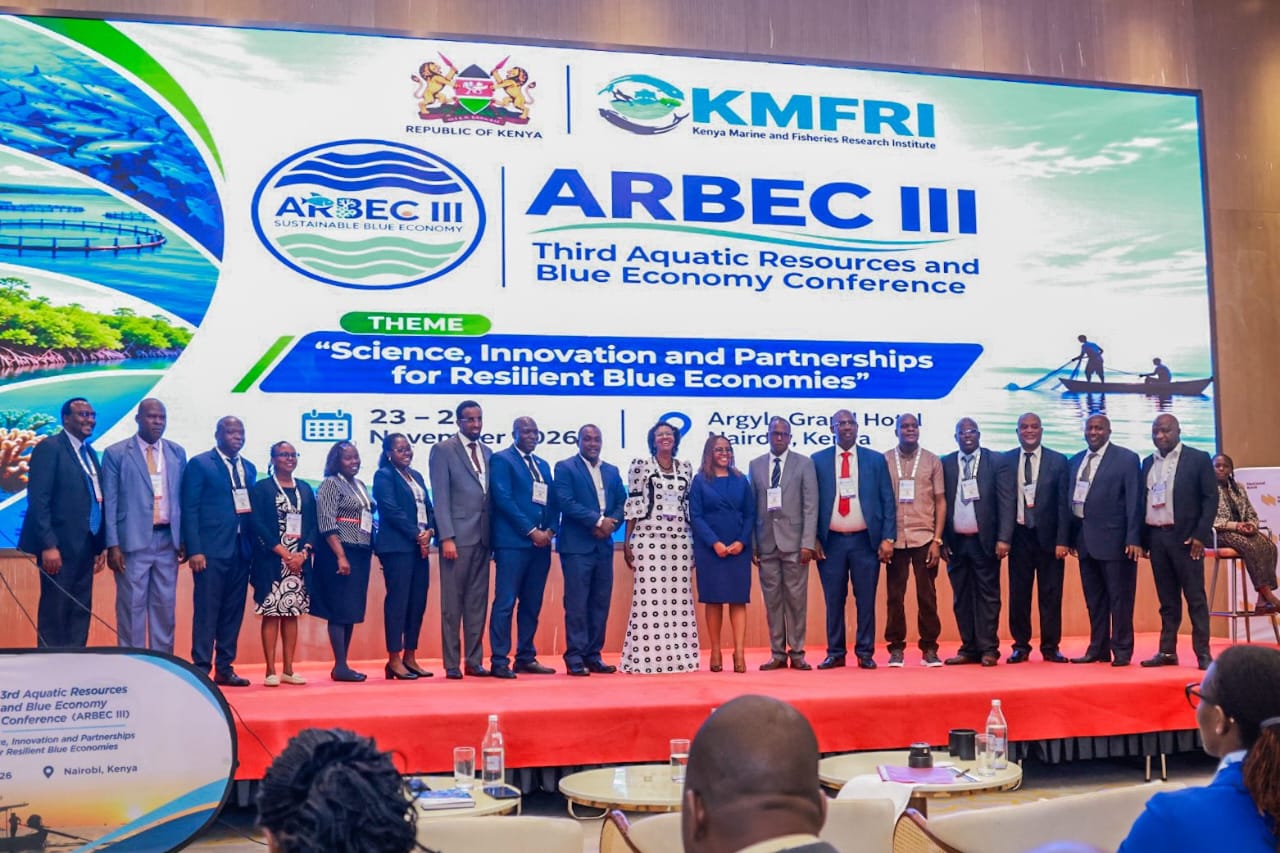
The official opening of the 3rd Aquatic Resources and Blue Economy Conference (ARBEC III) in Nairobi this week, led by Principal Secretary Betsy M. Njagi of the State Department for the Blue Economy and Fisheries, marks more than a ceremonial milestone. It crystallizes a national and regional recognition that Kenya’s—and Africa’s—aquatic resources can no longer be treated as residual or secondary economic assets. Declining fish stocks, climate impacts, pollution, post-harvest losses, and ecosystem degradation are not abstract risks; they are lived realities for coastal and lake-dependent communities. ARBEC III, hosted by the Kenya Marine and Fisheries Research Institute (KMFRI) under the theme “Science, Innovation and Partnerships for Resilient Blue Economies,” arrives at a moment when rhetoric must give way to disciplined execution.
PS Njagi’s call for stronger collaboration among researchers, policymakers, industry, and communities is the right diagnosis. Kenya already has policy scaffolding: the National Blue Economy Strategy 2025–2030 and the forthcoming Kenya Blue Economy Master Plan 2026–2036. These frameworks aim to raise fisheries and aquaculture contribution, expand production toward ambitious targets (including aquaculture scaling), cut illegal, unreported and unregulated (IUU) losses estimated in the tens of billions of shillings annually, modernize infrastructure, and place communities, women, and youth at the center. Yet strategies alone do not restore depleted stocks, stop nutrient-driven eutrophication in Lake Victoria, or reverse coastal habitat loss. The gap between plan and practice remains the central challenge.
The Scale of the Opportunity—and the Urgency of the Constraints
Kenya’s blue economy spans marine and inland systems. Fisheries currently support livelihoods for millions across the value chain, contribute modestly to GDP (around 0.7 percent in recent assessments), and face structural headwinds: overcapacity in some fisheries, post-harvest losses that erode incomes, limited value addition, and climate-driven stresses such as warming waters, altered upwelling, and extreme weather. Lake Victoria, a critical source of national fish supply, has seen declining catches amid pollution, sedimentation, invasive species, and oxygen stress. Coastal systems confront similar pressures from overexploitation, habitat degradation, and rising sea temperatures that affect reefs and nearshore productivity.
At the same time, the upside is substantial. Aquaculture and mariculture (including seaweed) offer pathways for production growth and livelihood diversification, particularly when women constitute a large share of participants in emerging enterprises. Maritime services, blue tourism, nature-based solutions, and technology applications (remote sensing, AI-assisted monitoring, traceability) can generate jobs and foreign exchange if governance and investment align. ARBEC III’s seven thematic tracks—sustainable fisheries and aquatic food systems, climate-smart aquaculture, blue tourism and nature-based enterprises, governance/policy/blue finance, technology/data/digital innovation, climate resilience and ecosystem health, and community engagement/equity/capacity building—map directly onto these priorities. The conference’s scale (targeting over 1,000 participants from 40+ countries and hundreds of presentations) reflects an intentional shift from purely scientific gatherings (as in earlier ARBEC editions in Kisumu) toward multi-stakeholder platforms that link evidence to investment and policy.
Science as Infrastructure, Not Ornament
PS Njagi’s challenge to researchers—to generate practical evidence, communicate findings effectively, and center communities—is essential. Too often, high-quality research remains siloed in journals or technical reports while decisions on gear restrictions, spatial planning, aquaculture siting, or pollution control proceed on incomplete information. KMFRI’s role as the lead research agency positions it to bridge this gap, but success requires sustained funding for long-term monitoring, co-designed studies with Beach Management Units and fishers, and deliberate translation of results into usable formats for county governments, regulators, and private operators.
The technology and data tracks at ARBEC III are particularly timely. Digital tools can improve stock assessment, combat IUU fishing through better Monitoring, Control and Surveillance, support climate-adaptive aquaculture, and enable transparent value chains. Yet technology is not neutral: without capacity building and equitable access, it risks widening divides between well-resourced actors and small-scale fishers or women-led groups. The conference’s emphasis on partnerships offers a chance to design inclusive innovation pathways rather than top-down solutions.
Partnerships, Finance, and the Politics of Implementation
Stronger collaboration is necessary but insufficient without clarity on roles, accountability, and finance. Blue finance instruments, blended public-private models, and community-based management can scale what works, but they require de-risking mechanisms, clear tenure and licensing regimes, and safeguards against elite capture. Investments in landing sites, cold chains, hatcheries, and processing capacity only deliver if matched by enforcement against destructive practices and support for alternative livelihoods where stocks must be rebuilt.
Placing women and youth at the center is both equity and pragmatism. Women already dominate certain segments of seaweed farming and post-harvest activities; youth bring energy and digital fluency. Centering them means more than consultation—it means targeted skills development, access to finance and markets, and influence over research agendas and management decisions. ARBEC III’s community engagement track can surface practical models if participants move beyond presentations to co-created action plans with measurable follow-up.
Regional dimensions matter. Aquatic ecosystems and fish stocks do not respect borders. Shared lakes and the Western Indian Ocean demand coordinated science, data sharing, and governance. ARBEC III’s continental framing is an opportunity to strengthen these linkages rather than treat them as afterthoughts.
From Conference to Continuum
The true test of ARBEC III will not be the quality of the opening speeches or the volume of abstracts. It will be whether the evidence generated, partnerships formed, and policy signals issued translate into sustained action after the closing ceremony. That requires KMFRI and partners to treat the conference as a node in a longer continuum: follow-up mechanisms, transparent tracking of recommendations, integration into national and county planning cycles, and honest evaluation of what works and what does not.
Kenya’s Blue Economy Strategy and Master Plan provide the high-level architecture. ARBEC III can supply the granular science, innovation pipelines, and multi-actor trust needed to operationalize them. Declining stocks, climate pressure, and pollution will not wait for perfect consensus. The window for building resilient, inclusive blue economies is open—but it is not indefinite. The principal secretary’s call for practical evidence, effective communication, and people-centered approaches is the correct starting point. The harder work of turning that call into durable results begins now.